The Leitner System: Flashcards Done Right
Almost everyone who has studied Spanish has a stack of flashcards somewhere. It keeps growing, you run it front to back, and half your time goes to words you already know. Meanwhile the handful that refuse to stick show up exactly once per pass — the same as the easy ones.
The Leitner system fixes precisely that. It is not about what goes on the cards, but about which card you see today and which one waits two weeks. The method comes from the German science journalist Sebastian Leitner, who described it in his 1972 book "So lernt man lernen" — long before any app, using an ordinary cardboard box.
How the system works
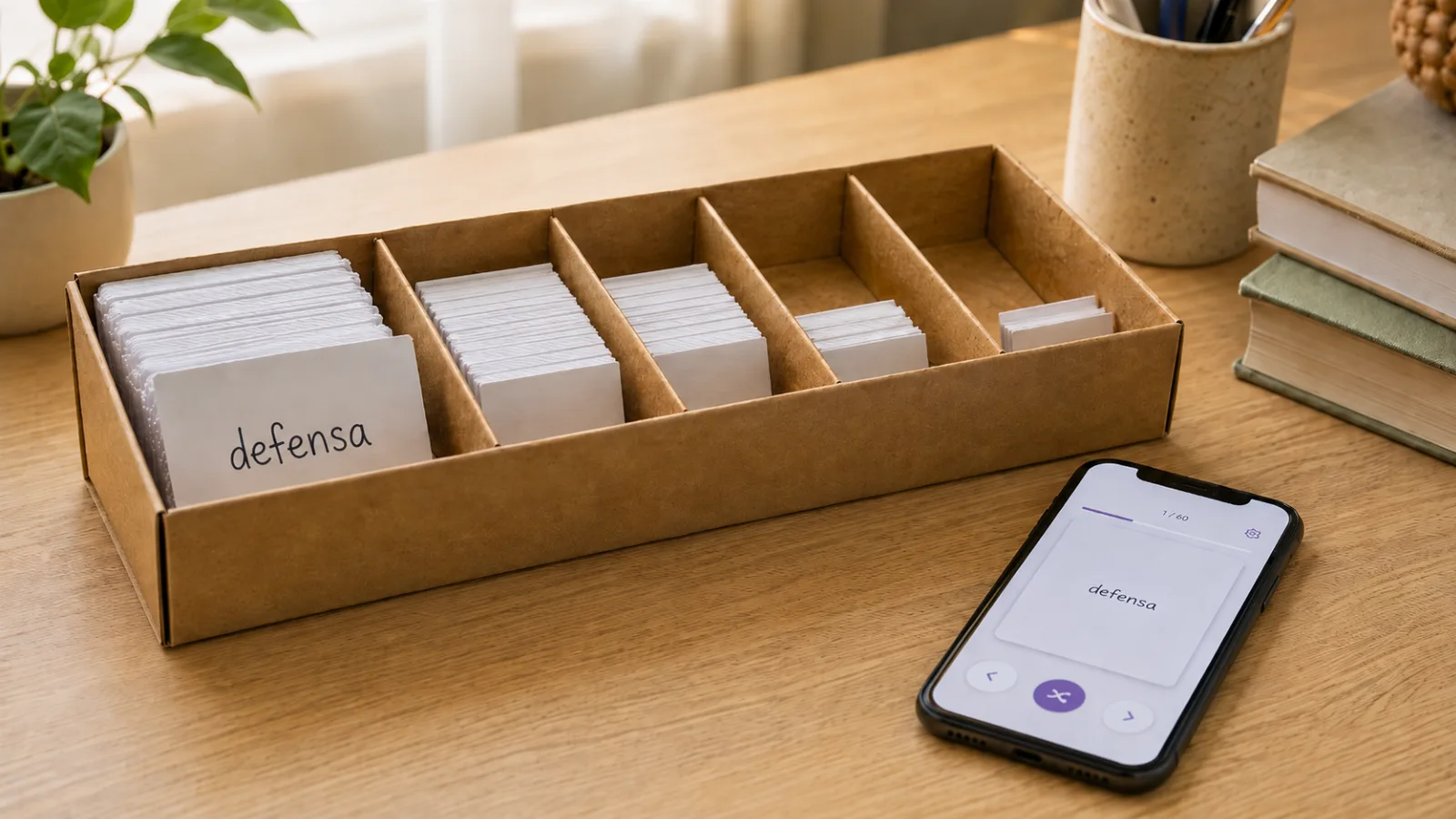
You take a box divided into several compartments — usually five. Each compartment has its own interval: the first one is reviewed every day, the last one once every two weeks.
There are only two rules:
- You recalled the word — the card moves one compartment to the right. Which means you will see it again later than before.
- You did not recall it — the card goes back to the first compartment. No matter where it was sitting: the fifth, the second, anywhere.
That is the whole method. New cards start in compartment one. Words you know confidently drift right and stop eating your time. Difficult ones keep circling at the start until they settle.
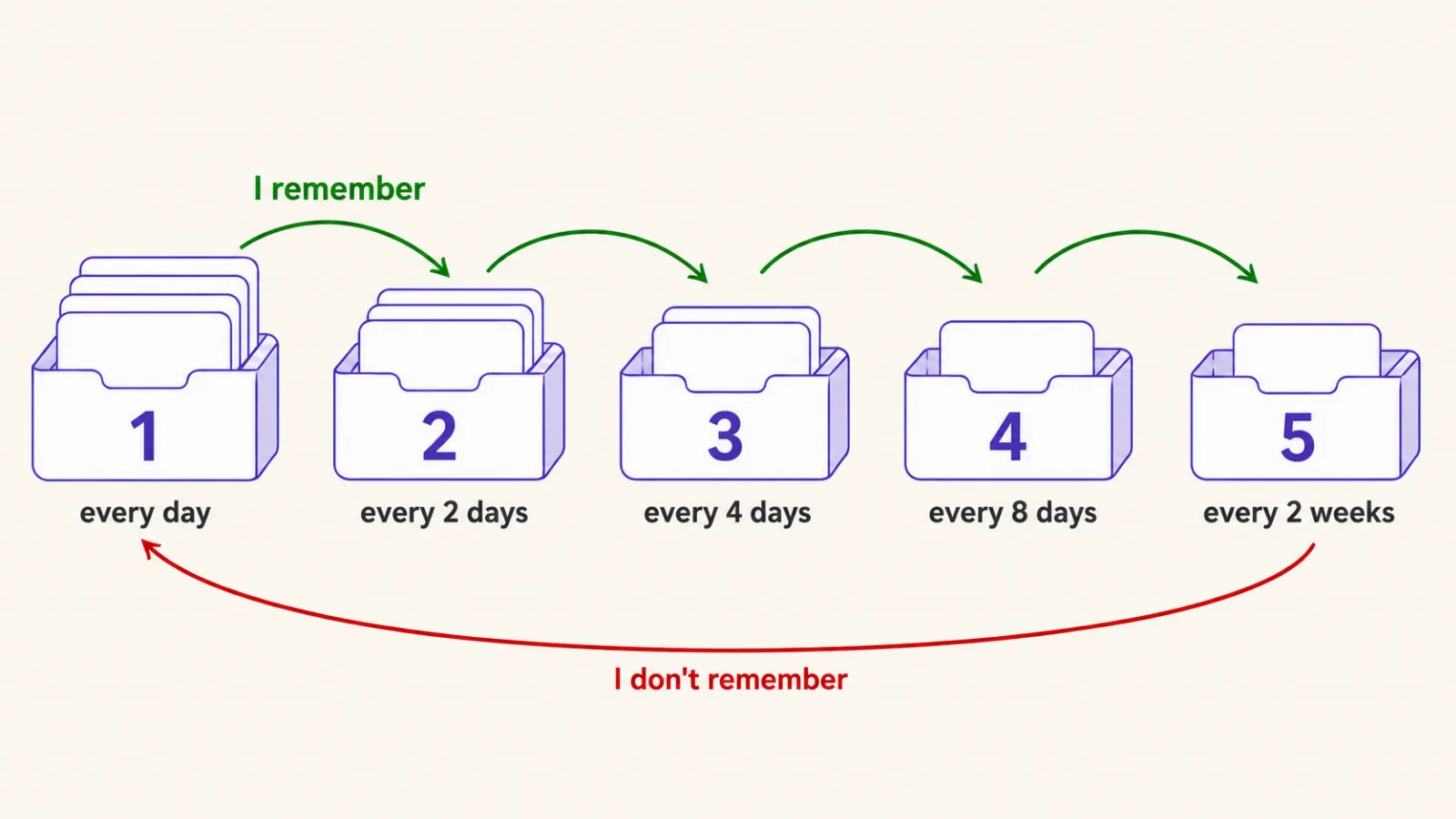
A typical schedule looks like this — the exact numbers are not sacred, adjust them to yourself:
| Compartment | Review frequency | What lives there |
|---|---|---|
| 1 | every day | new words and everything you got wrong |
| 2 | every 2 days | recalled once |
| 3 | every 4 days | holding up into the second week |
| 4 | every 8 days | almost learned |
| 5 | every 2 weeks | final check before the archive |
A card that reaches compartment five and gets answered correctly goes into the archive. Every couple of months it is worth running the whole archive once — just to make sure nothing has crumbled.
Why it works
Two simple things sit behind the method.
The first is review at growing intervals. Memory works so that a freshly learned word fades fairly fast, and we wrote about that in more detail in the article on why you forget new Spanish words. But every successful recall makes the trace stronger, and the next meeting with the word can be pushed further out. Leitner built the compartment mechanics on exactly that: the better you know a card, the more rarely it appears.
The second is that every time you recall the word instead of rereading it. The difference is huge. When you look at a list that says "defensa — defense" and nod, your brain does no work at all. When you see only defensa and try to pull the translation out of your head, the work happens — and that is what leaves a trace. A card is good precisely because it physically hides the answer on the back.
Before you flip the card, always say the answer out loud or in full in your head. A silent "yeah, I know this one" is the fastest way to cheat the system.
Building your own box in one evening
You need a cardboard box (or five envelopes), a pack of index cards and a marker. Then:
- One card — one word. The Spanish word on the front, the translation and always a short phrase with it on the back: defensa — defense; la defensa aguantó bien. Without an example the word lives in a vacuum and never makes it into speech.
- Do not stuff a hundred cards into compartment one. Realistically that is 10–20 new words a week. You review compartment one every single day, and if it is bloated you will quit by day four.
- Write down a day plan. On a sheet of paper mark which compartments are reviewed on which days: compartment two on even days, say, compartment three on Mondays and Fridays. Without a schedule the system turns back into an ordinary stack.
- A mistake means compartment one, immediately. Not "well, I almost had it, let it stay". That rule is what keeps the method honest.
Where the paper box breaks
The method is good, but the physical version has very concrete weak spots, and it is better to know about them in advance.
- You have to run the schedule yourself. Miss three days and it is already unclear which compartments are overdue and in what order to dig through them.
- Compartment one overflows. Mistakes from every level drain into it, and at some point the daily batch becomes impossible to lift.
- Cards have to be made by hand. You hear a word in a series, write it in your notes, someday copy it onto card stock, then look up the translation and an example. In practice that chain breaks at the first step.
- There is no sound. You see desarrollar and pronounce it however it comes out. A month later, relearning the pronunciation is harder than getting it right the first time.
- The box does not travel with you. And reviews are most convenient in a queue or on the bus — exactly where the box is not.
The same thing, minus the box
Every modern app for memorizing Spanish words grew out of this idea. The compartments became an algorithm: the program keeps an interval for each word and decides on its own what to show today. You answer "I remember" or "I don't remember" — and the card moves forward or returns to the start, exactly as Leitner had it.
In VibeLing it looks like this: you save a word you met in a film, an article or a conversation, the app pulls in the translation, an example and the audio, and from there it builds the review schedule itself. A word you keep stumbling over will come up more often; a learned one moves to the background. The daily portion is capped, so the "compartment one has swollen to a hundred cards" effect never arrives.
It also solves the main problem of paper — the moment between "heard a word" and "it is in the review rotation". In a box that gap is an evening with a marker; on a phone it is a couple of seconds.
What to do right now
If you want to try the method in its pure form, take five envelopes and 20 words that have been giving you trouble. In two weeks you will see that roughly half of them have already moved to the far compartments and stopped taking your time. That is the entire point of the system.
If you would rather not fuss with cardboard but still want the method working, it is easier to keep your own word list in VibeLing and drop words from real life into it. The compartments, the intervals and the error tracking are the app's job — yours is to answer "I don't remember" honestly when you really don't.