The Ebbinghaus Forgetting Curve: How to Stop Forgetting Words

You learn twenty new Spanish words in the evening, remember fifteen the next morning, and a week later five are left. It is a familiar picture, and the usual conclusion is "my memory is bad." In fact your memory is doing exactly what it is supposed to do, and the whole thing was described back in the nineteenth century. It is called the forgetting curve, and it has one useful property: you can flatten it.
What Ebbinghaus actually did
In the 1880s the German psychologist Hermann Ebbinghaus ran an experiment on himself. He made up a few thousand nonsense syllables like ZOF, KEB or DAX, deliberately meaningless so that nothing could suggest an association. He memorized lists of them until he could recite them without errors, then after various delays relearned the same list and timed how long that took.
He was not measuring "how much I remember" but "how much I saved": if a list took ten minutes the first time and five the second, half of the work had survived. He published the results in 1885 in a book called Memory. Here are his numbers:
| Time elapsed | Saved on relearning |
|---|---|
| 20 minutes | 58% |
| 1 hour | 44% |
| 9 hours | 36% |
| 1 day | 34% |
| 2 days | 28% |
| 6 days | 25% |
| 31 days | 21% |
In 2015 the Dutch researchers Murre and Dros repeated the experiment with the same method and got almost the same curve. So this is not a historical anecdote but a reproducible result.
How to read the curve
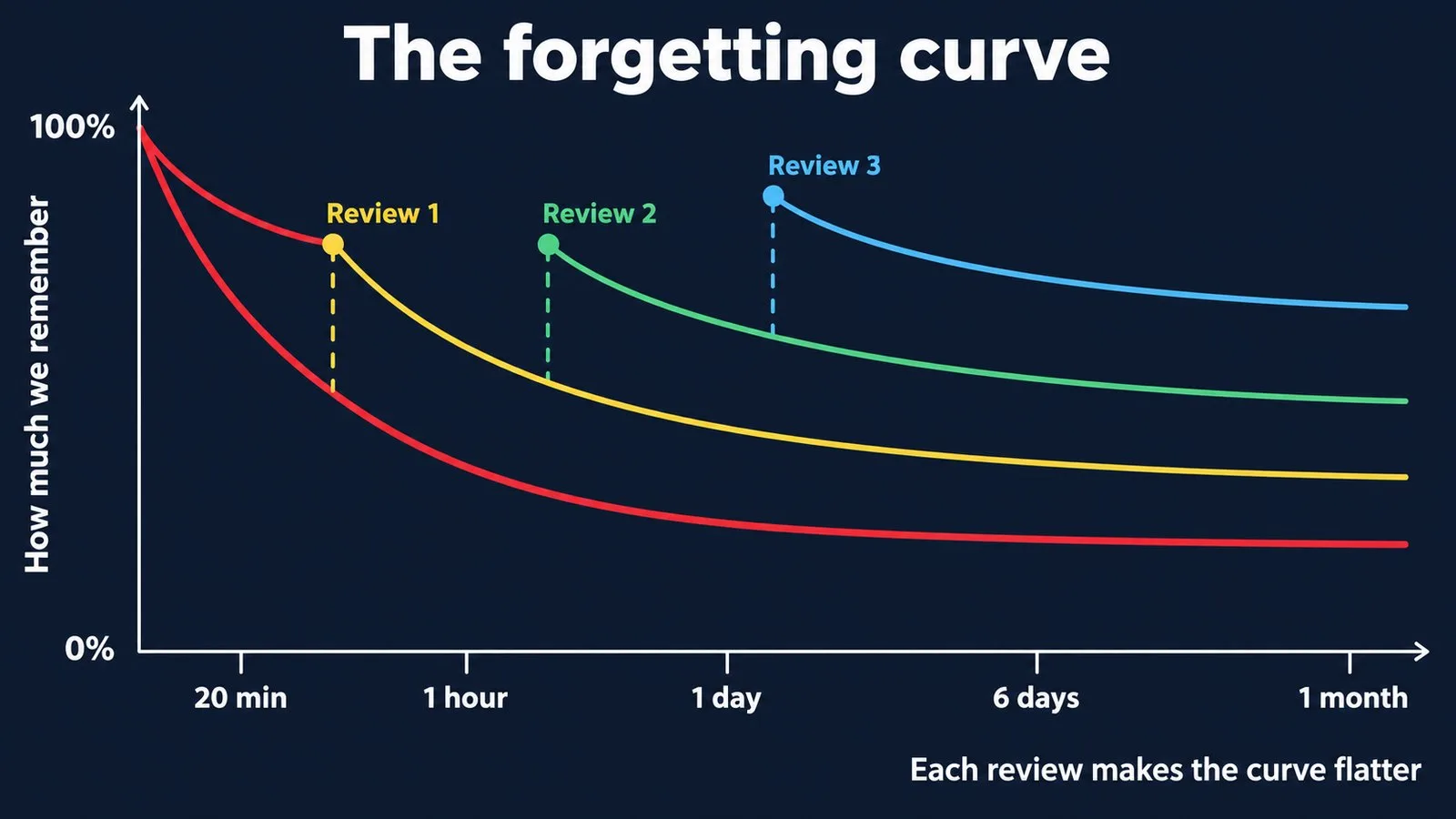
The important thing in the table is not the percentages but the shape. The curve drops steeply in the first hours and then almost levels off. More than half is gone within the first hour, a little more goes over the next day, and between day six and day thirty-one the difference is only four points. Whatever survives a week is going to stay for a long time.
That gives two conclusions for anyone learning vocabulary.
- The most dangerous period is the first day. If more than a day passes between your first meeting with a word and the next one, you are almost certainly learning it again rather than reviewing it.
- The effort of the first evening barely matters. You can write a word out ten times and say it aloud twenty, but without coming back to it the next day the result will be roughly the same as after a single encounter.
About "70% is forgotten within a day"
This figure travels from article to article and from course to course, and it really does come from Ebbinghaus's data. But he was learning nonsense syllables. A real word with a meaning, a sound and an example sentence is forgotten noticeably more slowly, because there is something to hold on to. The shape of the curve stays the same, only the steepness changes. So there is no reason to panic, but there is every reason to review.
What flattens the curve
Ebbinghaus made a second observation that gets mentioned less often. After each relearning, the curve fell more slowly. A word you recalled after a day will fade less by the end of the week. Recall it after a week, and the next decline stretches out over a month. Every successful retrieval makes the curve flatter.
The word "successful" matters here. Rereading a list of words with their translations is not a review, it is a repeat encounter: the brain recognizes the word, ticks the box "familiar," and never has to recall anything. What flattens the curve is the moment when you see the word, the translation is hidden, and you have to pull it out of memory yourself. We covered that difference in detail in recall or reread.
Timing is subtle too. Reviewing five minutes after learning is almost useless: the word has not had time to fade, so the brain did not have to work. Reviewing after a month is too late: the word is completely gone and you are starting from zero. What works best is a review at the point where the word is almost forgotten but can still be retrieved. That is where recall takes effort, and that is exactly why it sticks best.
A practical schedule
Put it all together and you get a timetable that language schools and apps have used for a long time:
| Review | When | Why |
|---|---|---|
| 1 | the same day, a few hours later | catch the steepest part of the curve |
| 2 | the next day | survive the first 24 hours |
| 3 | after 3–4 days | lock in what is left |
| 4 | after a week | move the word into long-term memory |
| 5 | after 2–3 weeks | a control check |
| 6 | after 1–2 months | make sure the word stayed |
This is a guideline, not a law. The word reacio that you met in a vivid scene of a series will last longer than sin embargo from a dry list. So their intervals should be different too. That is impossible to track by hand, which is why such schedules are rarely used in their pure form. In practice the interval is adjusted for every word separately: recalled easily, and the next appearance moves further away; failed, and the word returns to the nearest queue. We explained how that mechanism works in the article on spaced repetition.
What else slows down forgetting
Review is the main lever, but not the only one. The curve for meaningful words is flatter than for Ebbinghaus's syllables, and you can use that deliberately.
- Context instead of a bare word. Reacio on its own is a string of letters. Estaba reacio a admitirlo is already a situation you can picture. A word tied to a phrase fades more slowly because it has more entry points.
- Several channels. A word you have read, heard and seen on a picture is stored in three places, not one. Falling out of all three at once is harder.
- Sleep between reviews. It is during sleep that the brain moves fresh material into long-term memory. Two reviews in one evening give less than one in the evening and one the next morning.
- Small portions. Fifty words in one evening will, by the Ebbinghaus curve, turn into fifteen by morning. Ten words, but with a review the next day, will get you further.
How VibeLing handles this
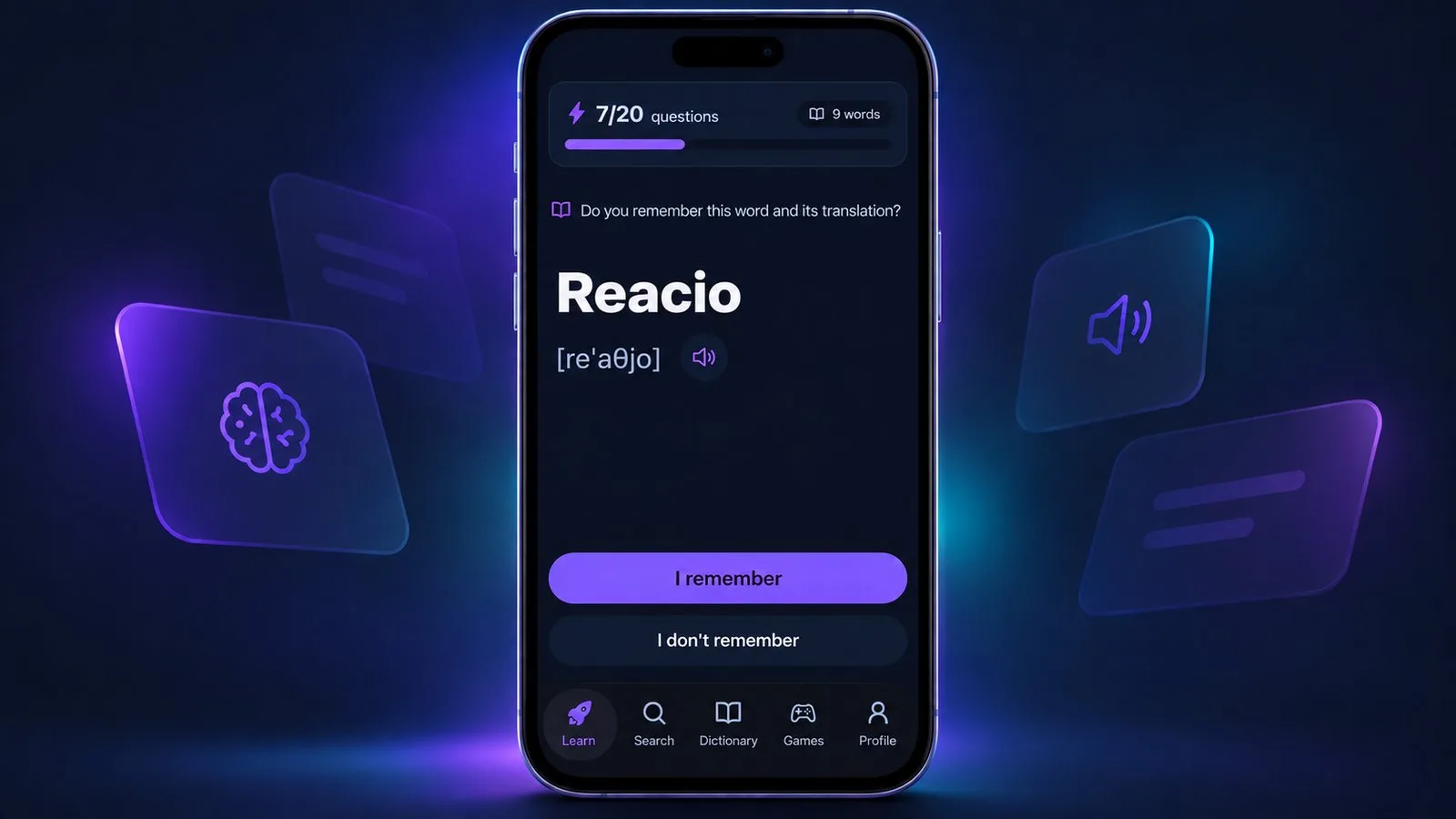
Everything above can be run by hand in a notebook with dates. But it is easier when the app keeps the schedule. In VibeLing every word is saved not bare but with a translation, transcription, audio, a picture and examples, that is, with several of the hooks described above from the start.
From there the app works out when the word needs to appear again. The "Recall" mode is an honest retrieval test: you see the word, the translation is hidden, and you tap "I remember" or "I don't remember." If you do, the next appearance moves further away; if you don't, the word goes back into the nearest queue. The other modes, where you pick the translation, build the word from letters or fit it into a sentence, train the same thing from different angles.
The daily queue is finite. The app does not make you review everything, only the words that, by the curve, have just reached the danger point. That is usually ten to twenty minutes a day, and it is enough to stop the curve working against you.
In short
Forgetting is not a fault in your memory but its normal mode. Most is lost in the first day, and every successful recall makes the next decline slower. So what matters is not how many times you repeated the word on the first evening, but whether you came back to it the next day, then a few days later, then after a week. If you would rather have someone else watch the schedule, try training your words in VibeLing: the app shows a word right when it is about to slip away, and all you do is answer "I remember" or "I don't."