Why You Forget New Spanish Words (and How to Fix It)

You wrote down thirty words from a Spanish series, looked each one up, ran through the list a couple of times and felt good about it. A week later you open the same list and recognise maybe five. The rest look like somebody else wrote them.
This is the single most common complaint from people learning a language on their own, and the conclusion they draw from it is almost always wrong: "I have a bad memory." Your memory is working exactly as designed. The problem is what you did with those words, and when.
Forgetting is not a malfunction
Your brain takes in far more information every day than it needs to keep. If it stored all of it, you would remember the licence plate of every car that drove past. So by default anything new is filed as temporary and gets cleared out unless you come back to it.
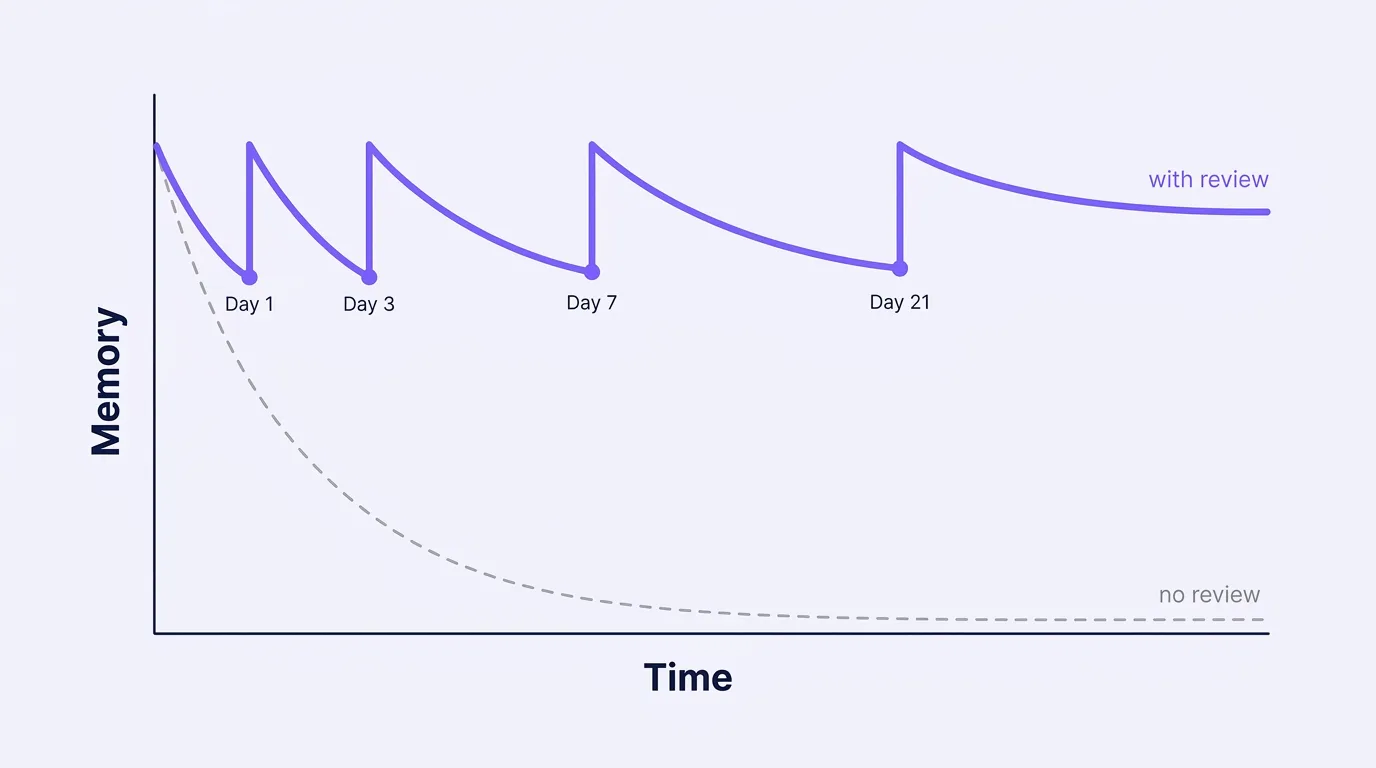
Hermann Ebbinghaus tested this on himself back in the late nineteenth century: he memorised lists of nonsense syllables and then measured how much was left after an hour, a day, a week. The result was a curve that falls steeply at first and then flattens out. Most of the loss happens right away, in the first day — and whatever survives a few days tends to stick around much longer.
Real words in a real language fade more slowly than nonsense syllables, but the shape of the curve is the same. Which leads to a simple conclusion: what matters is not how hard you worked on the first evening, but whether you came back to the word before it dropped out.
Five reasons a word does not stick
1. You met it once
A single encounter gives you almost nothing, even if it felt at the time like you had understood and memorised it. That feeling comes from recognition: the word is in front of you, the translation is right next to it, everything lines up. The real test comes later, when the word is not on the screen.
2. You reread instead of recalling
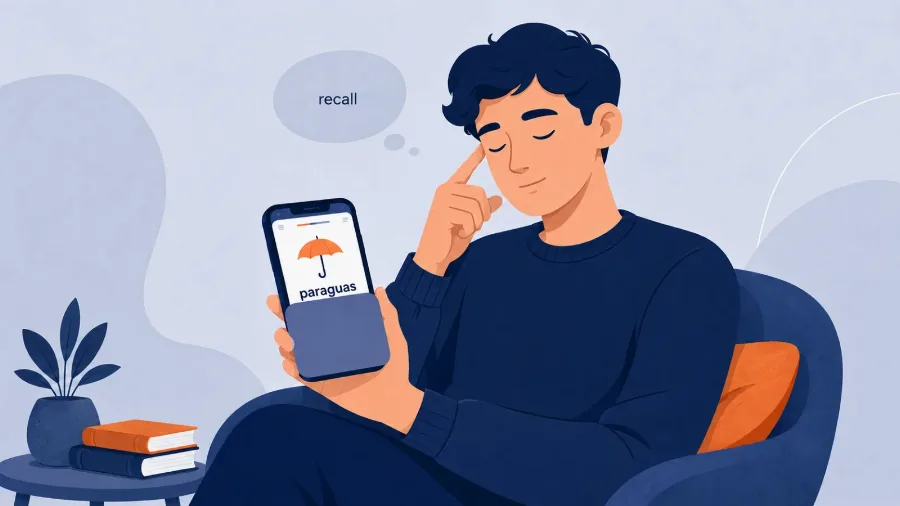
The most popular way to study vocabulary is to run down the list top to bottom a few times. It feels like the most efficient method and it works worse than any other. When you read the pair "agradecido — grateful", your brain does no work at all: the answer has already been handed to you.
In 2006 the psychologists Roediger and Karpicke compared two groups of students: one reread a passage several times, the other spent the same amount of time trying to recall it without looking. Right after the session, the rereaders were more confident in themselves. A week later, the ones who had tested themselves remembered considerably more. The effort of retrieval is what actually strengthens the trace.
3. You learned the word in a vacuum
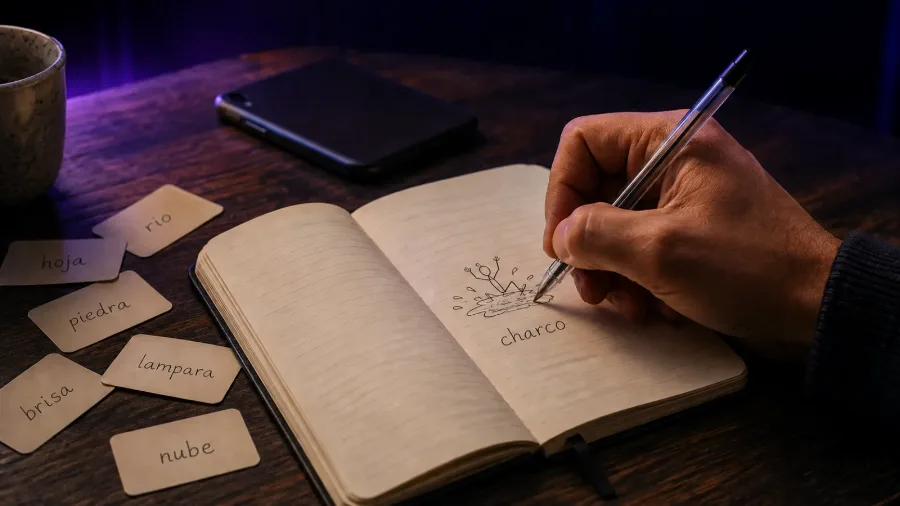
A word memorised as the line "tomar — to take" has nothing to hook onto. It has no situation, no neighbours, no tone of voice. The same tomar behaves quite differently in tomar un café, tomar el autobús and tomar una decisión, and a list translation says nothing about that.
The more connections a word has — a picture, a phrase, the scene in the show where you heard it — the more routes lead into it. Forget one path and you get there by another.
4. You only trained recognition
There is a big gap between "I understand it when I see it" and "I can produce it myself". The first comes easily and grows fast; the second needs its own training. If you always study in the direction "Spanish word → English translation", you are training reading and listening, and in conversation the word you need still will not surface.
5. Your reviews happened at the wrong times
You can review a lot and still forget. Five repetitions in one evening do less for you than the same five spread over a month. The first version feels like you have nailed it — right after cramming you really do remember everything. A week later nothing is left of that feeling.
What to do about it
Come back to the word on a schedule
The best moment to review is when a word is still there but already hard to reach. Then recalling it takes effort, and effort is the training. In practice that looks like this: once on the same day, then after a day, then after three, then a week, then two. From there the intervals grow on their own.
Tracking those dates by hand for a hundred words is impossible, which is exactly why spaced repetition exists — an algorithm keeps the schedule for you and shows each word right before it slips away. If you want to dig into the timing in more detail, we have a separate piece on how often to review vocabulary.
Test yourself instead of rereading
The rule is simple: if a review session never made you strain, it does not count. Cover the translation and try to recall it. If you cannot and you peek, that is fine — the attempt still registers as work.
Study in both directions
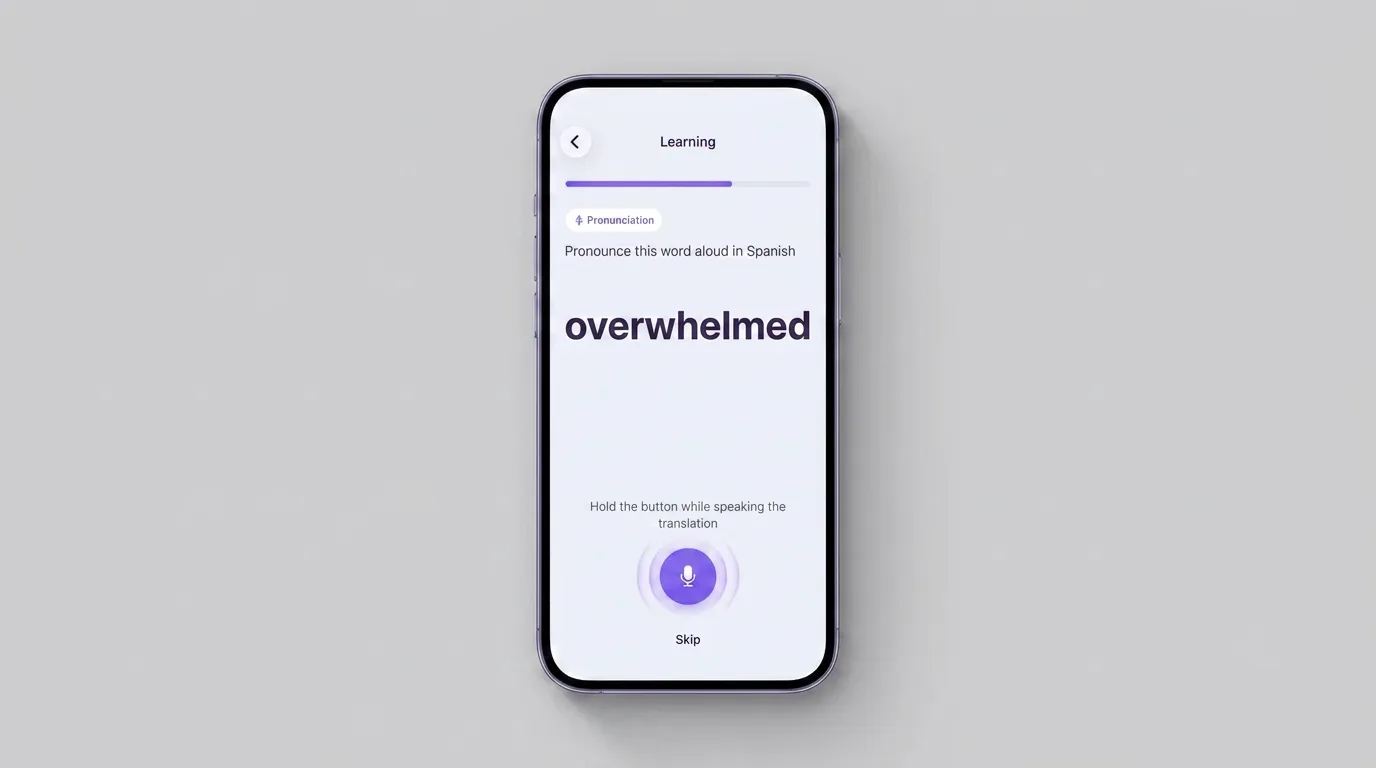
Do half of your reviews in the direction "English → Spanish". It is uncomfortable and slow for the first few days, but that direction is the one responsible for speech. Better still, say the answer out loud rather than in your head: articulation adds another channel for memory and takes the edge off your fear of your own accent.
Take words from things you actually care about
A word from the series you are watching or from a work email sticks better than a word from somebody else's top-1000 list. It already comes with context and emotion, and you know in advance why you need it. Course lists are fine for the basics, but living words hold on tighter.
How this works in the app
You can run all of the above with a notebook and a calendar — it works, but it takes discipline and time. We built VibeLing so that the mechanism runs itself:
- The word gets saved where you met it. Spot something unfamiliar in a series, an article or a chat and add it to your dictionary along with the translation, an example of use and audio. The context is not lost.
- The algorithm keeps the schedule. The app decides which word to show today and which one to put off for two weeks. You never have to remember when you studied agobiado.
- Training makes you recall. Fill in the missing word, build the phrase, say the translation out loud into the microphone — in every format the answer has to come out of your head rather than be recognised on screen.
- Both directions. Words are drilled for recognition and for production, so your active vocabulary grows along with the passive one.
In short
Words disappear not because your memory is bad but because your brain clears out anything you do not come back to. The fix is not more effort on the first evening; it is three things — returning to the word on a schedule, genuinely trying to recall it every time, and training production and not just understanding.
If you would rather not run all of that by hand, start a personal word list in VibeLing — the app takes over the scheduling and leaves you ten minutes a day.