How to Learn Vocabulary by Topic: Word Groups That Stick

Almost every textbook sorts vocabulary by topic: "Fruit", "Colors", "Clothes", "Days of the week". It looks logical, and it really is easier than a random list. But there's a catch textbooks don't mention: put words that are too similar into one group and they start getting mixed up. Plenty of Spanish learners confuse martes and miércoles for years precisely because they learned them on the same day.
Below is how to build topic groups so the words in them help each other instead of getting in the way: which topics to pick, how many words go in one group, and how to practice them afterwards.
Why a topic helps you remember
A word on its own doesn't stay in memory well. When other words from the same situation sit next to it, it gets connections: tarjeta de embarque pulls in puerta de embarque, that one pulls in retrasado, and retrasado pulls in perder la conexión. Recall one, and its neighbors come along.
The second reason is practical. You don't need words in alphabetical order, you need them by situation: at the airport, at the doctor's, on a call with colleagues. If a group is built around a situation, you learn exactly the set you'll need together. It's the same idea as learning words in context, just at the level of a whole topic rather than one sentence.
The catch: similar words interfere with each other
In the 1990s, vocabulary researchers (Thomas Tinkham, and later Rob Waring) tested which is faster to learn: a group of words from one category ("apple, pear, plum, peach") or the same number of unrelated words. The set of same-type words was learned more slowly. The brain remembers that they're all "some kind of fruit" but mixes up which is which.
This is called interference, and you've almost certainly run into it:
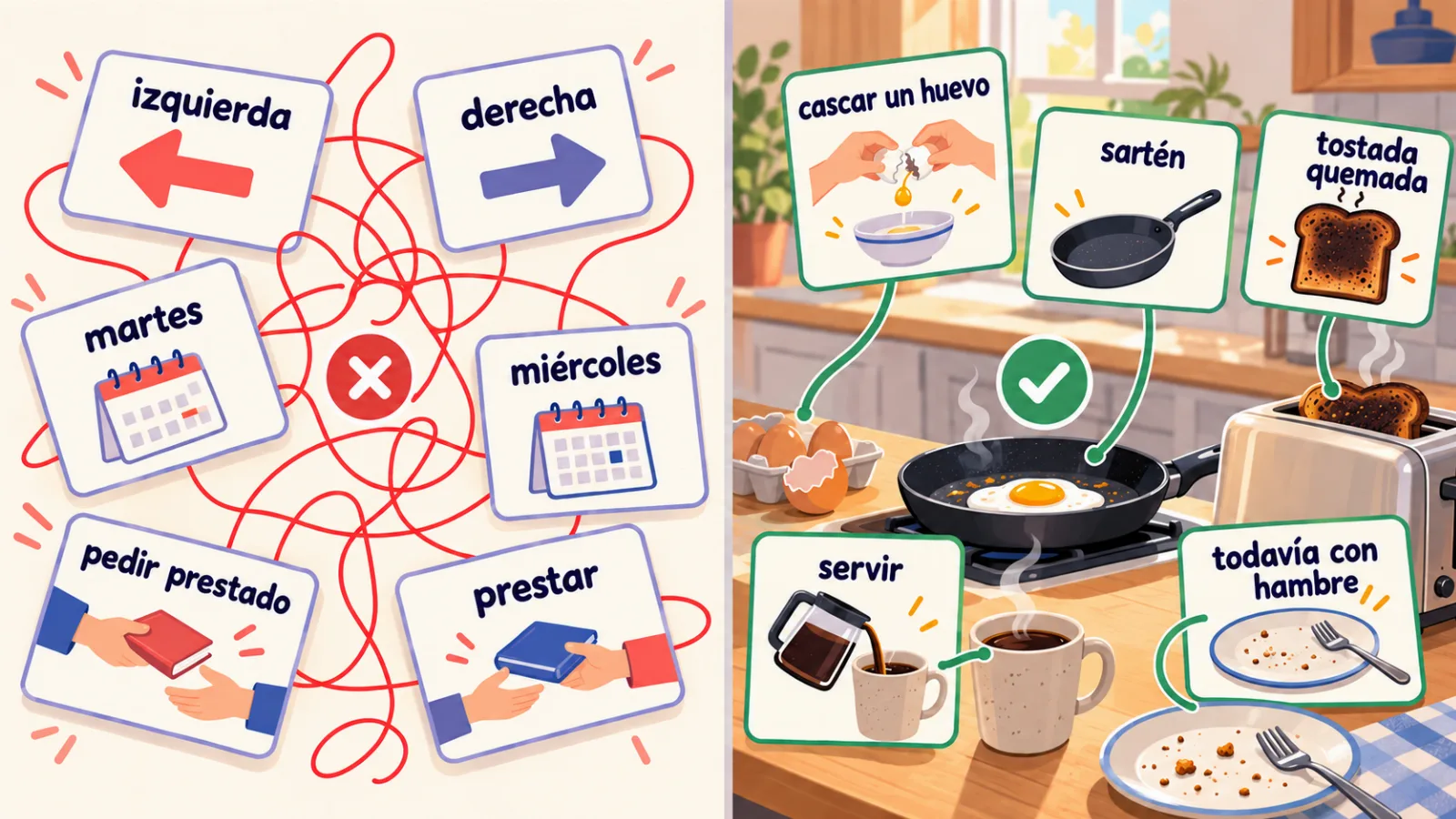
- izquierda and derecha — learned together, and you still pause for a second;
- prestar and pedir prestado — "lend" and "borrow" blur into one;
- martes and miércoles, sesenta and setenta;
- camisa, camiseta, chaqueta, chaleco — four pieces of clothing that sound alike.
The same research showed that a different kind of grouping works better: words united not by category but by a situation or a story. Not "all the kitchen utensils" but "making breakfast": cascar un huevo, sartén, tostada quemada, servir, todavía con hambre. The words are different — nouns, verbs, adjectives — but they all belong to one scene. There's nothing to confuse them with, yet they're connected.
| Category group (gets mixed up) | Situation group (sticks) |
|---|---|
| Body parts: codo, tobillo, muñeca, rodilla, hombro | At the doctor's: dolor de garganta, cita, receta, dos veces al día, sentirse mejor |
| Transport: autobús, tranvía, tren, metro, autocar | Missed the train: perder, andén, el siguiente, retraso, reembolso |
| Verbs of motion: caminar, correr, saltar, trepar, gatear | Moving house: alquilar, casero, fianza, mudarse, hacer las maletas |
This doesn't mean you can never learn categories. It just means similar words are better spread out: prestar today, and pedir prestado a week later, once the first one has settled. Then the second word lands on a solid base instead of competing with the first.
How to build a word group that sticks
1. Take a topic from your own life
The best topic is one you'll soon be in: a trip, a new job, a move, a hobby, the show you're watching right now. You'll run into words from that group in the coming weeks, and every encounter is a free review. The textbook topic "Professions" may never come up for you, while "Job interview" might come up next month.
2. Eight to ten words, no more
A group of thirty words isn't a group anymore, it's a list. Eight to ten items can be held in your head at once, and you can see how they connect. If the topic is big, split it: "Airport: check-in" and "Airport: on the plane" are two groups, not one.
3. Mix parts of speech
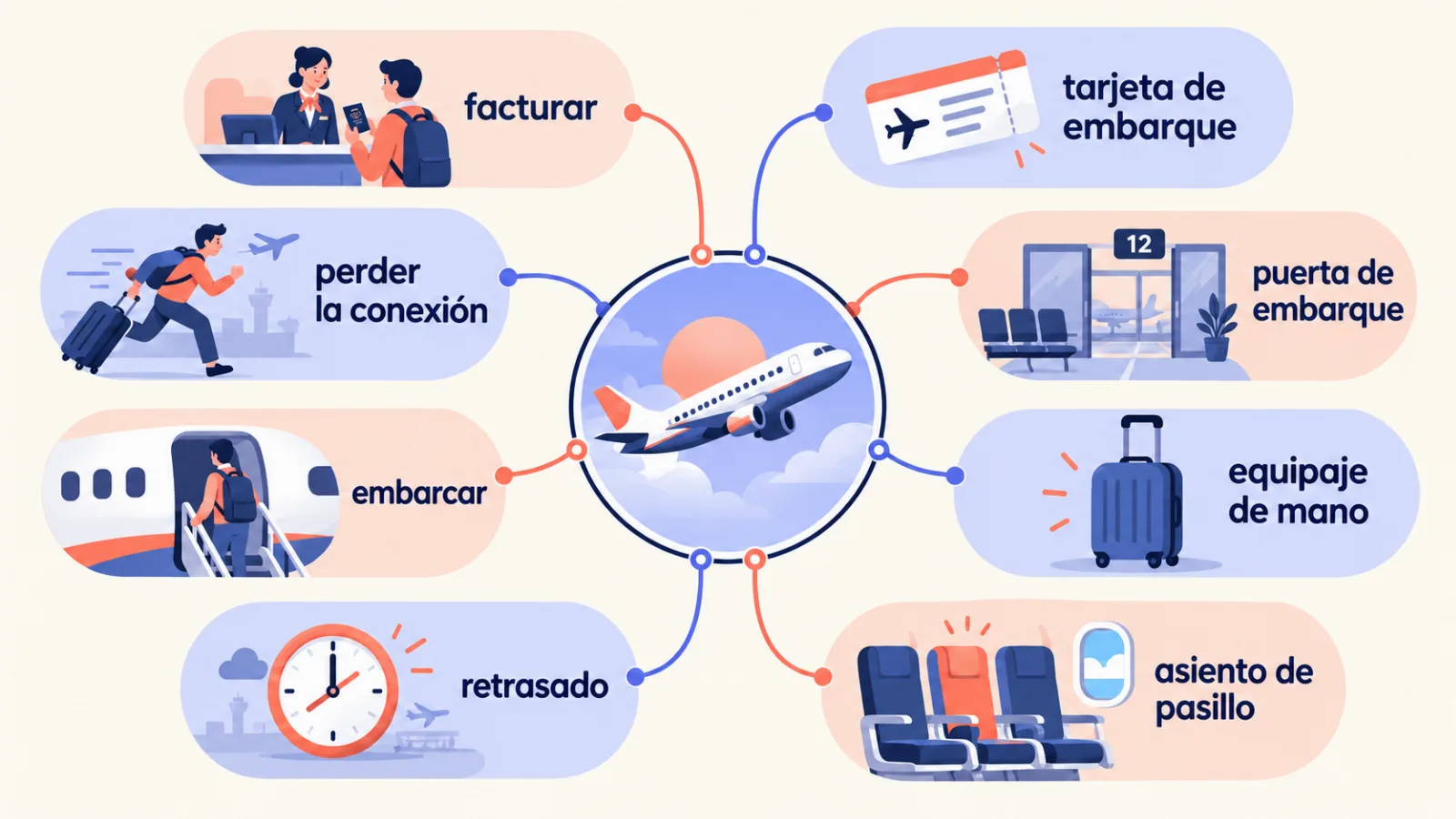
A good group reads like a tiny story: it has things, actions and descriptions. For the topic "Airport":
facturar — to check in
la tarjeta de embarque — boarding pass
la puerta de embarque — gate
el equipaje de mano — carry-on
el asiento de pasillo — aisle seat
retrasado — delayed
embarcar — to board
perder la conexión — to miss a connection
You can already build a sentence out of these: Mi vuelo salió retrasado y perdí la conexión. Words that fit together into sentences are remembered better than eight nouns in a row.
4. Learn phrases, not bare words
Within a topic, many words live in fixed combinations: reservar una mesa, pedir la cuenta, quédese con el cambio. Save them whole. When you need to tell a waiter to keep the change, a ready-made phrase will come to mind instead of a lone word cambio that you still have to fit somewhere.
5. No more than one pair of look-alikes per group
If two twins like prestar and pedir prestado both want into the topic, keep one and save the other for next week. One such pair per group is tolerable; three is a recipe for confusion.
Good topics to start with
If you don't have a topic of your own yet, here are situations where almost everyone needs words:
- at a café or restaurant: ordering, asking for the bill, checking what's in a dish;
- at the airport and on the road;
- at a hotel or rented apartment: checking in, complaining that something's broken;
- at the doctor's and the pharmacy;
- at work: a call, a deadline, vacation, moving a meeting;
- small talk: the weather, the weekend, plans, what people do.
Each topic is two or three groups of eight to ten words. In a month that adds up to a hundred words you will definitely use.
How to practice a topic group
Building a group is half the job. For the words to stay, you need to recall them, not reread them.
- Day one. Get acquainted: look at the words in examples, listen to the pronunciation, write one sentence about yourself.
- Then recall. You see the translation and retrieve the Spanish word. Or the other way round. Rereading a list feels useful but does almost nothing.
- Mix with old words. Once the group has settled a bit, review it shuffled together with words from other topics. That checks whether you remember the word itself, not its neighbor on the list.
- Review at growing intervals. After a day, after three days, after a week. Growing intervals are what move a word into long-term memory.
A speed game is a handy way to check a group. In the browser game Pairs you match words with their translations: you get sixty seconds, and every wrong pair costs you two. Your mistakes show right away which words in the group are still getting mixed up. Other short drills are in the word games section, and why games help at all is covered in the article about online word games that build vocabulary.
Common mistakes
- Learning a whole topic in one sitting. Forty "Kitchen" words in an evening — and a week later not one is left.
- Taking only nouns. Without the topic's verbs and adjectives you can't make a single sentence.
- Picking topics from the textbook rather than from life. Words you never run into don't get reviewed on their own and are the first to go.
- Always reviewing the group in the same order. You memorize the order, not the words. Shuffle.
How it works in VibeLing
The app has ready-made topic collections: "Travel", "Moving" with housing, paperwork and banking, "Top 100 verbs" and others. You can add a whole collection or pick only the words you need. Every word comes with a translation, audio, a picture and examples, so the phrases are right there. Your own words from a show or work emails go into the same personal dictionary.

From there the app schedules the reviews itself: words come back at growing intervals, shuffled with older ones, in different modes — choose the translation, recall, fill in the sentence, say it out loud. All that's left for you is to pick a topic and practice for ten to fifteen minutes a day.
Try building your first group around the situation waiting for you in the coming month, and practice it in VibeLing. Eight words a week doesn't sound like much, but in six months that's two hundred words you actually use.