How to Learn Words in Context

You probably know how this goes. You write down twenty words, learn them from the list and get almost all of them right on the quiz. A week later five are left. And when one of them shows up in an article, you don't recognize it, even though you remember the translation. The words aren't the problem, the method is. A word learned as a pair, "Spanish word — English word", has almost nothing to hold on to in memory. A word you met inside a sentence stays much longer.
Below: what learning in context actually means, why it works and how to turn it into a daily routine.
What it means to learn a word in context
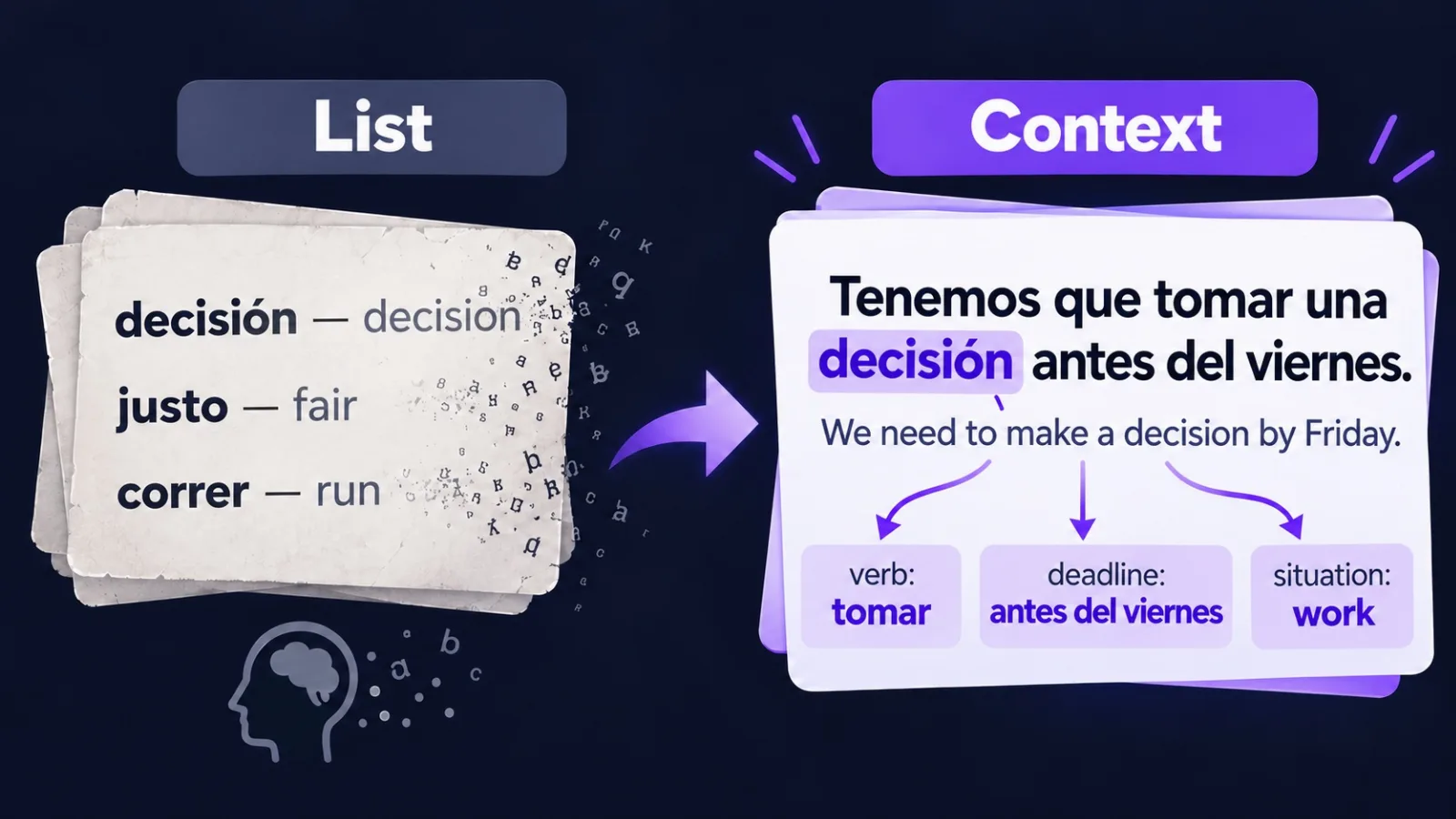
Context is the sentence or situation the word lives in. Not decisión — decision, but:
Tenemos que tomar una decisión antes del viernes. — We need to make a decision by Friday.
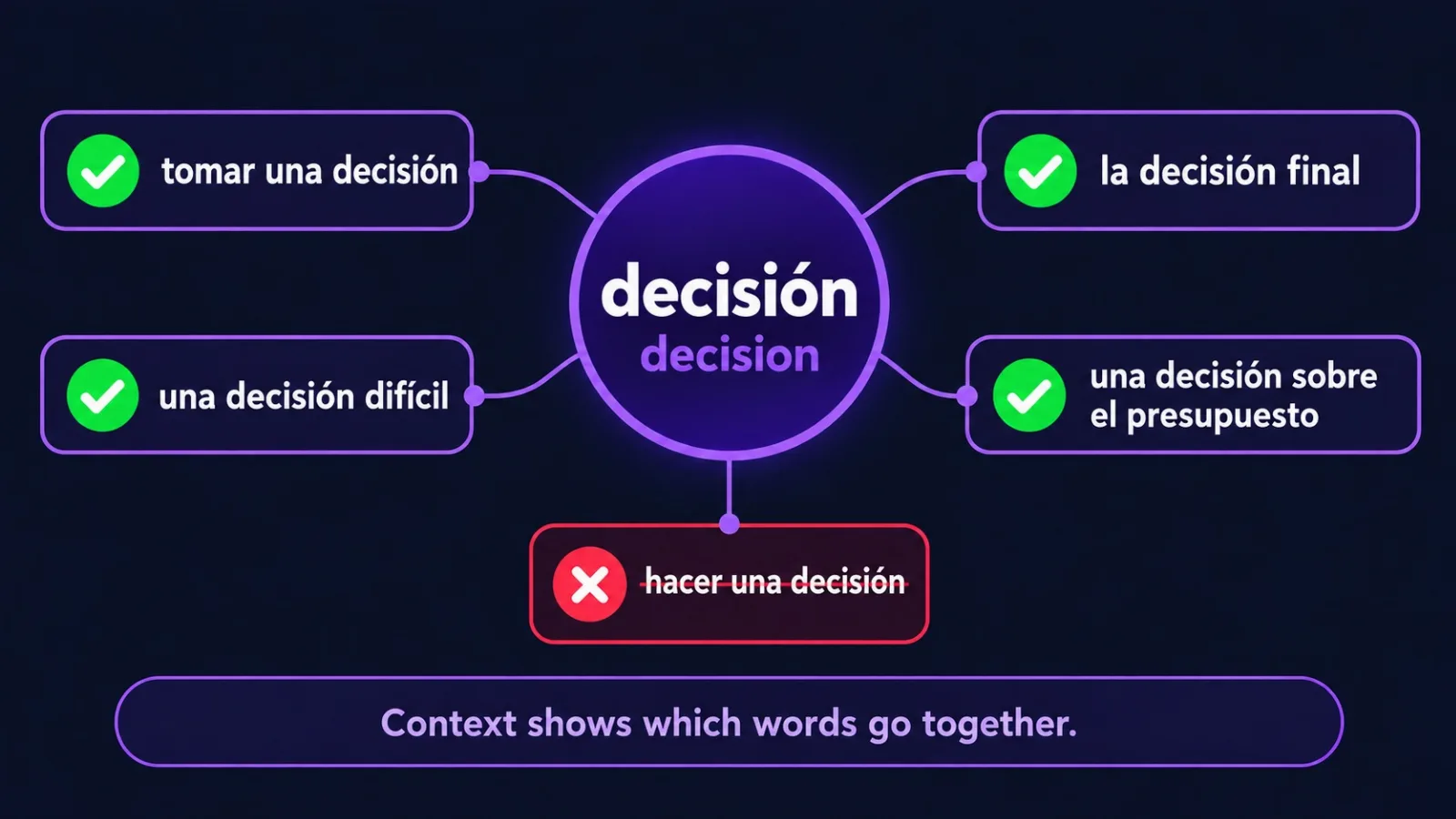
That one line tells you more than a pair on a list: in Spanish you "take" a decision with tomar, not "make" it with hacer; the word comes up easily at work; it is often followed by a deadline or a reason. All of that arrives together with the word, and you don't have to memorize it separately.
Why words from a list don't stick
A list is convenient: easy to make, easy to check. But it has a few built-in problems.
- Memory has nothing to hook onto. Two words side by side is very little information. The brain holds on to things connected to an image, a situation or other words. A bare pair is connected to nothing, so it is the first to go.
- The translation doesn't match the meaning. Spanish llevar means "to carry", "to wear", "to take someone somewhere", and it is also how you say how long you've been doing something. Your list will have one meaning, and the text will use another.
- You don't know which words it goes with. In English you "are hungry", in Spanish you "have hunger": tengo hambre, not estoy hambre. You "make a mistake" in English, but in Spanish you cometer un error. A list won't tell you that, and your sentences come out in a way a native speaker notices at once.
- The word doesn't come to mind when you need it. When you speak, you aren't looking for a single word, you're looking for a way to say something. If the word is stored together with a phrase, the whole phrase comes back.
What context gives you
| What you learn | Example |
|---|---|
| Which meaning is meant | Ella lleva gafas. — here llevar means "to wear", not "to carry" |
| Which words it goes with | tener frío, tener miedo — "have" cold and fear, not "be" them |
| Which preposition follows | pensar en, depender de, soñar con |
| Whether it's casual or formal | vale in conversation, de acuerdo in a work email |
| What tone the word carries | viejo about a person can sound rude, mayor is the polite choice, and the sentence shows which one fits |
How to learn words in context: six steps
1. Save the word together with the sentence where you found it
The most valuable context is your own: a line from a show you're watching, a sentence from a colleague's email, a line from a book. You remember where it was, and that memory works as an extra hook. If you read in Spanish, here is how to pick up words from books without giving up on reading.
2. Pick a short, clear sentence
A good example is one line where the new word is the only unknown one. If a sentence has three new words, it doesn't help, it gets in the way: you end up memorizing noise. There's no need to copy the whole paragraph, just the part where the word does its job.
3. Learn fixed combinations as a whole
Many words aren't worth learning on their own at all. Darse cuenta, echar de menos, tener ganas de are ready-made blocks, and that is how you should learn them. More on this approach in learn phrases, not single words.
4. Collect two or three different examples
One sentence ties a word to one situation. Two or three different ones show how it changes. Take llevar:
Llevo una mochila. — I'm carrying a backpack.
Ella lleva gafas. — She wears glasses.
Llevo dos años en Madrid. — I've been in Madrid for two years.
After three lines like these, the word stops confusing you when it shows up in an unfamiliar text.
5. Test yourself with a gapped sentence
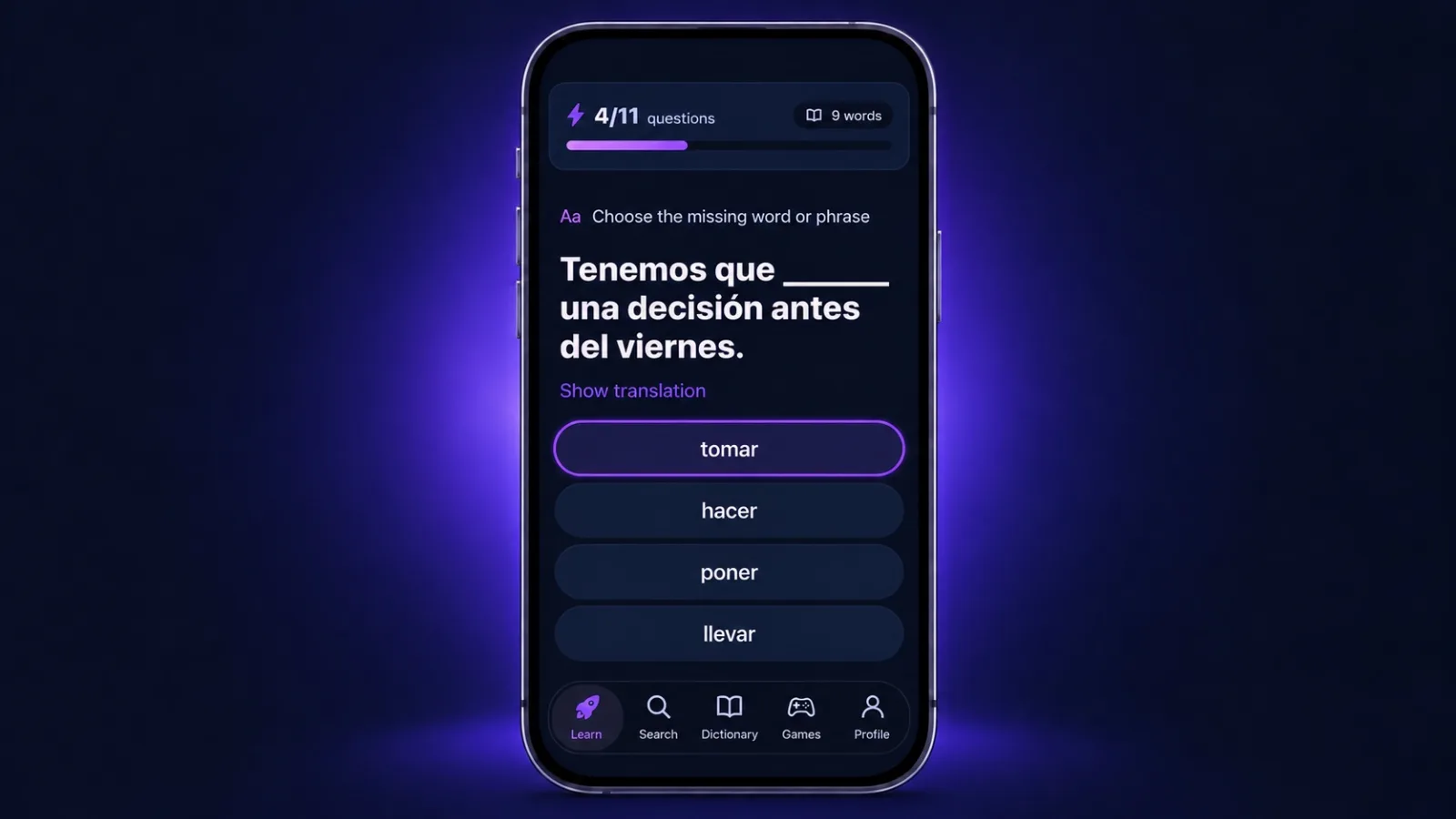
Reading an example and nodding along is weak practice. It is much stronger to hide the word and recall it from what's around it: Tenemos que ___ una decisión antes del viernes. This trains exactly what you need when speaking: pulling out a word when you already have the thought and the start of the sentence. You can try it right in your browser: in the Missing Word game you fill a word into a Spanish sentence.
6. Write your own sentence
The last step is one sentence about yourself: El año pasado tomé la decisión de cambiar de trabajo. Your own sentence sticks better than someone else's, because it's about your life. And it's the first time you're not just recognizing the word but using it.
Where to find context
- Shows and films with Spanish subtitles — real spoken phrases, with intonation and a situation around them.
- Books, articles, posts — more written vocabulary, and you can reread at your own pace.
- Messages and emails in Spanish — words you will definitely need.
- Dictionaries with examples — SpanishDict and WordReference give several example sentences for each meaning.
- YouGlish — shows video clips of people saying the word you need, so you hear both the context and the pronunciation.
Common mistakes
- Context that's too long. A paragraph instead of a phrase is hard to review, and within a week you'll start skipping it.
- Learning the translation of the sentence instead of the word. The translation is there to help you understand; the Spanish sentence is what you practice.
- Hoping context will replace review. It won't. A word in a sentence sticks better, but without reviewing it after a day, three days and a week, it will still fade. Context makes each review more useful; it doesn't cancel reviews.
- Using examples that have nothing to do with you. A sentence about tax reporting is useless if you're learning Spanish for travel.
How it works in VibeLing
We built VibeLing so that a word arrives with its context straight away. Look up a word and you get a card: translation, transcription, audio, definition and example sentences. One tap adds it to your dictionary with all of that attached.
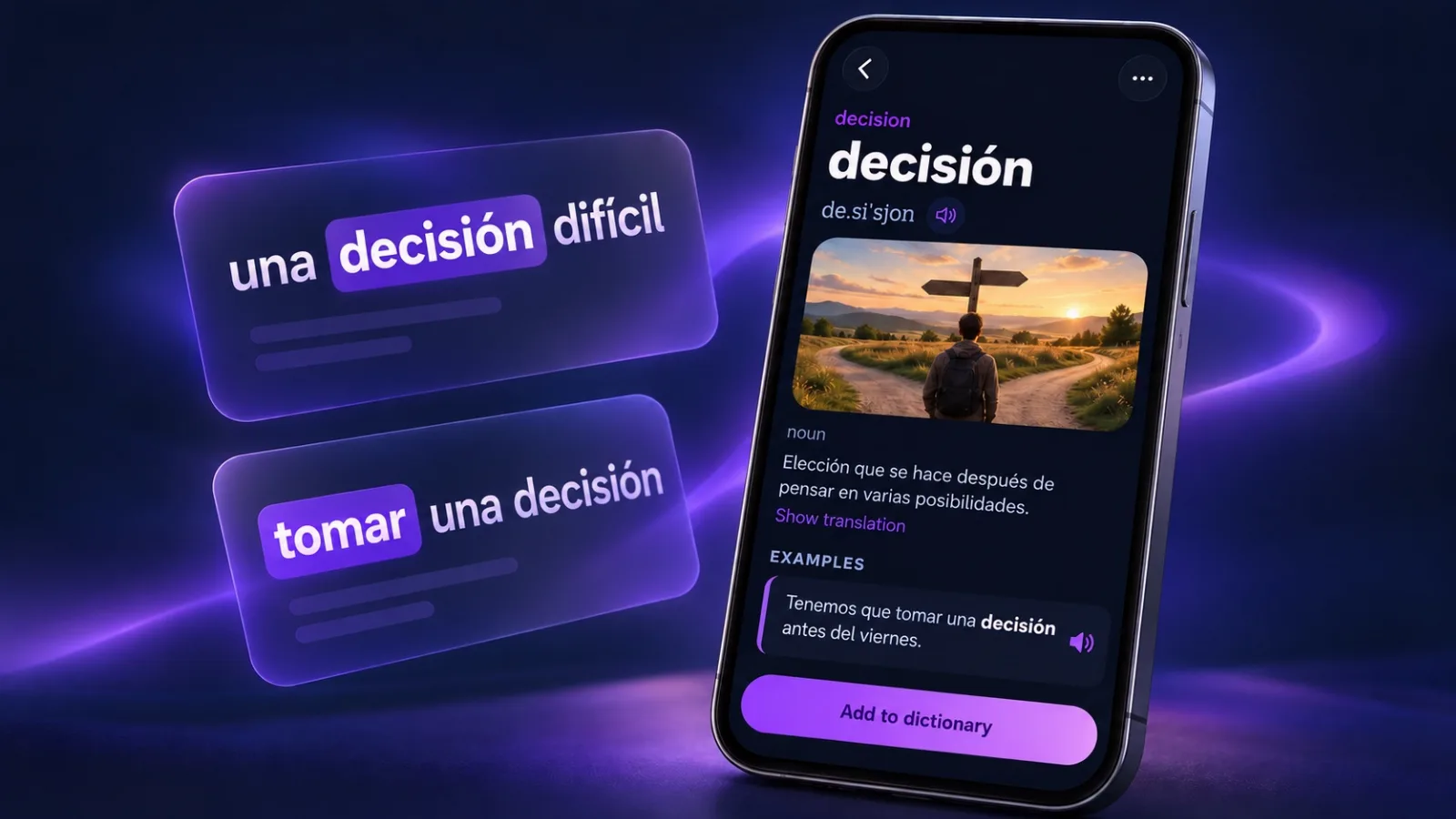
After that the app puts the word into your review queue and brings it back in different exercises. One of them is exactly the gapped sentence: you see a Spanish phrase and choose what's missing. So the word is reviewed not as a bare pair but in the situation where it works, and on the day it's due.
Summary
Context gives memory what a list doesn't: a situation, neighboring words, grammar and tone. In practice it comes down to a few simple habits: save the word with its sentence, pick short examples, learn combinations as a whole, test yourself with a gap and write your own sentence. If you'd like all of that to happen on its own, start a personal dictionary in VibeLing and add the first five words from whatever you're reading or watching right now.