Vocabulary Trainer App: How to Choose One
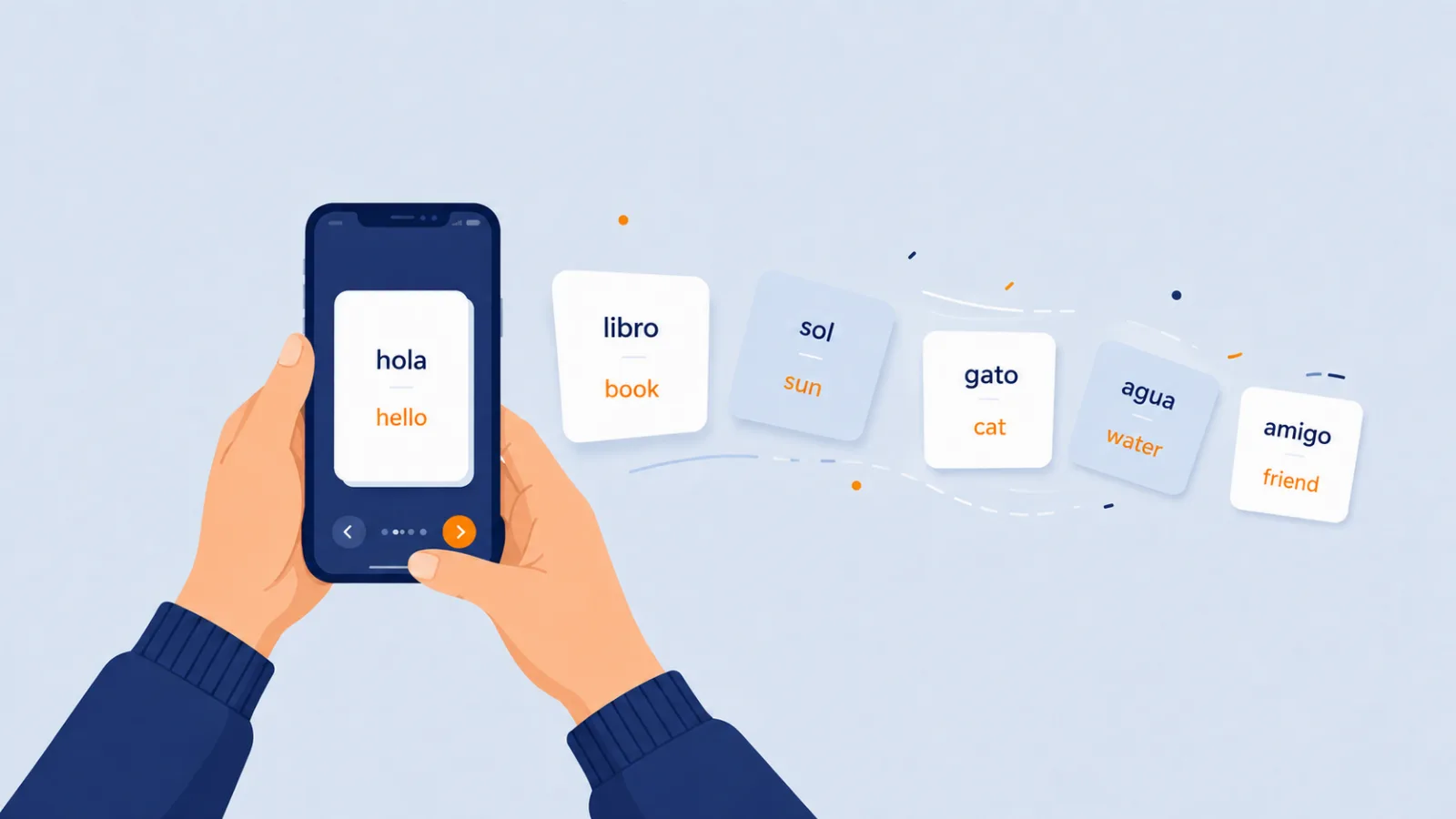
A trainer is not a course. A course walks you through a syllabus and decides what you will study tomorrow. A trainer works with what you already have: it holds a list of words and makes sure they do not fall out of your head. The difference looks minor right up to the moment you finish six months of lessons and notice that the words from month one are gone.
Here are six things worth checking before you settle into an app for the long run. The order is deliberate: the first two decide whether you will still be using it in a month, the rest affect comfort.
How a trainer differs from a course and a dictionary
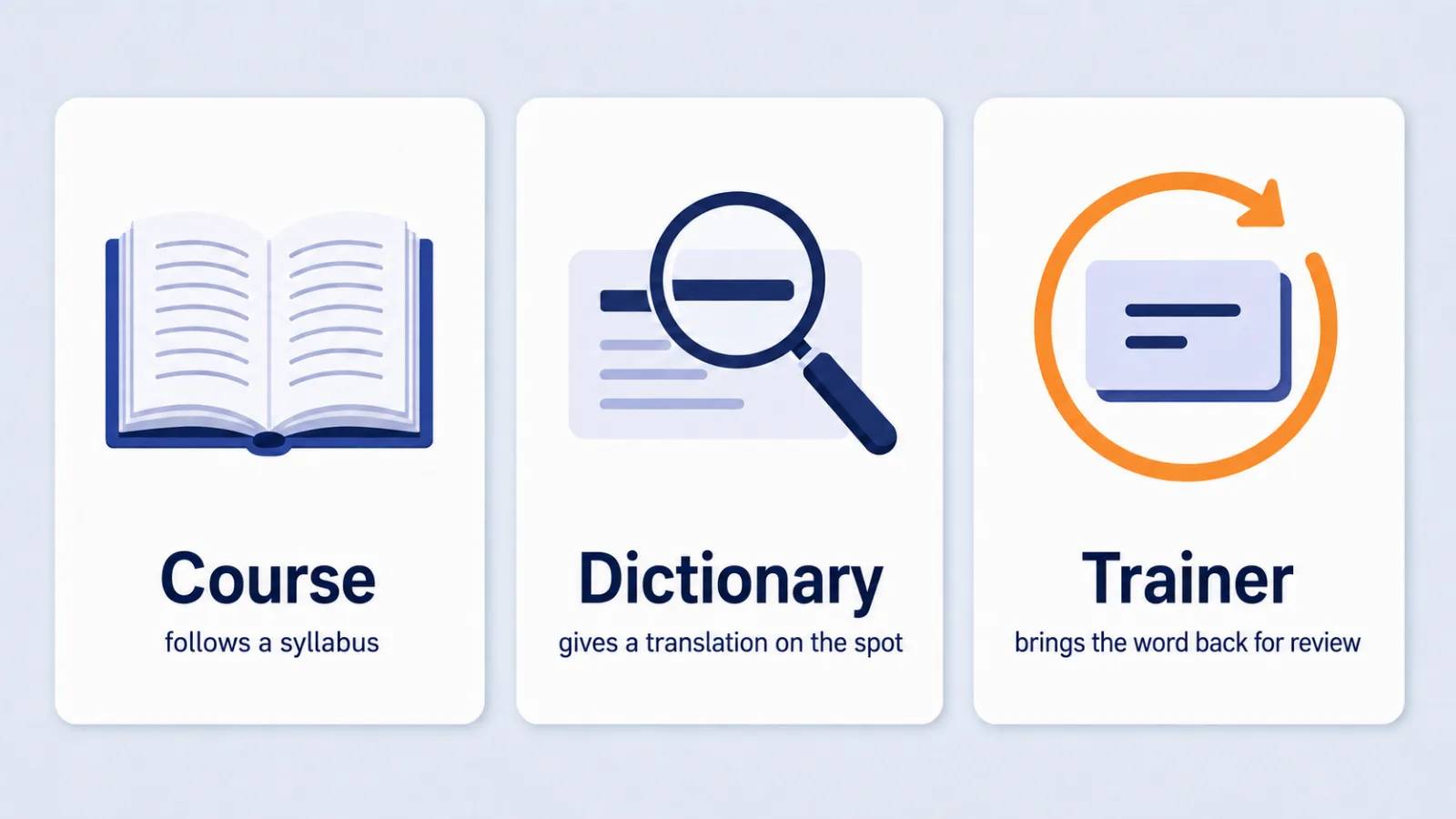
All three sit in the same store category and do completely different jobs.
| Type | What it gives you | What it does not do |
|---|---|---|
| Course | A syllabus, an order of topics, a sense of movement | Does not track an individual word: a finished lesson never comes back |
| Dictionary or translator | The translation, the pronunciation, examples at the moment you meet a word | Remembers nothing for you — you looked it up and closed it |
| Trainer | Stores words and brings them back for review until they stick | Will not teach you grammar and will not replace reading and talking |
A course and a dictionary without a trainer produce a familiar feeling: you have been studying, and you still cannot say anything. A trainer plugs that one hole and nothing else.
Check 1. Where the words come from
This is the main question, and it matters more than any algorithm. Apps split into the ones that hand you ready-made lists and the ones you fill with your own words.
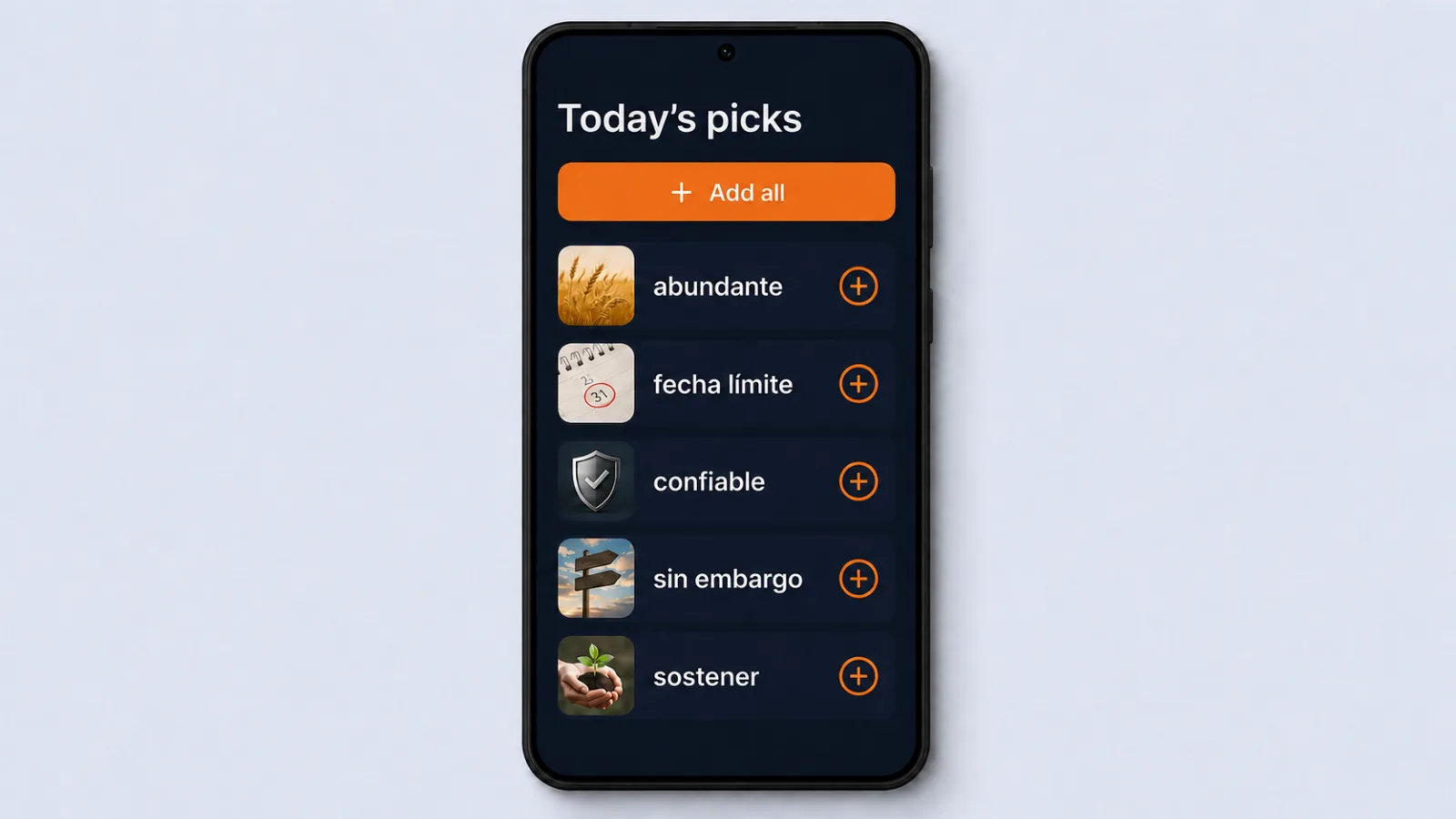
A ready-made list is convenient in week one and dead by week three. The reason is simple: its words are not connected to anything you read, watch or hear. You are learning abundante because it came seventeenth in the set, not because you ran into it somewhere. Your own words hold better, because each one carries the memory of meeting it: you remember the scene in the show or the line in the email, and that works as an extra hook.
Your own words have the opposite problem — there is nothing to add. Someone installs an app with an empty dictionary, types in ten words off the top of their head and stalls. So a good trainer does both: it takes your words without limits and suggests new ones at your level when you have run out. That fork is covered in more detail in the piece on your own collections versus ready-made lists.
What to check: can you add a word in two taps at the moment you meet it, and does the translation with examples get pulled in automatically? If adding a word is a five-field form, you will not be filling it in.
Check 2. Who decides when to review
Second in importance. Some apps leave you scrolling a list and reviewing whatever you land on. In others an algorithm builds the schedule.
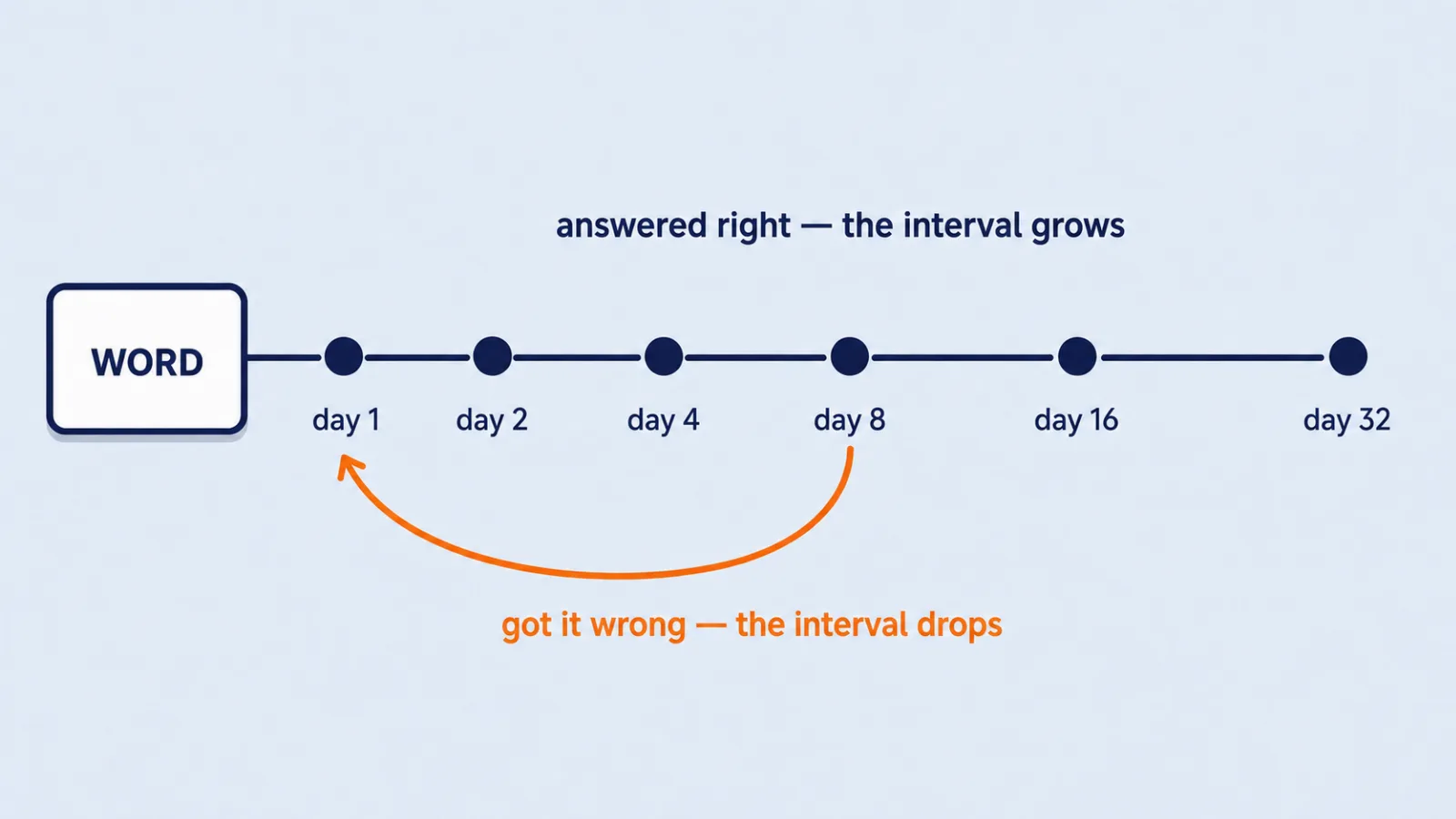
The working scheme looks like this: a word you got right comes back in a day, then two days, four, eight, sixteen and onwards. Get it wrong and the interval drops almost to the start. The point is for the review to land shortly before you would have forgotten: earlier and you wasted the time, later and you are learning it again from scratch. The mechanics are laid out in the article on the Leitner system, where all of this started.
Look separately at how the app decides difficulty. Some trainers ask after every card: was that easy, hard or impossible? It is an honest approach, and it demands attention and self-criticism that you do not have at eleven at night — people press "easy" because it makes the queue shorter. The alternative is to infer difficulty from behaviour: how many seconds you thought, how often you missed, whether you took a hint. Then nothing is asked of you except the answer.
Check 3. Recognition or recall
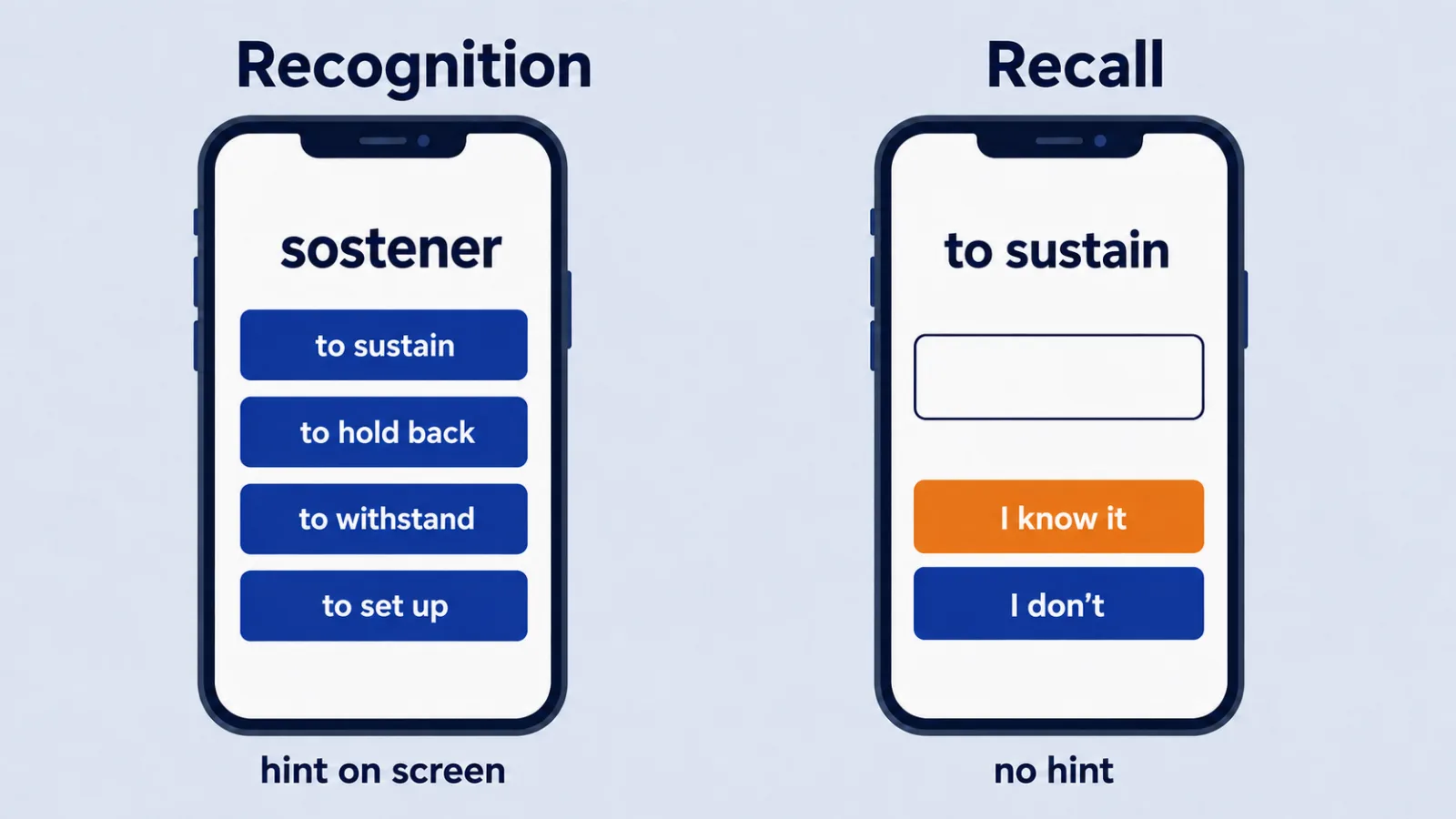
Picking a translation out of four options and producing the word from nothing are two different skills, and they are stored separately. A trainer where everything comes down to multiple choice grows a beautiful statistic and leaves you in the position of recognising the word on a page but never reaching it in conversation.
The test takes a minute: cover the options with your hand and try to say the word yourself. If it will not come without the prompt, all you have been training so far is recognition.
A reasonable set of exercises looks roughly like this:
- Choose the translation — a quick pass, fine for meeting a word for the first time;
- Recall and check yourself — the actual retrieval, the most useful and the least pleasant part;
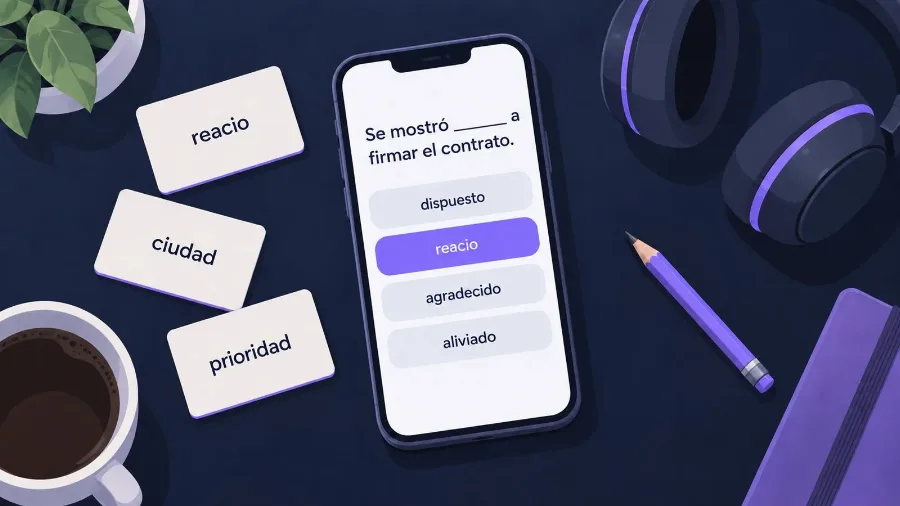
- The word missing from a sentence — checks that you know how it combines, not just its dictionary entry;
- Build the word from letters — fixes spelling on the way;
- Say it out loud — the only exercise that trains speech rather than reading.
Check 4. What happens to a mistake
Watch where a word goes when you get it wrong. The bad version: it slides to the back of the queue and resurfaces tomorrow, by which point you have forgotten that you even missed it. The good version: the word returns inside the same session a few questions later, when you have stopped holding it in your head but still remember tripping over it.
Nobody advertises this detail, and it changes the outcome noticeably: the second attempt inside a session is what turns a miss into a learned word.
Check 5. The daily queue has to end
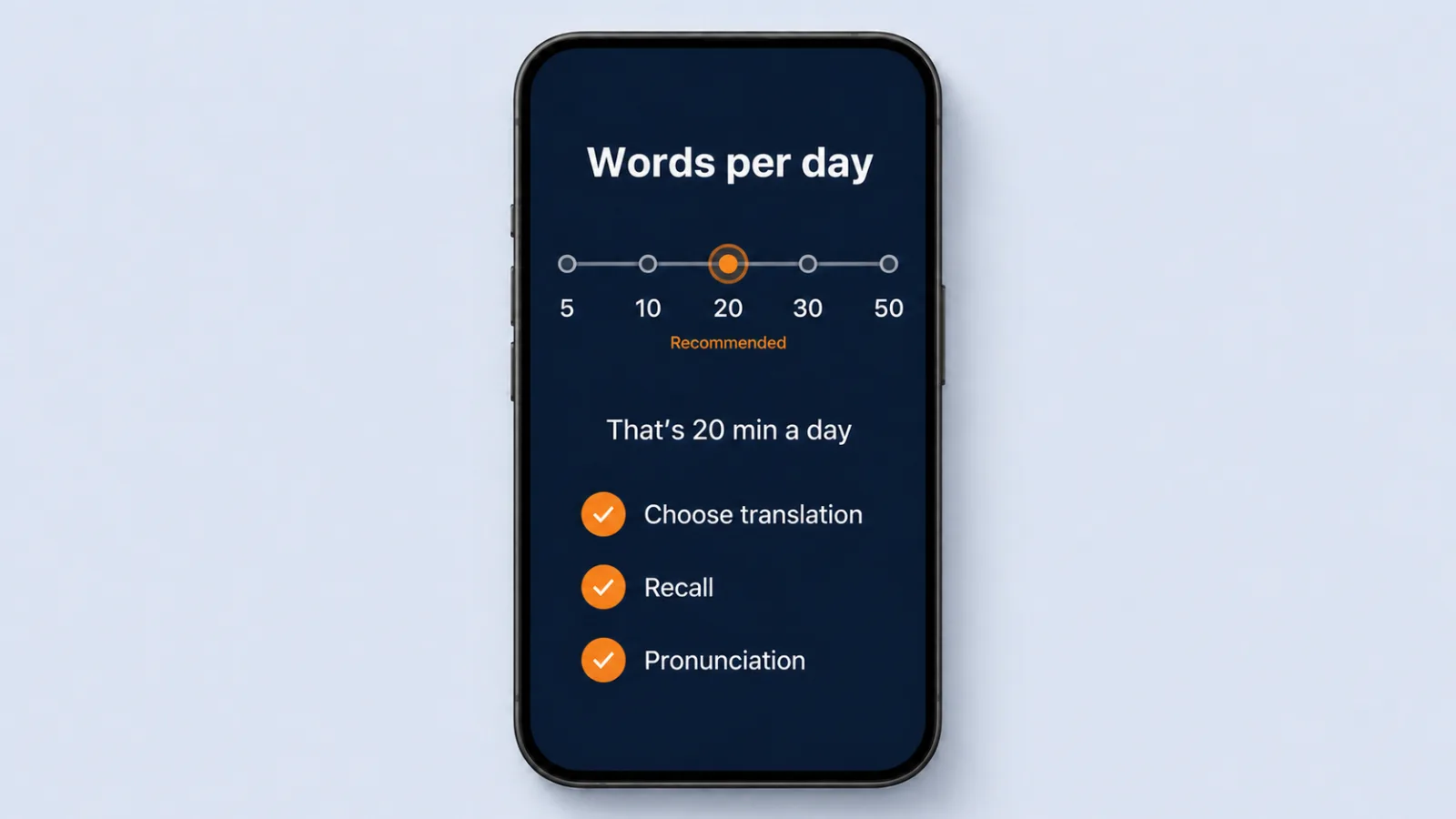
Social apps are built so the feed never runs out. A trainer should be built the other way round: twenty-three questions today, and when they are done you are free. A finite queue is the thing that makes daily practice possible at all.
While you are there, check whether the number of new words is adjustable. There is a non-obvious arithmetic here: twenty new words a day turn into roughly forty reviews a day within a couple of weeks, because the old words do not go anywhere. If the app will not let you slow down, in a month you will have a queue you do not want to open.
Check 6. The small things you discover in week two
- Offline. The metro and the plane are the best review time, and it stings to find that the app shows a spinner without a connection.
- Audio. A word without pronunciation gets learned by eye and never recognised by ear. The voice is not decoration.
- Where the free version ends. Look not at whether there is a paid tier but at what sits behind it. A cap on how many of your own words you can keep is a stop sign; a cap on how many words the app suggests per day is tolerable.
- Sync and platforms. A dictionary you built over six months should not live on one phone only.
The short checklist
- Can you add your own word in a couple of taps, and does the translation with examples arrive by itself?
- Does the app work out the review schedule for you?
- Are there exercises that make you recall, not just recognise?
- Does a missed word come back inside the same session?
- Does the daily queue end, and can you change the pace?
- Does it work offline, is there audio, and where exactly does the free version stop?
How we built ours
Those six points are what we assembled VibeLing around. Your own words go in without limits, and the translation, transcription, examples and a picture arrive automatically; when you have nothing to add, the app suggests words based on your level and interests. The schedule is computed for you across intervals from one day to several months, and difficulty is inferred from how you answered — how long you thought, where you missed, whether you took a hint — so there are no "easy / hard" buttons at all. There are five exercises: choose the translation, recall with self-check, the missing word in a sentence, building the word from letters, and saying it out loud into the microphone. The daily queue is finite, its size is adjustable, and there is no "Start session" button — the first question shows up the moment you open the app.
Nothing stops you from running someone else's trainer through the same list: six questions take about ten minutes and save you a month of practice that would not have paid off.