Why Your Own Word Collections Beat Ready-Made Lists
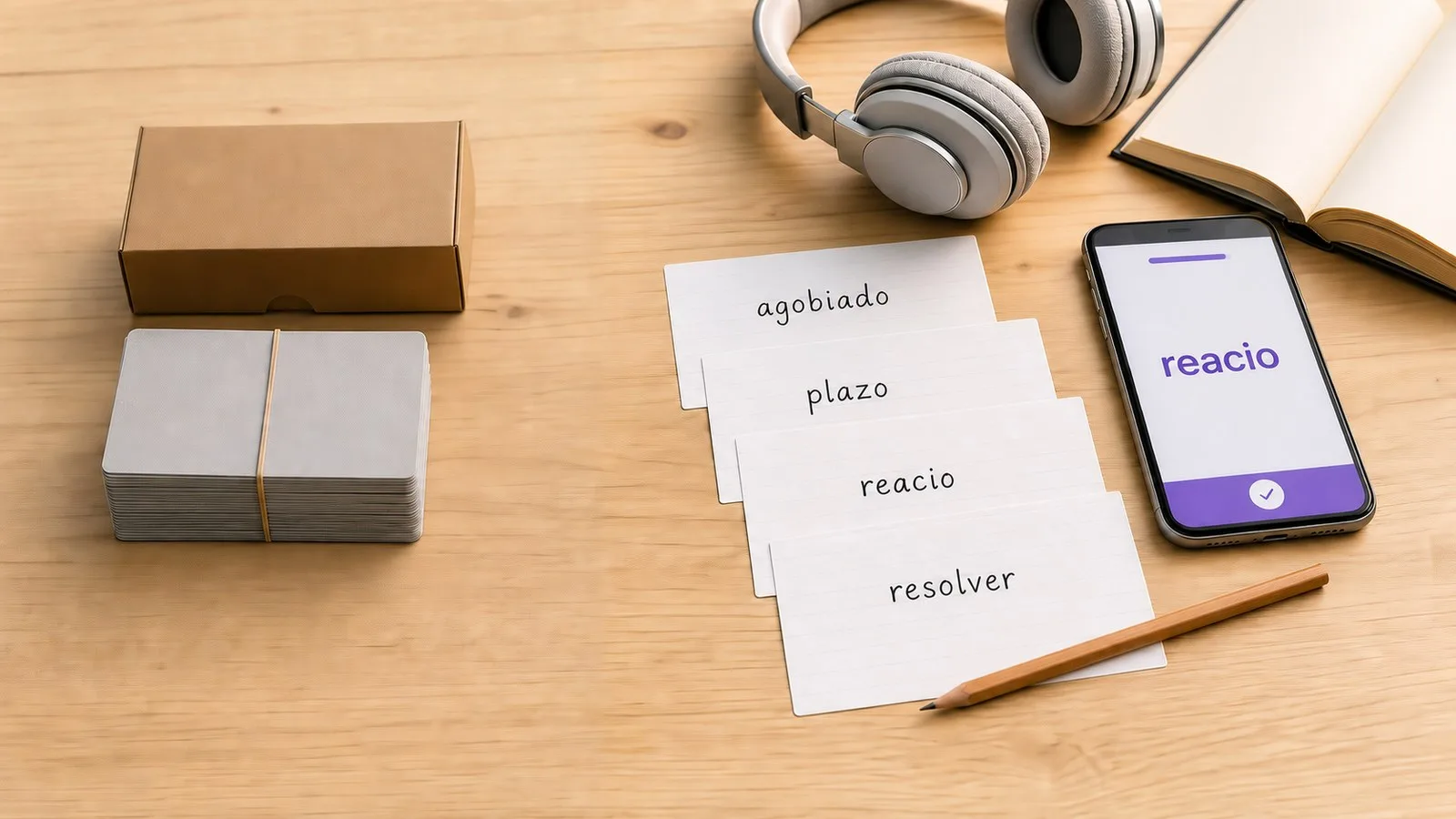
Almost everyone who gets serious about a language eventually downloads a ready-made list: "the 3000 most frequent Spanish words", "top 500 for conversation", a shared flashcard deck from someone else's account. The logic makes sense: somebody already picked out what matters, all that's left is to memorize it. Two weeks later there are a hundred and fifty words checked off, and almost none of them have come up in a real conversation.
The lists aren't bad. They're just not built for you.
What ready-made lists get right
Let's be fair: frequency lists have real value. The first couple of thousand words in Spanish genuinely cover most everyday speech, and working through them in order beats picking up words at random when you're starting out. If you're a beginner, a ready-made set saves effort — you don't have to decide what to learn, it's already decided.
Exams work the same way. If you're preparing for the DELE, there's a closed circle of academic vocabulary, and taking it as a prepared set is a reasonable move: the list is known in advance and isn't supposed to adapt to you.
But a frequency list has a built-in limit. It answers the question "which words appear most often in the language overall", not "which words do I need".
Where someone else's list stops working
Average frequency isn't your frequency
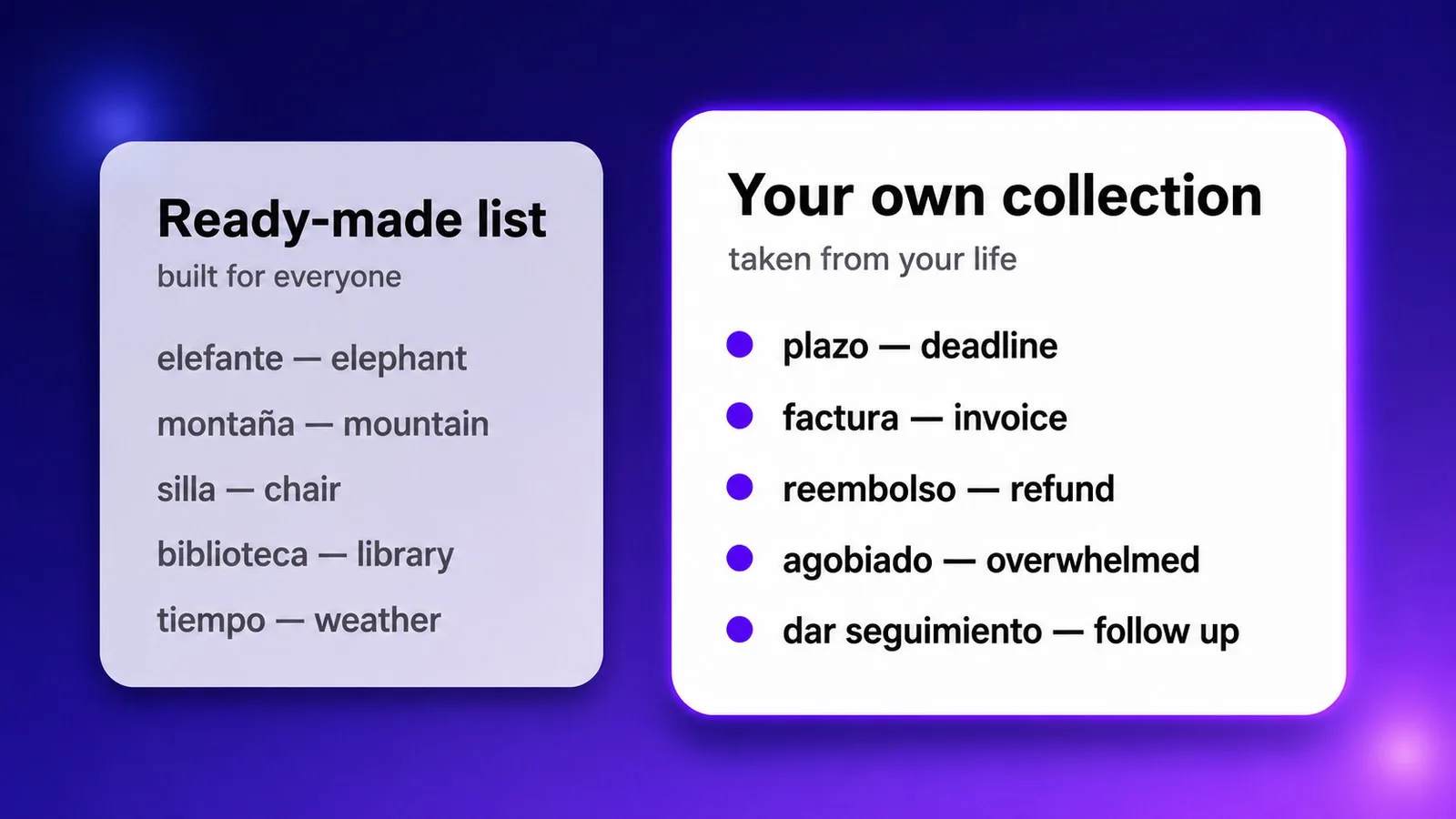
Take two people. The first works in tech and reads messages from Spanish-speaking colleagues every day: plazo, alcance, factura, presupuesto, dar seguimiento. The second moved abroad with a small child and has a completely different set: cochecito, sarpullido, cita, reembolso, contrato de alquiler. No general frequency list will assemble both sets at once — it gives both people something in the middle.
Meanwhile, the words from a personal set are needed tomorrow. A word you run into again the next day sticks almost on its own. A word from someone else's list waits months for its moment and gets forgotten along the way.
A word without context holds up worse
In a ready-made deck a word arrives bare: agobiado — overwhelmed. That's it. When you save a word yourself, it comes with a history: you heard it in a scene where a character couldn't cope with work, or read it in an email from a colleague. That attachment is exactly what your memory grabs onto when it's time to recall the word.
Which gives a simple rule: save the phrase the word appeared in, not just the word. There's a separate piece on that — why learning phrases works better than learning single words.
Someone else's list is easy to quit
With a ready-made deck of 3000 cards you can never feel progress: however much you learn, there's always a wall ahead. Your own collection of 40 words, gathered over a month of watching one show, can be taken in as a whole. You can see it, you can finish it, you want to come back to it.
What a personal collection gives you
- Relevance. You learn what you've already met and will meet again, not what might come in handy someday.
- Context. Every word drags along a phrase, a scene, a situation — recall gets easier.
- Your level. A word you already know won't make it into your personal list, and neither will a word you're not ready for.
- Motivation. A list you put together yourself feels like your own project, not homework from a stranger.
- Thematic blocks. Words group naturally by source: a show, work email, a trip, a book — and inside a group they support each other.
How to collect your own sets so it actually works
Save on the spot
The main enemy of a personal dictionary is delay. Put the saving off until evening and the word won't survive: you'll forget both the word and where you met it. The rule is simple — you see an unfamiliar word worth knowing, you save it right then, in five seconds, without leaving the show or the article.
No more than five to seven words at a time
You could write down forty unfamiliar words per episode. You won't learn them. Take five, seven at most — the ones that actually got in the way of understanding, or that immediately looked useful. The rest will show up again, and then you'll grab them.
Write down the phrase, not just the word
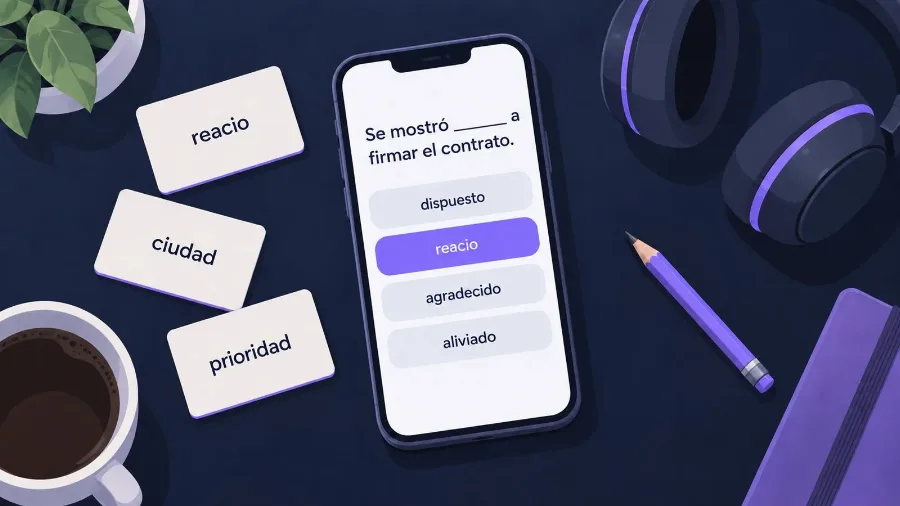
Instead of reacio, save se mostró reacia a responder. Instead of resolver — vamos a resolverlo mañana. The phrase immediately shows which words this word keeps company with and in what situation people say it.
Split collections by meaning
One general dump of 500 words quickly becomes as faceless as someone else's list. Keep separate sets: words from work, words from a show, words for a trip, words from a book. That way you can review what you need right now instead of everything at once.
Don't drag in everything
A rare literary word, a narrow term from someone else's profession, an archaic expression from a period drama — all of it takes up space and doesn't pay off. Simple guideline: save what you can picture yourself saying in the next few months.
The hybrid: a frequency base plus your own
Lists and personal collections don't compete if you separate them by stage.
| Situation | What to use |
|---|---|
| Starting from zero, almost no vocabulary | A ready-made frequency list of the first 500–1000 words |
| You understand simple texts but struggle to speak | Your own collections from what you read and watch |
| Preparing for an exam | A ready-made academic list plus your own words from practice tests |
| You need the language for work or a move abroad | Only your own collections — from emails, meetings, documents |
Once the basic thousand words are covered, the value of general lists drops fast, and the value of personal ones grows.
How this works in VibeLing
The app is built around a personal dictionary rather than ready-made decks. You run into a word in a film, an article or a message — you add it to yourself, and it arrives with a translation, an example of use and pronunciation, so you don't have to hunt for context separately.
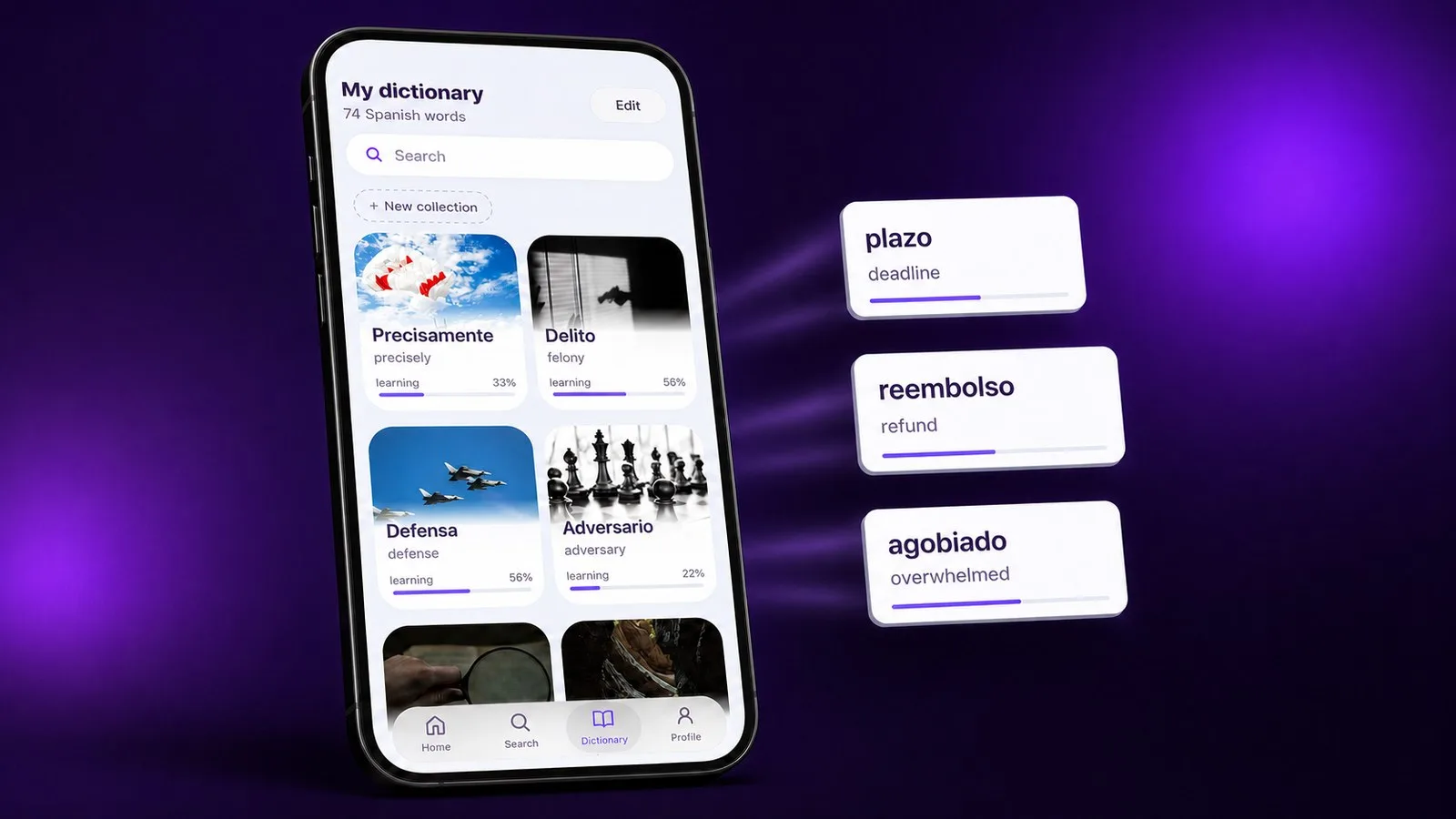
From there words are sorted into collections: one set for work vocabulary, one for a show, one for a trip. Each collection shows how well it's learned, and training runs on spaced repetition — a word comes back exactly when you're starting to forget it. That's a whole topic of its own, covered in the piece on why new words slip away.
The training formats vary too: pick the translation, fill the missing word into a phrase, say it out loud into the microphone. You meet the same word in several modes, and it stops being a line in a list.
In short
A ready-made list is a decent starting crutch and a poor long-term strategy. It doesn't know what you watch, where you work, what you talk about, or which words are already on the tip of your tongue. A personal collection knows all of it, because you build it out of your own life: from the show you're watching now, from the email that arrived this morning, from the conversation where you came up a word short.
Start small: create one collection and spend a week dropping every unfamiliar word you meet into it. After seven days it will hold twenty or thirty words, and all of them will be yours. Building that kind of dictionary and reviewing it on schedule is what VibeLing is for — the app saves a word with its translation and an example in a couple of taps, then brings it back for review on its own.