Mnemonics for Memorizing Words
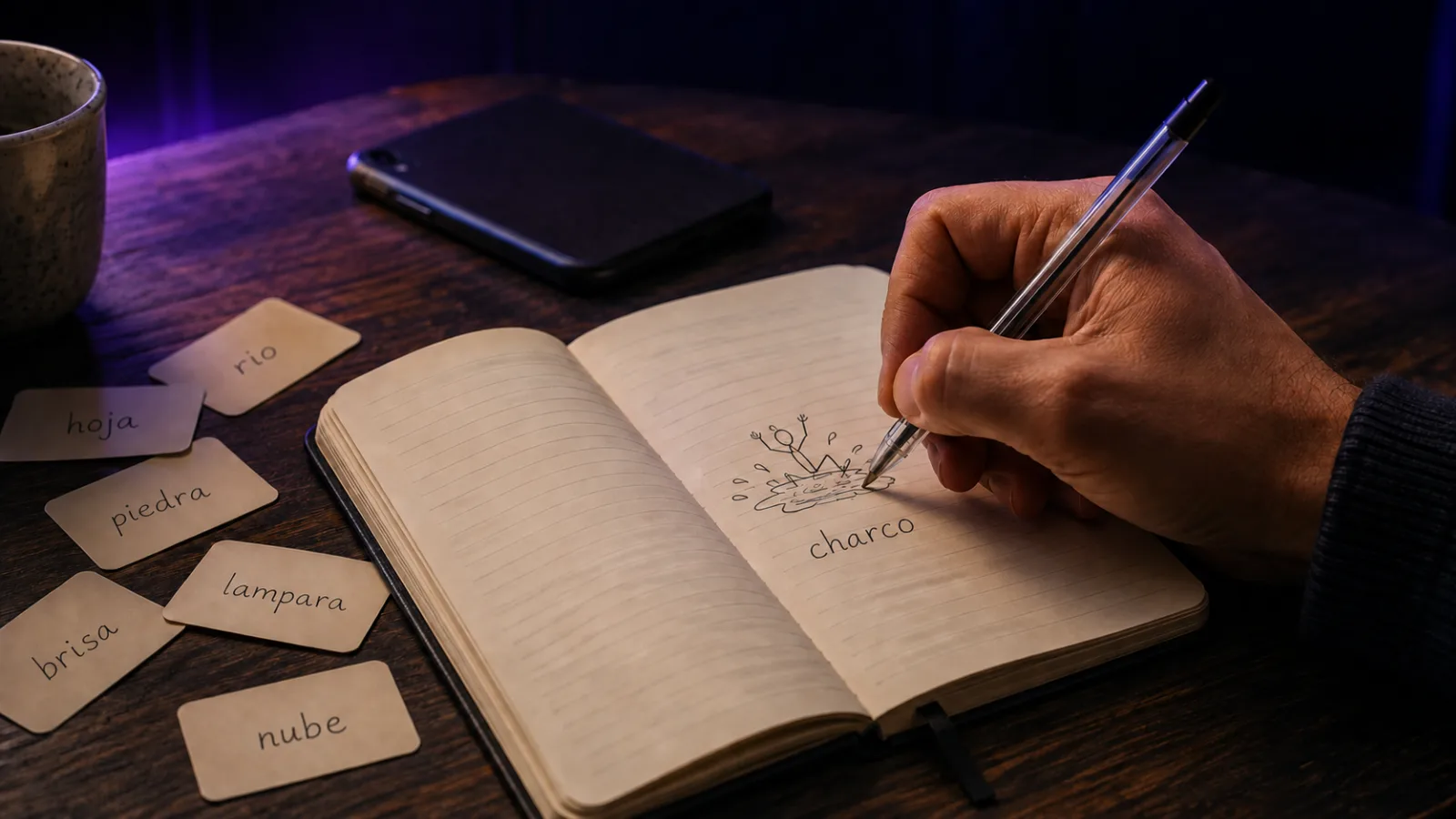
Some words refuse to stick no matter how often you review them. You open the card for the fifth time, honestly cannot recall the translation, and start to suspect your memory is the problem. Usually it isn't. The word simply has nothing to hold on to: it resembles nothing you know, connects to nothing you have, and hangs in empty space.
A mnemonic is a way of giving that word a handle artificially. Not to learn it, but to drag it past the first barrier, after which ordinary review keeps it in place.
How it works
Memory is bad at storing isolated facts and good at storing connections. A new word is an isolated fact: a set of sounds with a translation attached. A mnemonic adds two things memory can grip: a sound resemblance to something familiar and a picture.
It goes like this. You find a word or fragment in your own language that sounds like the foreign one. Then you invent a small scene where that familiar word meets the translation. Later, when you meet the foreign word, the sound-alike surfaces first, then the scene, then the meaning.
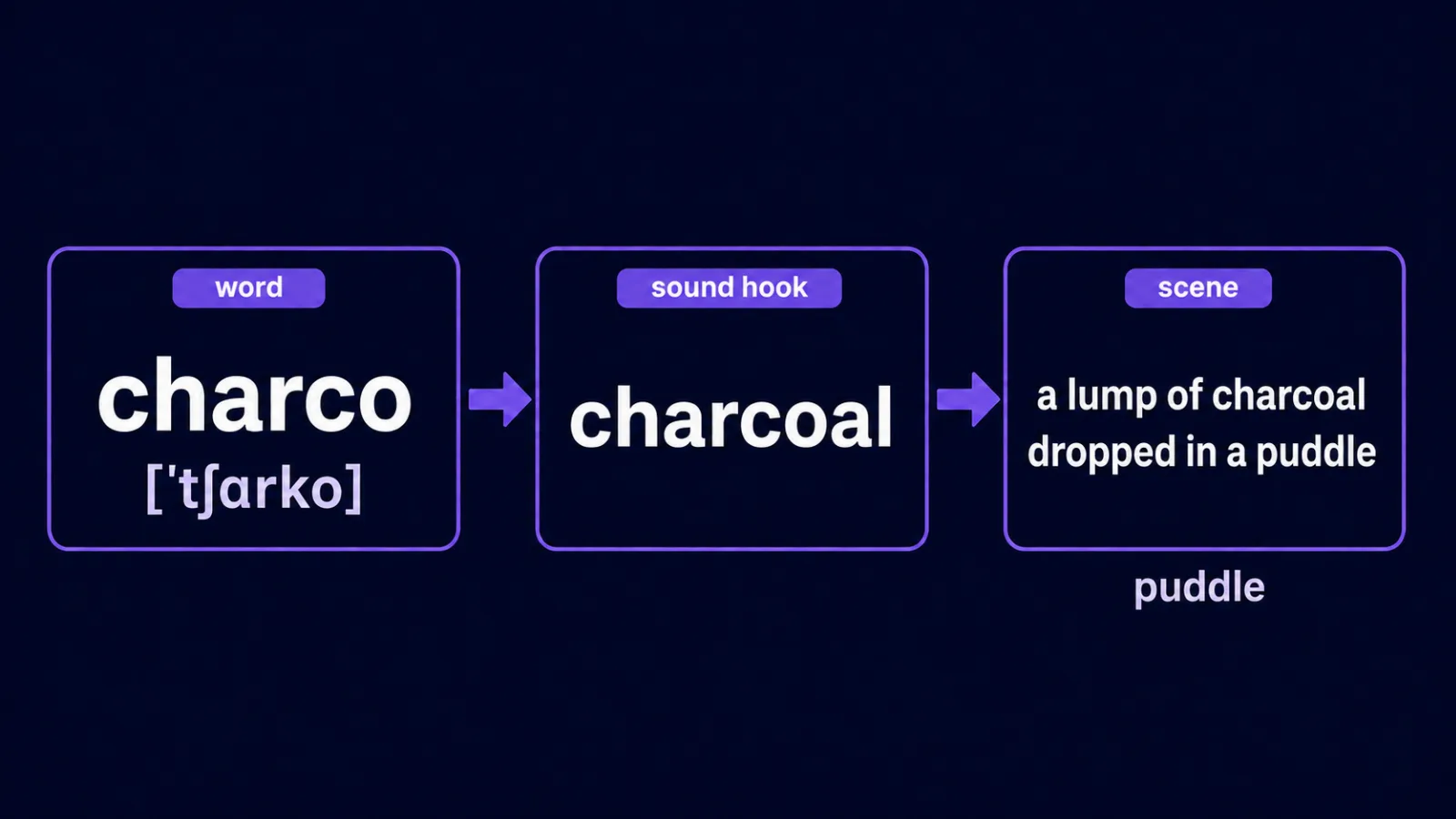
This is called the keyword method, and it is the main working technique for foreign vocabulary. Everything else is an add-on.
Three examples
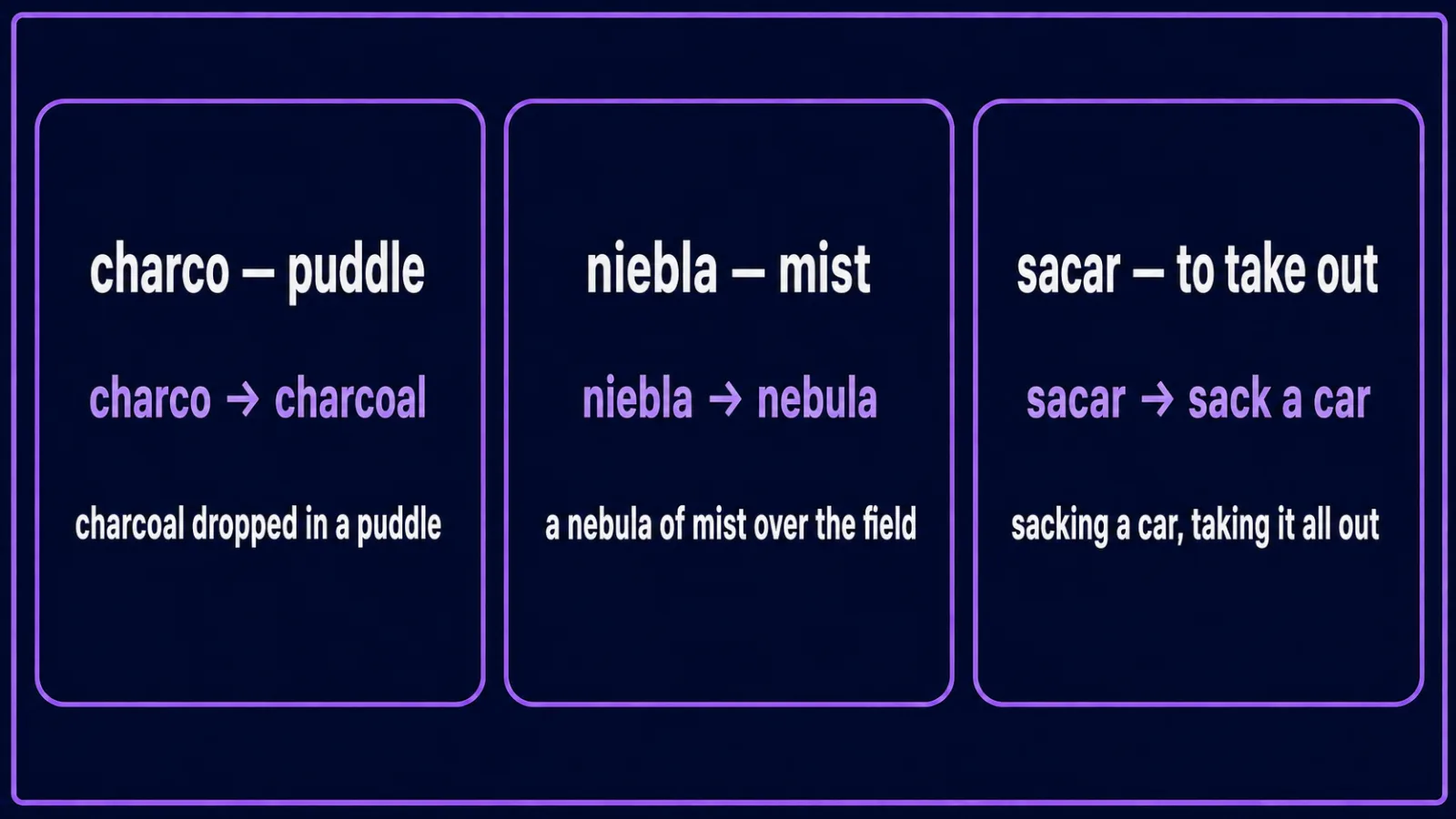
So you can see what a finished handle looks like:
| Word | Sound hook | Scene |
|---|---|---|
| charco [ˈtʃaɾko] — puddle | charcoal | A lump of charcoal dropped into a puddle |
| niebla [ˈnjeβla] — mist | nebula | A nebula of mist sitting over a field |
| sacar [saˈkaɾ] — to take out | sack a car | Sacking a car, taking everything out of it |
Notice the hooks are crooked. "Charco" is not "charcoal" and "sacar" is not "sack a car". That is fine: the hook does not have to be accurate, it has to be sufficient for memory to pull up the rest. Accuracy actually gets in the way, because chasing it costs time.
Four rules, without which it doesn't work
Invent them yourself. This is the most important and the most annoying part. Someone else's mnemonic barely works: you lack the associations it was built from, so you end up memorising both the word and a stranger's image. Ready-made lists of mnemonics are interesting to read and give you nothing.
The image has to be concrete. Not "something to do with falling", but a specific man in a specific coat slipping outside a specific doorway. Abstraction is not stored. A scene is.
Absurd beats sensible. A tidy logical link fades along with the word. A strange, exaggerated, slightly unpleasant one holds. This is not an aesthetic preference, it is how memory selects what to keep.
Twenty seconds, no more. If the handle does not appear in that time, the word goes into ordinary review without one. Half an hour hunting for the perfect image for a single word is not language learning, it is entertainment.
When you don't need a mnemonic
This is where people overdo it. Mnemonics are a tool for difficult words, not a mode of operation for your whole vocabulary.
Most words need no handle at all. Frequent words settle on their own: you meet them daily and the repetitions arrive without any images. Building a scene for porque or gente is wasted work, and it will actually slow you down, because every encounter now runs through an extra step.
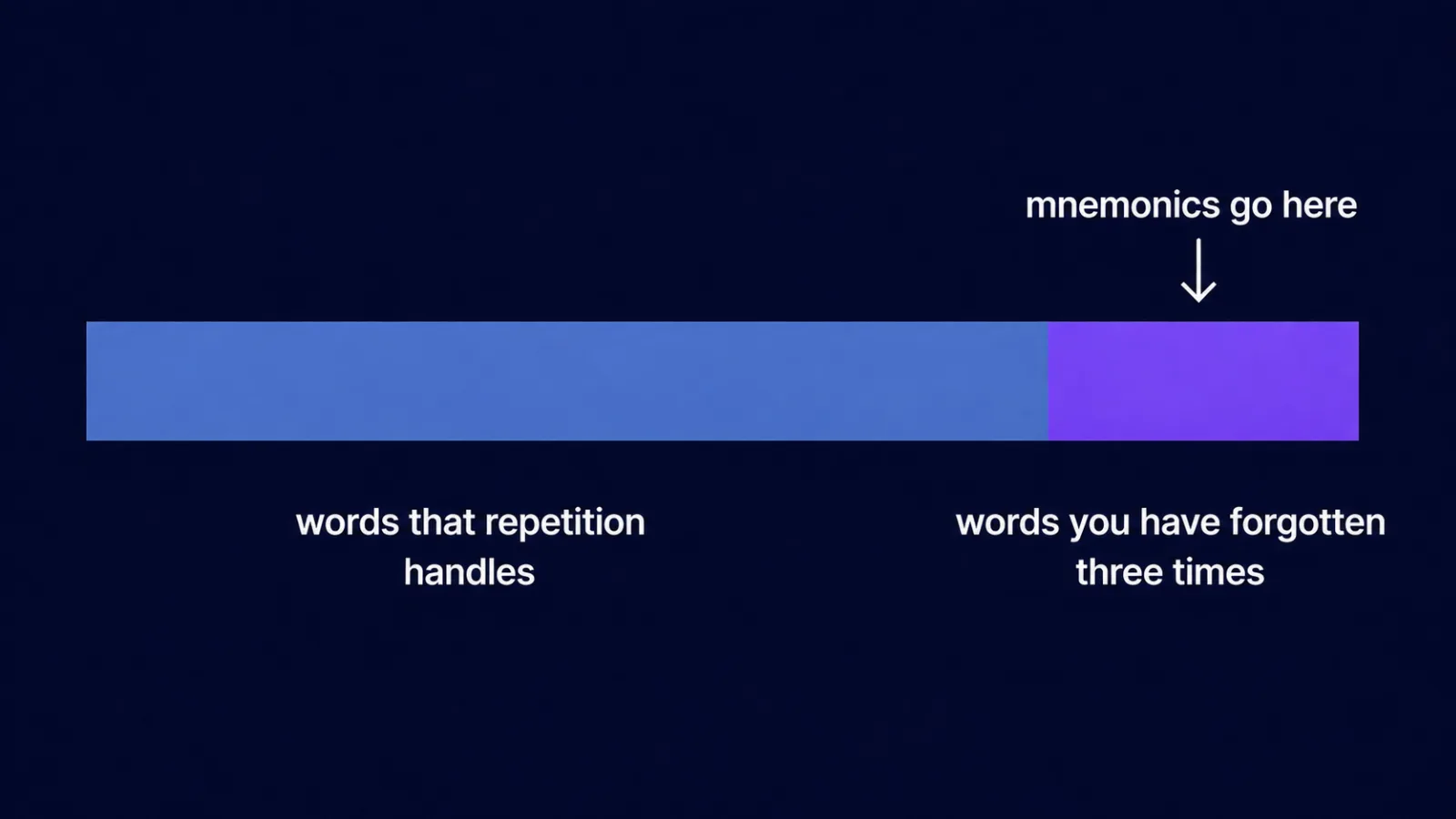
Handles are for words you have already forgotten several times. That is an honest criterion: do not invent mnemonics in advance, produce one when a word has failed review three times. There are usually not many such words, ten or fifteen percent of a vocabulary, and they are exactly the ones eating a disproportionate amount of effort.
The main limitation
A mnemonic gives you recognition, not fluency.
A word with a handle is recalled through a middleman: the hook surfaces, then the scene, then the meaning. That takes a second or two. Invisible while reading, a full pause in conversation.
So a mnemonic is a starting crutch, not a destination. The word still has to go through normal review, and as it settles the middleman falls away by itself. You stop thinking about charcoal and simply know that charco is a puddle. If that never happens, the word has just not been reviewed enough.
The practical conclusion: mnemonics do not replace a review schedule, they sit on top of one. How the schedule itself works is covered in the piece on the Leitner system.
What else exists besides the keyword method
Two techniques worth knowing, though they suit individual words less well.
The method of loci means placing what you memorise around the rooms of a familiar building and mentally walking the route. Good for sequences: shopping lists, ordered steps, a speech. Nearly useless for vocabulary, because words are needed in random order, not along a route.
Breaking the word apart is not strictly a mnemonic, but it works similarly and often better. If a familiar root or prefix is visible, no handle is needed: increíble comes apart into in + creíble, and there is nothing left to memorise. Before inventing an image, check whether the word takes itself apart.
What this looks like in practice
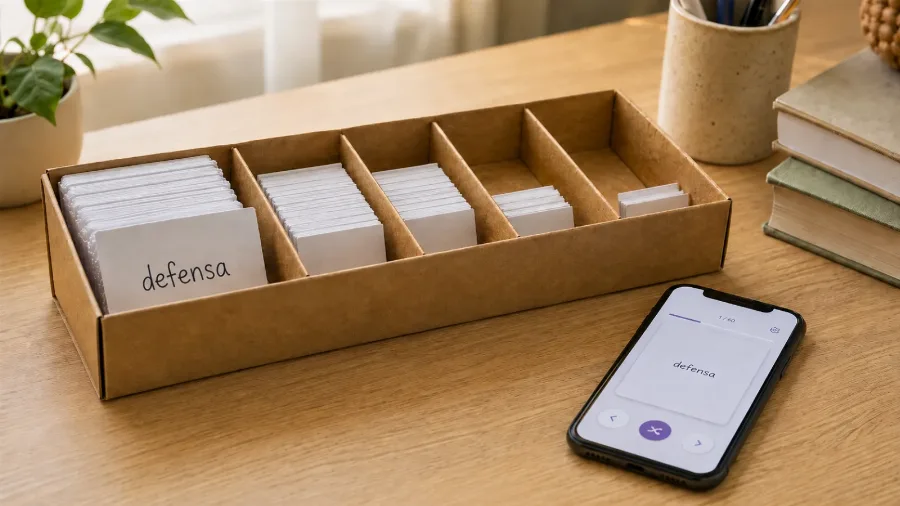
The working setup is this. You keep a vocabulary notebook and review it on a schedule. A word that fails three times in a row gets flagged, and you give it a handle in twenty seconds. You write the handle into the card itself, next to the translation, otherwise it will be forgotten before the word is. Then the word goes back into the normal cycle, and after a few successful passes the handle stops being necessary.
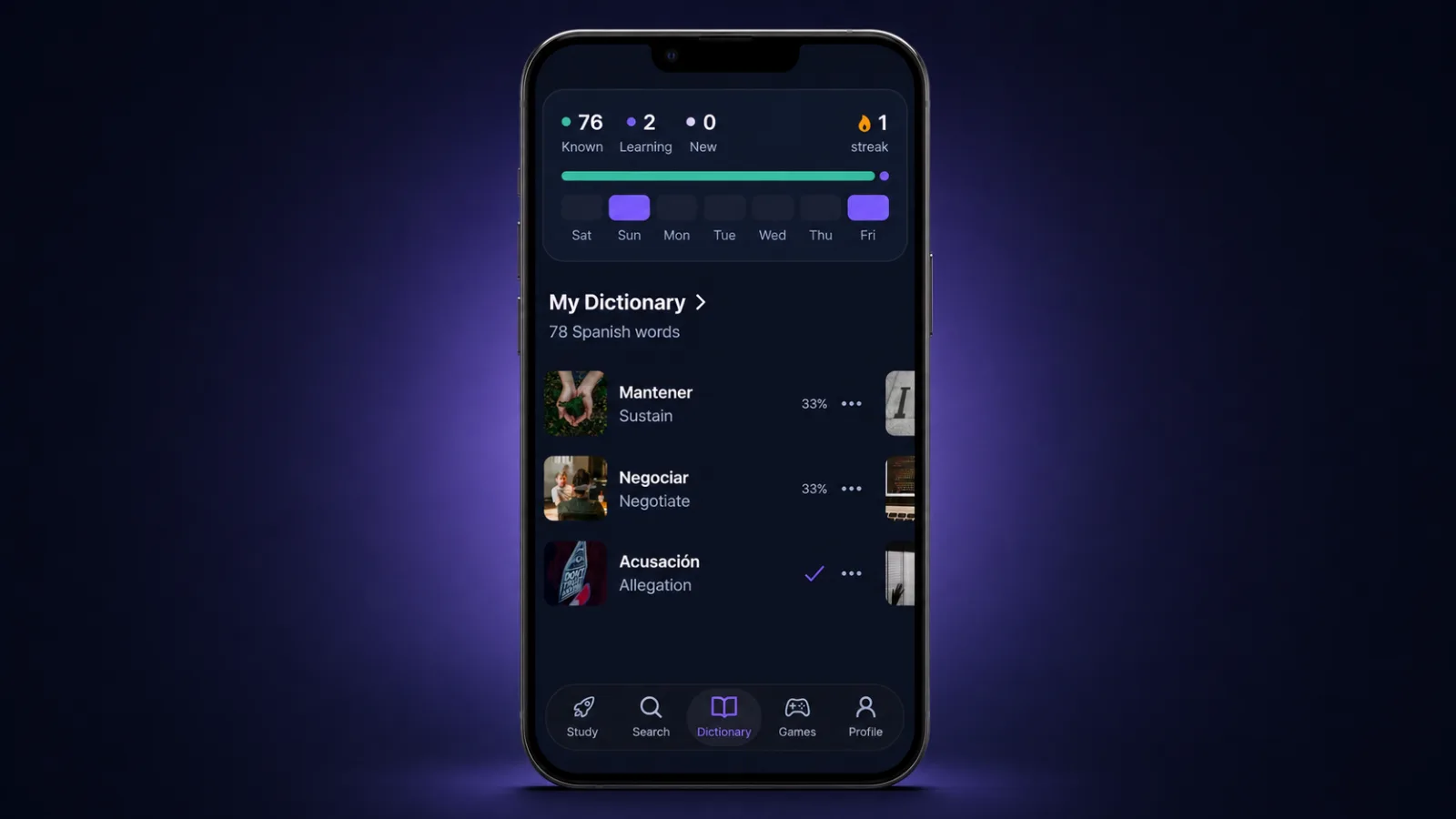
In VibeLing this maps onto the app almost unchanged: you add the words, the app schedules reviews from your answers, and the difficult words are visible by their mastery percentage in the dictionary. Nobody can invent the image for you, and that is precisely the step that cannot be automated. Everything around it can.
In short
- Mnemonics are not for every word, only for the ones you have already forgotten several times.
- The main technique is the keyword method: a sound-alike in your own language plus a concrete absurd scene.
- The hook does not have to be accurate, it has to be sufficient.
- Other people's mnemonics barely work. Invent your own.
- Nothing in twenty seconds? Leave the word to ordinary review.
- A handle gives recognition. Only repetition gives fluency.
If you would rather have the review schedule and the notes on difficult words living in one place instead of a notebook and your head, that is exactly what we built VibeLing for.