How to Review Words: Recall or Reread

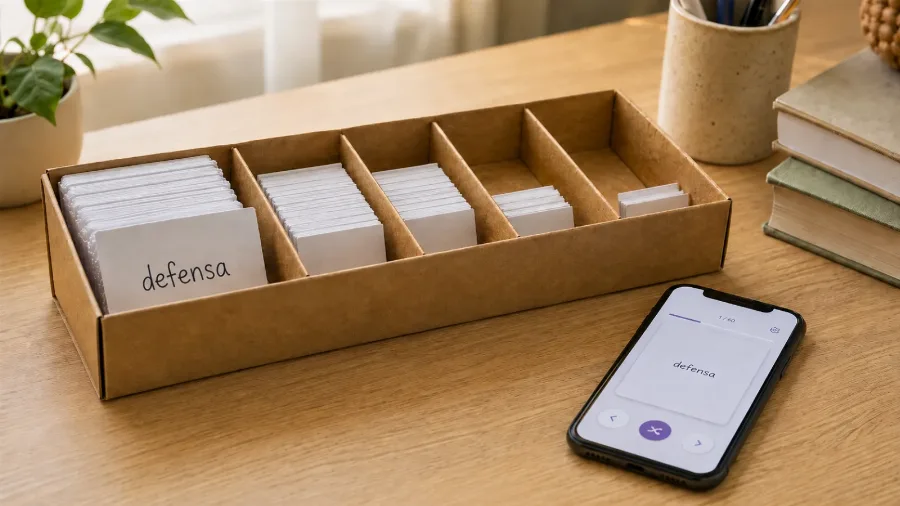
There are two ways to review vocabulary. The first: open the list and run your eyes down it, reading the word and the translation. The second: cover the translation, try to produce it yourself, and only then check. It looks like a small difference in technique, and the gap in results is large enough that you can leave almost everything else about your reviews alone.
The awkward part is that the feeling lies. Rereading feels productive; recalling feels painful and inefficient. It is exactly the other way round.
Why rereading fools you
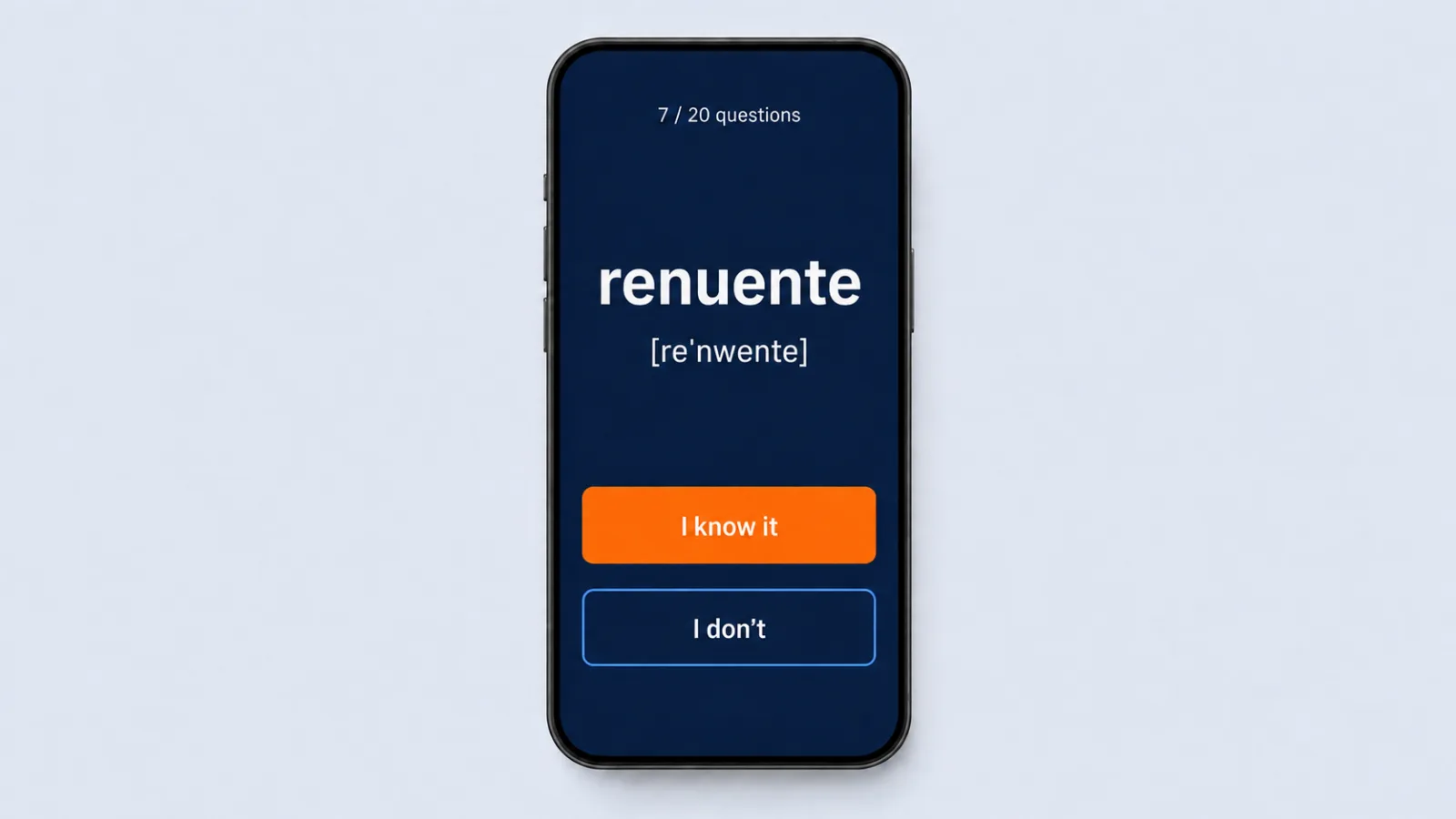
When you read renuente — reluctant for the second time, the text processes more easily than it did the first: familiar things read faster. Your brain takes that ease for knowledge. The sense of "I know this" comes out of reading fluency, not out of the word being available for retrieval.
The swap is easy to catch. Go through a list of twenty words twice in a row, close it and try to write the translations from memory. The gap between the feeling and the result is usually unpleasant.
What happens when you recall
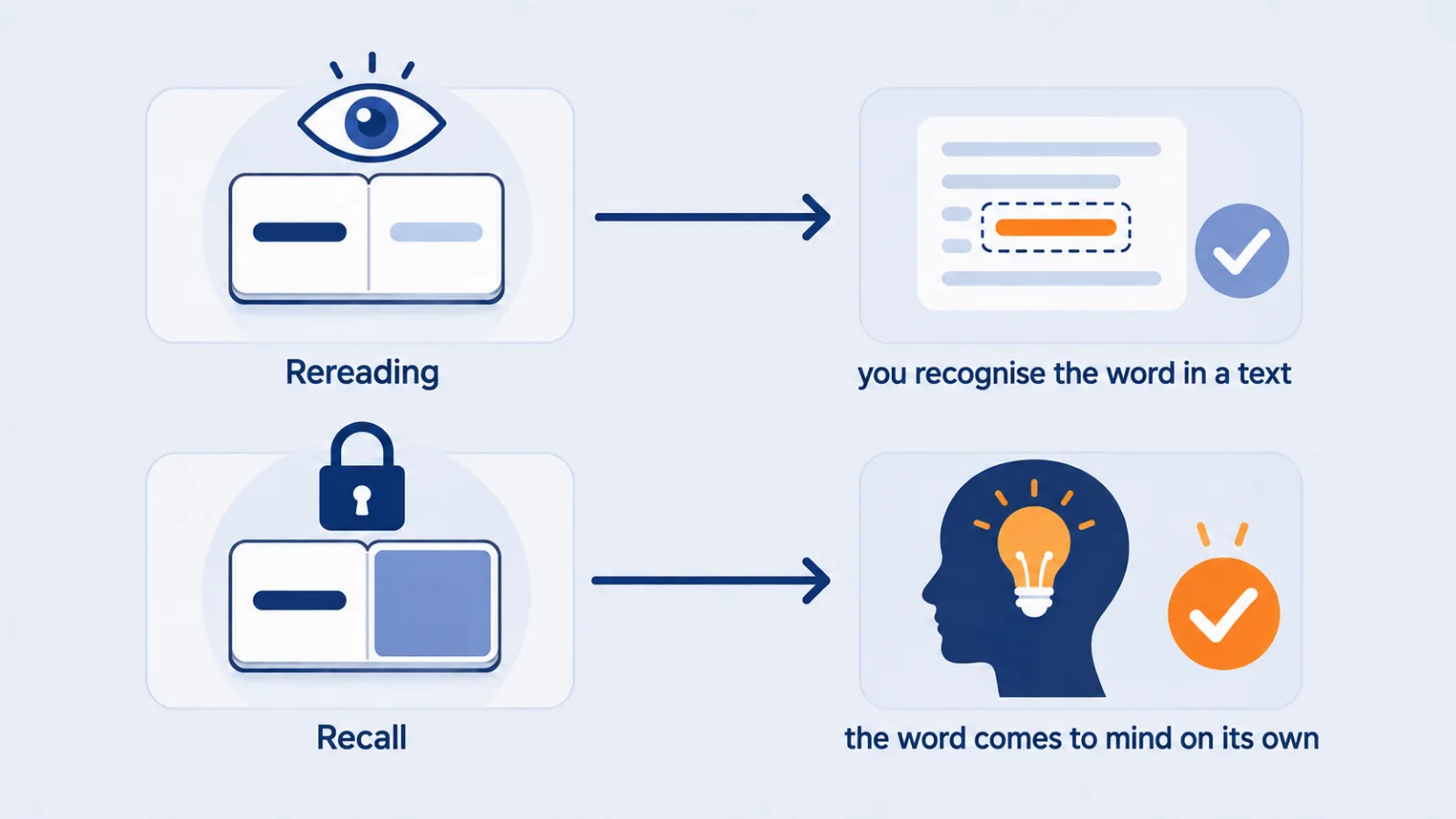
Trying to pull a word out of memory is not a test of knowledge, it is the learning itself. Every successful retrieval makes the next one easier and pushes the moment of forgetting further out. In memory research this is called the testing effect, and it is one of the most reproducible findings in the field: groups that quizzed themselves consistently beat groups that reread the same material for the same amount of time.
The mechanics are simple. Rereading strengthens recognition: you will confidently spot the word on a page. Recall strengthens retrieval: the word will arrive when you need to say it. These are different skills and they do not transfer to each other on their own. The same gap shows up in the piece on tracking your vocabulary progress: everyone recognises many times more words than they can actually use.
What it looks like in practice
The working routine for a single word:
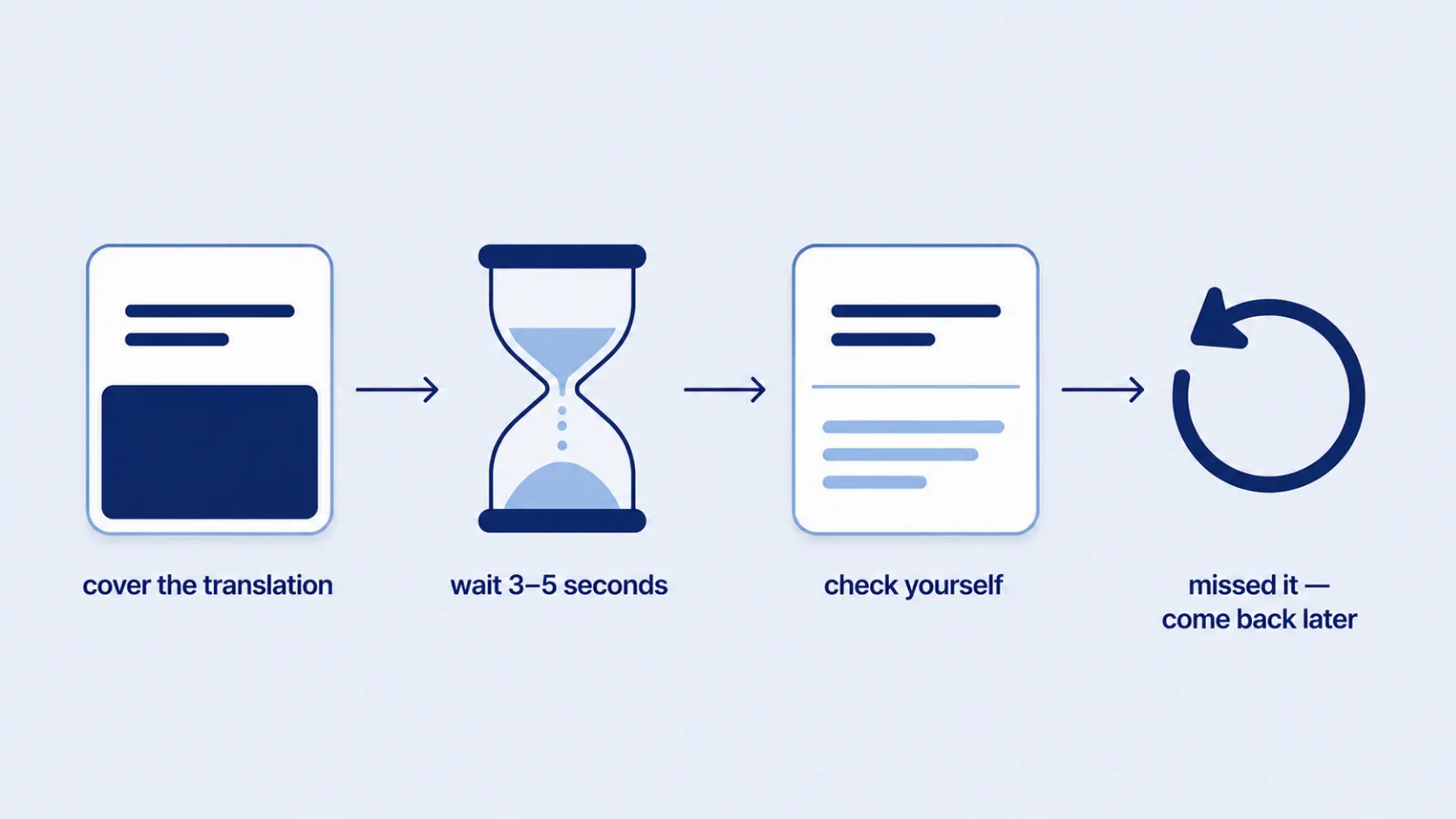
- Cover the translation. Look only at the word itself.
- Try to recall it — and give yourself three to five seconds, even when it feels hopeless.
- Uncover the answer and check.
- If you missed it, do not move on for good: come back to that word a few questions later.
Step two is the whole thing. Those few seconds of effort are the review; everything else only serves them. Peeking after half a second turns the exercise back into rereading.
Which direction to recall in
Direction changes both the difficulty and the payoff. Seeing renuente and recalling "reluctant" is easier: recognition of the form does the work. Seeing "reluctant" and producing renuente is harder — you are pulling the word out from nothing, exactly as in conversation.
| Direction | What it trains | When it helps more |
|---|---|---|
| Foreign → native | Recognition while reading and listening | The first meeting with a word |
| Native → foreign | Retrieval, which means speaking and writing | Everything after the first week |
A sensible order: while the word is new, go from foreign to native; as soon as it stops being a mystery, flip the direction and keep it that way.
A miss is more useful than it feels
The usual reaction is: I did not get it, so that was wasted time, I should have looked straight at the answer. In fact the failed attempt does work too: it marks out exactly what is missing, and an answer seen after honest effort lands better than an answer seen without it.
Which gives a practical rule: do not shorten the pause before checking, even when you are sure the word will not come. Sitting through those seconds is unpleasant — and that is the entire job.
When rereading is still the right move
Recall has an obvious limit: you can only retrieve what was in your head to begin with. On the first meeting with a word there is nothing to pull, and this is exactly where you should calmly read the translation, look at the examples, listen to the pronunciation. Rereading is a fine first step and a poor only strategy.
In practice that means one attentive introduction to the word, and recall from then on.
Recall and intervals are two different settings
They get mixed up, and they answer different questions. Intervals say when to come back to a word; recall is what you actually do once you are back. Either one alone works at half strength.
| Rereading | Recall | |
|---|---|---|
| All of it in one day | The worst case: easy and crammed at once | Hard, and almost nothing is left |
| On growing intervals | The sensation of studying, a weak trace | The thing all of this is for |
How the interval half is built is laid out in the article on the Leitner system — it also shows why a miss has to throw the word almost back to the start.
What to do about it
If you review from a list in your notes or a notebook, one change is enough: cover the second column. A sheet of paper, your palm, a page folded in half — the mechanism does not matter, what matters is that the translation does not reach your eyes before you have tried to recall it.
If an app handles your reviews, look at what it actually asks you to do. Choosing a translation out of four options is recognition with the answer on screen. Typing the word, building it from letters, saying it out loud or honestly answering yourself "I know it / I don't" before the answer appears — that is retrieval.
VibeLing is built around the second half: in the recall exercise the word is shown with no options, you answer yourself first and only then open the translation, and there is also building the word from letters, the missing word in a sentence, and speaking out loud into the microphone. You never rate difficulty by hand — the app infers it from how long you thought and where you slipped, and schedules the next showing itself. That is exactly the combination this whole article is about: effort at the moment of review, plus a well-chosen moment.