How to Track Your Vocabulary Progress
The app says: 812 words learned. It sounds solid right up until you try to tell someone in Spanish how your weekend went and stall on the third sentence. The counter keeps growing, the sense of progress does not, and it is hard to tell which one is lying.
The counter is. Or rather, it counts something other than what you think. Here is what to measure instead, and how to test yourself in an hour and come away with an honest number.
What the "words learned" counter actually counts
In almost any app, "learned" means one of two things: the word has been through a set number of reviews, or you tapped "I know this" on it. That is a record of your actions, not a description of your memory.
Between "I tapped I know this" and "I can say this" there is a lot of room:
- you may have recognised the word from a prompt that will not exist in a conversation;
- you may have recalled it inside a flashcard and not inside a live sentence;
- you may have marked it known on autopilot because you were rushing to clear the queue;
- the word may have held for three days and then vanished — but the counter already banked it forever.
The counter cannot subtract. It only adds, so the longer you use it, the further it drifts from reality.
First decide what "I know this word" means to you
Without that there is nothing to measure. Two different skills hide under the same phrase, and they are easy to confuse:
Recognition. You see or hear the word and you know what it means. That is enough for reading, for shows, for messages.
Production. You need the word right now, there is no prompt, and you pull it out of your head in a second or two. That is what a conversation demands.
Recognition always runs well ahead, and that is normal — it works the same way for native speakers. The problem is only that your app's counter reports recognition while the thing you actually want is the second one. If you are also trying to work out how many words you need in total, it is worth reading the breakdown of how many words you need to speak Spanish first — it covers exactly this gap between active and passive vocabulary.
The one-hour test: a hundred random words
This is the simplest honest measurement you can run on yourself. You need an hour and a sheet of paper.
1. Take a hundred random words from your own deck
Random, not "the ones I remember". If your deck holds a couple of thousand words, open the list and take every twentieth. If your app can show the whole deck, scroll and write them down without looking closely. The point is that your memory should not get to pick the sample.
2. First pass: recognition
Look at the Spanish word and say the meaning. Not "something to do with money" — the actual meaning. Mark a plus or a minus without peeking. Once you have gone through all hundred, count the pluses.
3. Second pass: production
Now reverse it: look at the English meaning and say the Spanish out loud. Out loud matters — silently, you always give yourself credit too generously. Allow yourself two or three seconds: if it does not come out in that window, it will not come out in a conversation either. Count those pluses separately.
4. Write down two numbers and the date
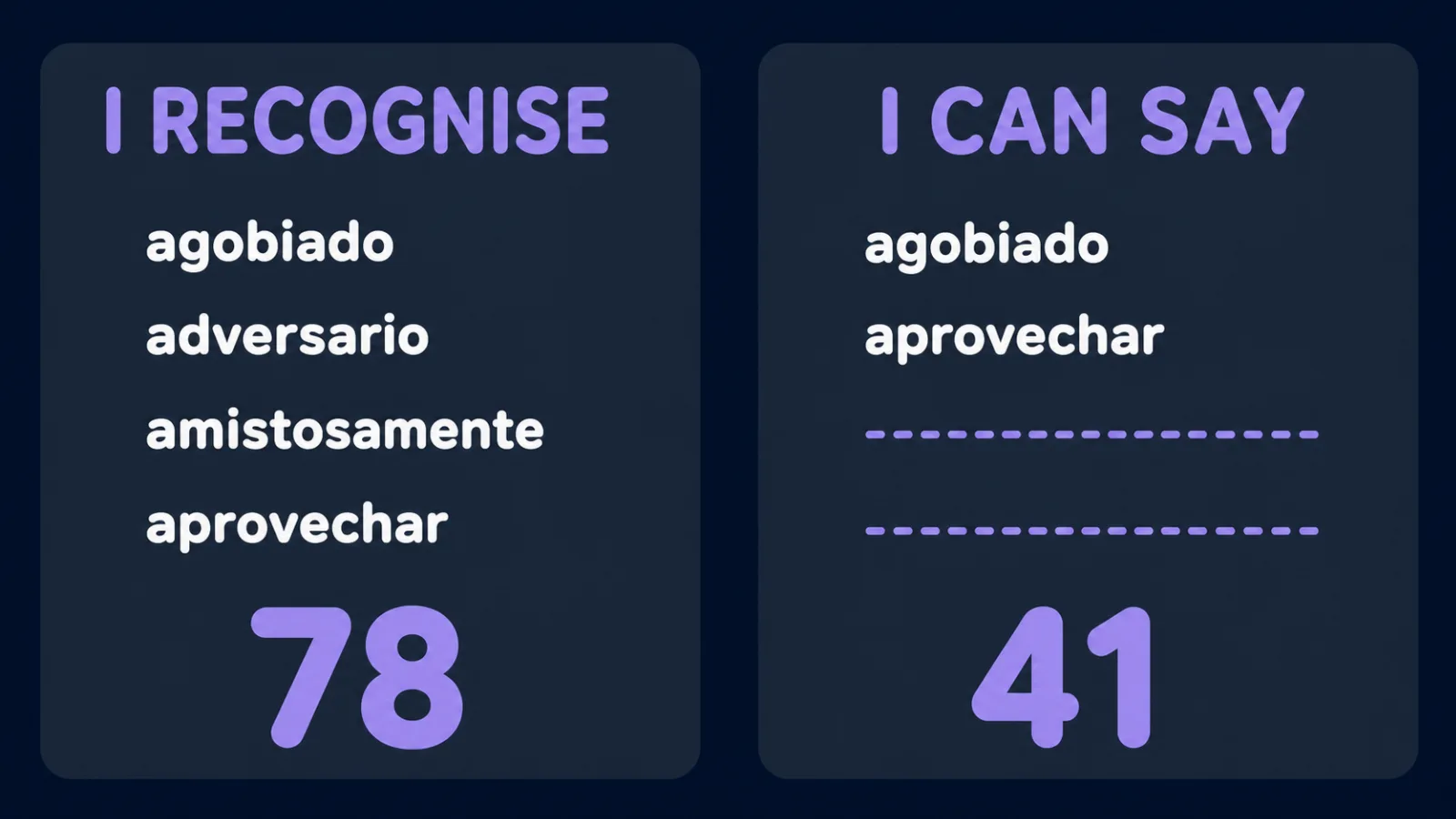
For example: 15 March, 78 and 41. That is your progress in human terms. A month later you run the same test and you see something better than a rising counter — you see growth in the part you actually use.
The first measurement is almost always unpleasant. That is good news: you are finally looking at the real picture instead of the one the statistics were painting.
Three numbers worth tracking
The test gives you three indicators. Do not add more, or measuring turns into a hobby of its own.
| Indicator | How to work it out | What it tells you |
|---|---|---|
| Active vocabulary | The share from the second pass, times the size of your deck | How many words you can actually say |
| The gap | First number minus second number | How far you are skewed towards recognition |
| Retention | The share from the first pass among words added more than two months ago | Whether what you learn stays or leaks |
Once a month is plenty, and once a quarter is calmer. Vocabulary changes slowly, and frequent measurements mostly capture noise and what kind of day you were having.
What to do with the result
A large gap — say 78 against 41 — means you have been training the easy direction the whole time. The fix is to flip the cards so that most reviews run from English to Spanish and you have to retrieve the word rather than recognise it. Your accuracy will drop immediately, which is the sign that the exercise has started working.
Low retention means words are going in faster than they are settling. Usually the culprit is not your memory but your intake rate and review schedule; there is a detailed piece on why new words disappear and how to fix it. As a rule, halving how many new words you add and leaving the intervals alone does the job.
Both numbers climbing slowly but together means everything is fine, carry on. Twenty or thirty extra usable words a month looks unimpressive and adds up to a very noticeable difference over a year.
What not to measure
Three metrics that look like progress and are not:
- Streak length. It measures your discipline, not your vocabulary. You can hold a streak for six months and stand still, if every day you are tapping buttons on autopilot.
- Time in the app. Twenty minutes of listless scrolling is worse than six minutes in which you genuinely tried to recall and got things wrong.
- Number of reviews. That is your cost, not your result. A word that needed thirty reviews is probably a word you do not need — better deleted than dragged along.
All three rise pleasantly, which is why they are so popular. None of them answers the question of whether speaking has got any easier.
Making the test part of the routine
The check does not have to be a special occasion. It only needs your deck to be personal and small enough to see: then a hundred random words take five minutes to collect instead of being fished out of somebody else's five-thousand-card pile.
That is roughly what VibeLing is built around: words land in it from whatever you actually ran into — a line from a show, a phrase from a message, something you looked up because you wanted to say it — and they stay there with the context you met them in. Reviews run in both directions, so the second number does not get ignored, and the app works out the intervals for you. A personal deck is also easy to audit: it is yours, and there are no thousand words in it that you never added.
In short
The words-learned counter measures actions, not memory. Real progress is two numbers you can get in an hour from a hundred random words: how many you recognise and how many you can say. Write them down with the date once a month or once a quarter, watch the gap between them, and stop mistaking streak length for progress.
Keep a personal deck, test yourself out loud, and compare yourself not with a counter but with yourself a month ago.