How to Learn Two Languages at Once

Learning two languages at once happens more often than it sounds. You move abroad and need the local language for daily life while still working on Spanish for your partner's family. You are preparing for an exam in one language and simply like the other. Or you already have some Spanish and want to add a second one for a trip. The question is usually not whether it is possible, but how to stop one language from eating the other.
I have been living in this situation for a few years: one language for work, Serbian for everything else, from the grocery store to the doctor's office. In that time I managed to make almost every mistake people write about in articles on learning two languages, plus a few of my own. Below is what came out of it and which rules actually hold up.
The main trap: one language grows on its own, the other stands still
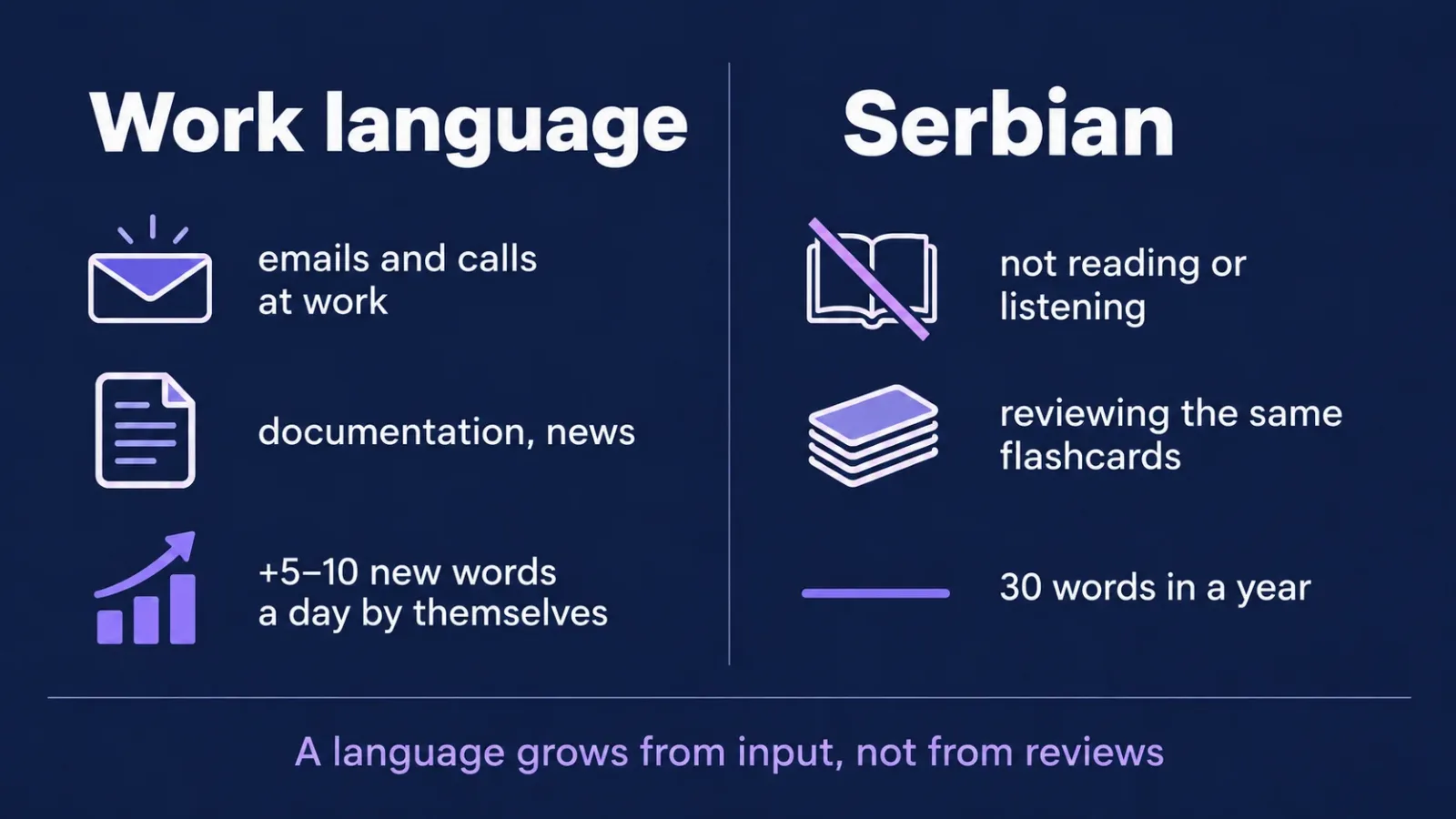
The first thing that happens when you study two languages in parallel is that they start moving at different speeds. The difference is not in how hard the language is and not in your motivation. The difference is where the words come from.
The language I use at work I read every day: emails, documentation, calls. New words arrive by themselves, I never have to look for them. Serbian I did not read or listen to for a long time. And my Serbian vocabulary sat at about thirty words for a year, even though I honestly reviewed my flashcards. There was simply nothing to review: I knew the words I had written down in the first month, and new ones had nowhere to come from.
That is the first conclusion worth accepting before any schedules and apps: a language grows from input, not from reviews. Reviews keep what has already arrived. If you read, watch and hear nothing in one of your languages, no review system will move it forward. There is more on how this works in the article on comprehensible input.
Rule 1. Each language gets its own place in the day
The most common mistake is splitting time evenly: "half an hour of Spanish, half an hour of Italian". It looks neat in a plan and falls apart in week two, because an hour for two languages after work is hard to find, and when the time does appear, it goes to whichever language feels easier that day.
What works is different: each language has its own place, not its own share. Spanish is your morning podcast on the commute. Serbian is the walk to the store and the queue at the bank. The place can be small, ten minutes. But it is guaranteed: you do not decide every day what to study, because circumstances have already decided for you.
If the second language has no such place in your life, you create one artificially: one podcast only in that language, one series only in that language, one channel on your phone. Not "more content in the language", but one specific source that you open at the same time every day.
Rule 2. Two languages at different levels are easier than two from scratch
Spanish at the level of "I read comfortably and speak with mistakes" and Serbian at the level of "I understand the cashier" is a convenient pair. One language no longer needs effort for input, it only needs practice with your active vocabulary. The other needs everything, but it is the only one that does.
Two languages from zero at the same time is hard, and not so much because of the volume as because of the mixing. Especially if the languages are close. Spanish and Italian get tangled so badly that after six months l'estate pops up instead of verano. Serbian and Russian get tangled differently: the similarity creates the illusion that "it's clear anyway", and the words just never get learned until you find yourself alone at a counter in a government office.
If both languages really do start from zero, separate them at least in time: two or three months of focus on one, then bring in the second. In three months the first language reaches a state where input and light reviews are enough, and it frees up your attention.

Rule 3. Words from different places do not get mixed up
Interference, when a word from one language jumps out instead of a word from the other, almost always happens with words that were learned the same way: from a list, at the same time, off identical flashcards. The brain has nothing to hold on to in order to tell one from the other.
Words tied to a situation do not get confused. If your Spanish factura comes from a client's email and your Serbian račun from a supermarket checkout, they mean the same thing but never compete, because they live in different places. That is why the second language especially needs words taken not from a frequency list but from the places you actually go with it. The three or four words you got stuck on today are worth more than twenty from a textbook: tomorrow you will be back in the same pharmacy, and they will repeat themselves.
Rule 4. Separate reviews, shared rhythm
This is where an app genuinely helps. Two languages means two independent dictionaries and two review queues, each with its own intervals. A Spanish word you have known for a year should come back once every few months; a Serbian word you added yesterday should come back tomorrow. Mixing them into one deck does not work: one language's queue crushes the other's.
The rhythm, though, is better kept shared. One short session a day, with the words of one language first and then the other, and both queues finite: 8 Spanish words and 5 Serbian words for today, and that is it. Finiteness matters more than volume. When the queue ends, you close the app feeling that the day is done, not guilty about what is left.
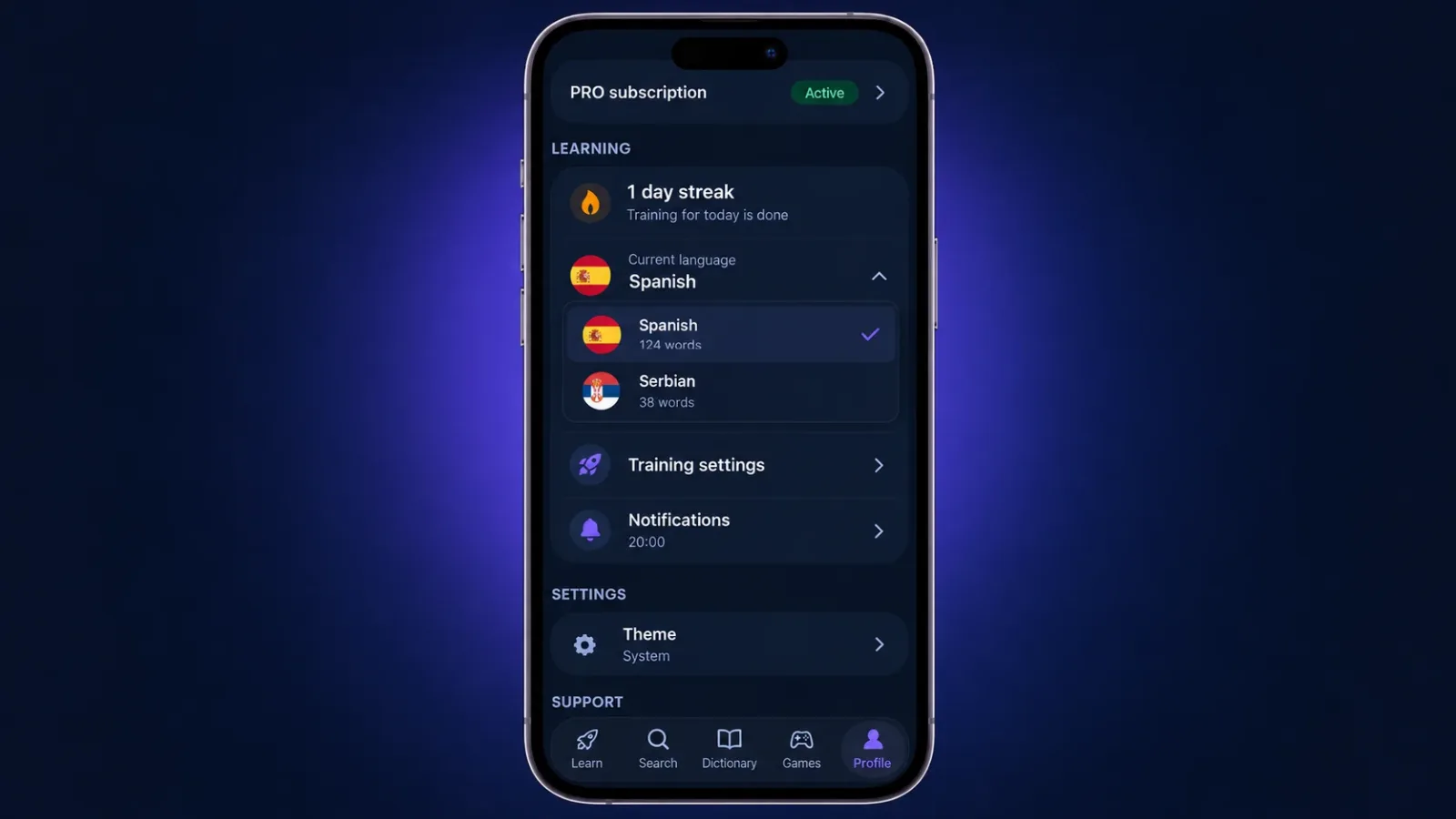
This is exactly how VibeLing is built. Each language you learn has its own dictionary and its own queue: you add a word from an email to Spanish and a word from the pharmacy to Serbian, and reviews for them are scheduled separately, by their own intervals and by how you answer. Switching languages takes one tap, and several languages at once are available in Pro. And there is no "start training" button: open the app and the first question is already on screen, answer your daily quota and the queue is over.
What a week with two languages looks like
As an example, here is the pattern that holds for me. It is not universal, but it shows the principle: different places, different roles, shared rhythm.
| When | Work language | Serbian (for daily life) |
|---|---|---|
| Morning, 10 minutes | Review the queue in the app | Review the queue in the app |
| Working day | Input arrives on its own: email, calls, docs. 1–2 unknown words from an email go into the dictionary | — |
| Commute, shops, errands | — | 3–4 words I got stuck on go into the dictionary. One Serbian podcast on the way |
| Evening, 5 minutes | Put two or three words from the dictionary into tomorrow's email | Say out loud what I will say tomorrow at the pharmacy or the bank |
| Weekend | Nothing on purpose | A series or a video in Serbian, 20–30 minutes |
Notice that almost no dedicated time goes to the work language: it lives inside the job. All the set-aside time goes to the second language, because it has nowhere else to get input. That is the honest split: not equal, but by need.
When two languages at once is a bad idea
Sometimes it is more honest to postpone the second language than to drag both along badly:
- There is a hard deadline for one of the languages: an exam, a job interview, a move in two months. The second language only takes attention away during that period.
- Both languages together get less than 15 minutes a day. One language survives on 15 minutes, two do not. Better one that grows than two that stand still.
- Both from scratch and both close (Spanish and Portuguese, Czech and Slovak). Wait until one reaches at least confident reading.
How long it takes to bring a language to a working level is covered separately in how long does it take to learn a language. With two languages those timelines do not add up, but they do not double either: the second language slows down by exactly as much input as it is missing.
In short
Two languages at once is fine if you keep four things in mind. A language grows from input, not reviews, so each language needs its own source. Each gets its own place in the day, not a share of the time. Words come from different situations, so they do not get mixed up. And reviews run separately, but in one short daily rhythm.
If you want to keep two dictionaries without them getting in each other's way, give VibeLing a try: separate dictionaries and queues for each language, words from real life instead of ready-made lists, and a finite daily quota after which the day counts as done.