How to Learn Spanish as an Adult Beginner
What stops most adults from starting Spanish is not memory or age — it is a bad starting setup. You pick a textbook written for a school schedule, install an app with leagues and rankings, and a month later the time is gone and you still cannot say anything. The idea that adults are too old for this is wrong: an adult has a better starting kit than a child. You know how to learn, you know why you want the language, and you can list in five minutes the situations where you actually need it. The real problem is different: you have very little time, so any plan shaped as "first cover everything, then speak" never survives to the end.
Here is what a start looks like when it has to fit a real schedule — work, family, thirty or forty minutes a day at best.
Zero is almost never zero
The first thing worth doing is an honest inventory of what you already have. An English speaker starting Spanish in 2026 usually recognises several hundred Spanish words without ever having studied them. Latin roots did the work, and so did menus, songs and travel.
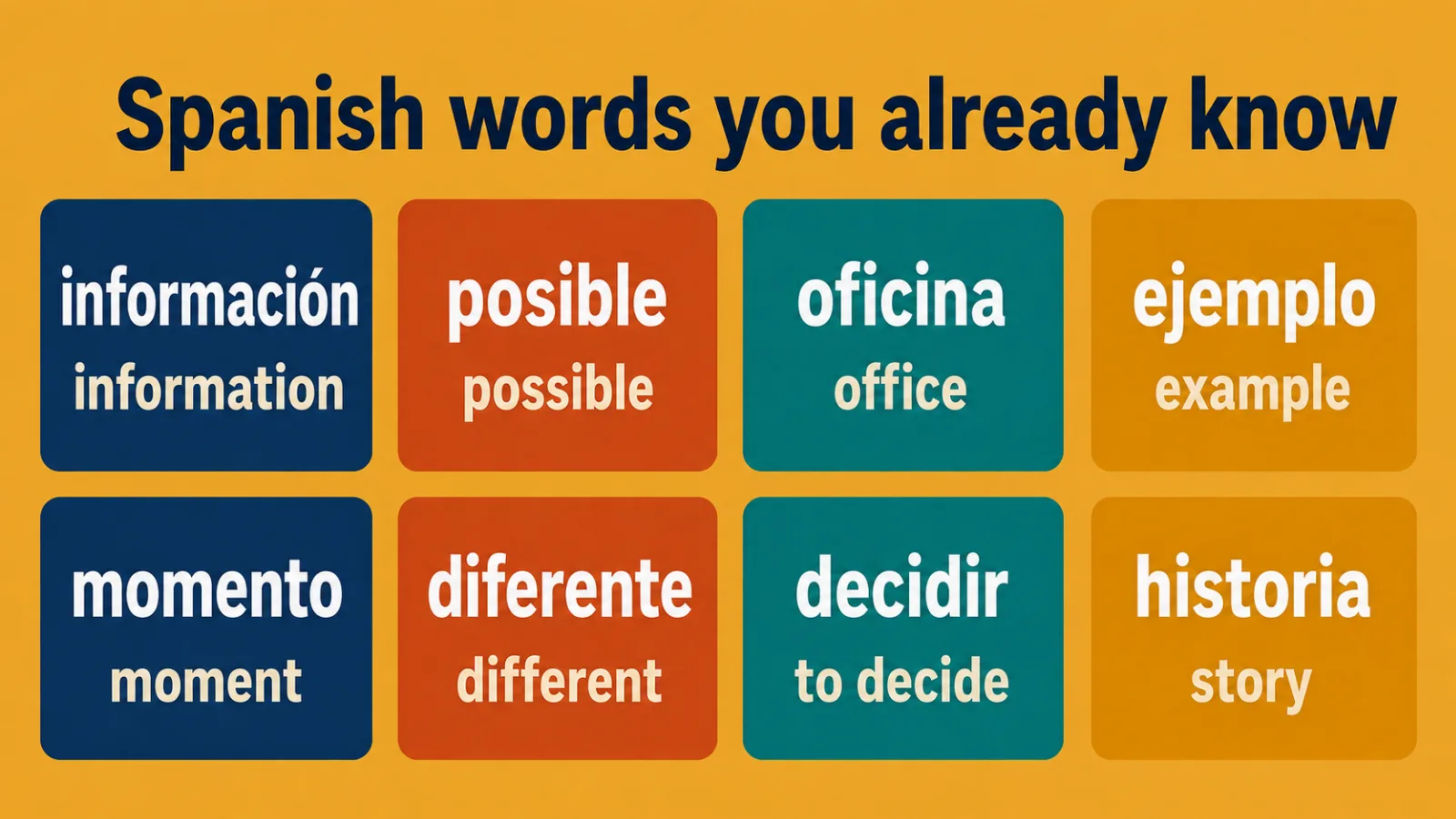
Take a sheet of paper and spend ten minutes writing down everything Spanish you can recall without a dictionary: información, posible, oficina, ejemplo, momento, diferente, decidir, historia. Most people end up with 100 to 300 items. That is not a working vocabulary — you recognise these words but do not produce them or use them in your own sentences. Still, you are not starting from nothing, and that changes the plan: the first weeks go into turning what you already half-know into something you can say, not into learning anything at all.
Three things in the first month, not ten
The classic adult mistake is trying to cover everything at once: pronunciation, grammar, all the tenses, a thousand words, shows without subtitles. The energy runs out in two weeks. In the first month it makes sense to do exactly three things.
- Sort out sounds and reading. Spanish is kind here — spelling maps to pronunciation almost perfectly, so a week of ten-minute sessions gets you to the point where you can read an unfamiliar word out loud and be roughly right. Without that, everything else is learned blind.
- Collect the first 300–500 frequent words. Not themed lists of animals and colours, but the words ordinary speech is made of: to do, to need, still, already, to try, to decide, to ask, to find.
- Collect simple constructions whole. Necesito, me gustaría, ¿puedes…?, ¿cuánto cuesta?, estoy buscando. These are ready-made joints you plug words into later.
Everything else — the past tenses, the subjunctive, ser versus estar in its full glory, idioms — waits comfortably for month two or three and goes faster once there is something to attach it to.
How much time a day this takes
The realistic minimum that produces visible movement is 15–20 minutes a day, every day. Not two hours on Sunday: a language runs on contact frequency, not on total hours. If weekdays only give you ten minutes, that works too, just slower. We went through how long it actually takes to learn a language in detail, and the conclusion there is the same: a predictable schedule beats a long session.
A practical shape for an adult is to split the day into two short blocks: 10 minutes in the morning for reviewing words already in progress, 10 minutes in the evening for new ones. The morning block matters more — it is what stops what you learned from quietly falling apart.
Which words to take first
There are two sources worth using here, and you should mix them.
Frequency lists. The first thousand most common Spanish words cover most of ordinary text and conversation. It is dull material and the highest-return material you will find at the start — we looked at what a thousand frequent words really buys you and where that runs out.
Your own words. The ones you personally need: the vocabulary of your job, the topics you talk about every day in English, words from the show you are watching. These stick far better because they have a place in your life.
Roughly two to one in favour of frequency words in the first month, and the reverse by the third: the further you go, the more the personal vocabulary matters, because the general words are already in.
How to review so the words do not fall apart
A word you learned lives a few days if you never come back to it. That is memory working normally, not a personal defect. The fix is a schedule: the word comes back the next day, then three days later, then a week, then two — each time closer to the edge of forgetting.
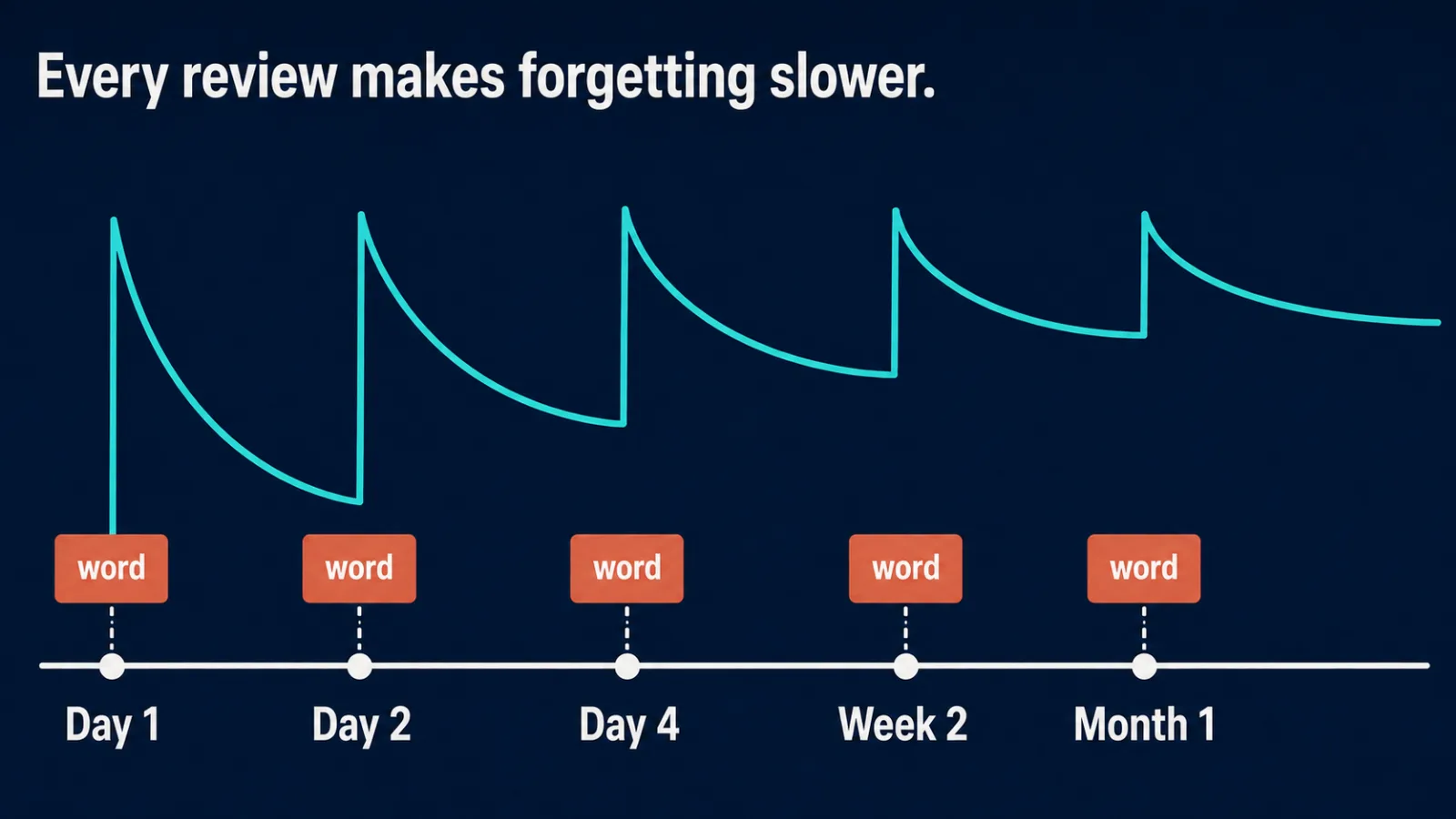
The form of the review matters as much as the frequency. Re-reading a list gives you almost nothing: your eye slides across it, a feeling of recognition appears, and then the word is missing when you try to speak. What works is attempting to recall: you pull the translation out of your head first and only then check yourself. That is why self-check cards and multiple-choice drills beat reading a notebook.
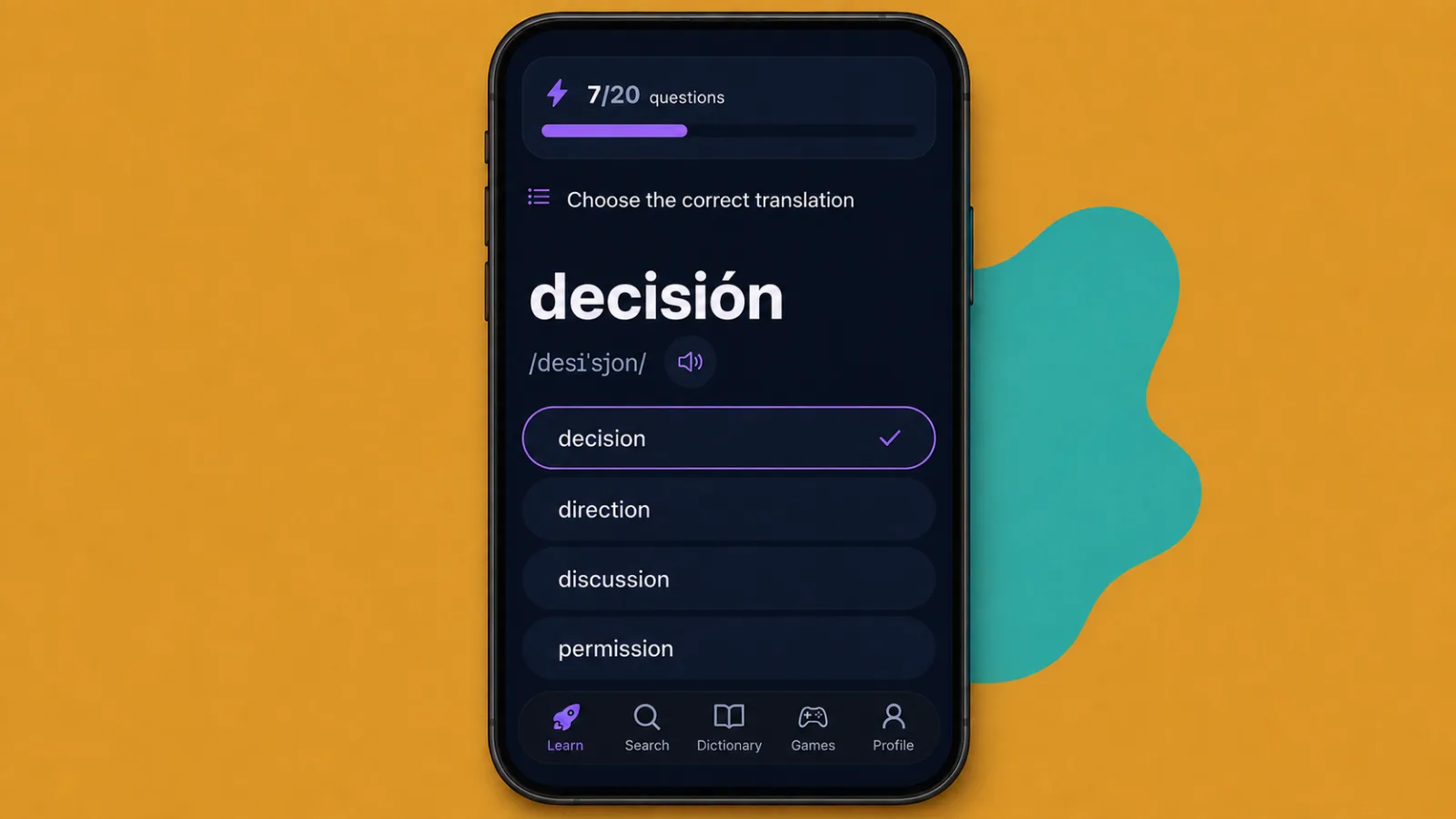
For an adult it is easier to hang this on an app than to count intervals by hand. In VibeLing a word goes into your personal dictionary with one tap — from search, from the daily set, or straight from the show you are watching — and then the app decides which day to bring it back and runs it through different modes: choosing the translation, recall with self-check, the missing word in a sentence, building it letter by letter, and saying it out loud with speech recognition. The daily queue is finite: when the words run out, the session is over, which matters more to someone with a schedule than an endless feed of exercises.
How much grammar you need at the start
Less than people think, but not zero. For the first months four things are enough: the present tense, the simple past (preterite), ir a + infinitive for the future, and word order in questions. With that set you can talk about yourself, about what happened yesterday, and about your plans — which covers almost every everyday conversation.
The subjunctive, the compound tenses and the finer points of por versus para are better left alone at the start. They give little in speech and plenty of opportunities to feel incapable, and that feeling is what usually ends language learning for adults.
Speak from the first week, not from B1
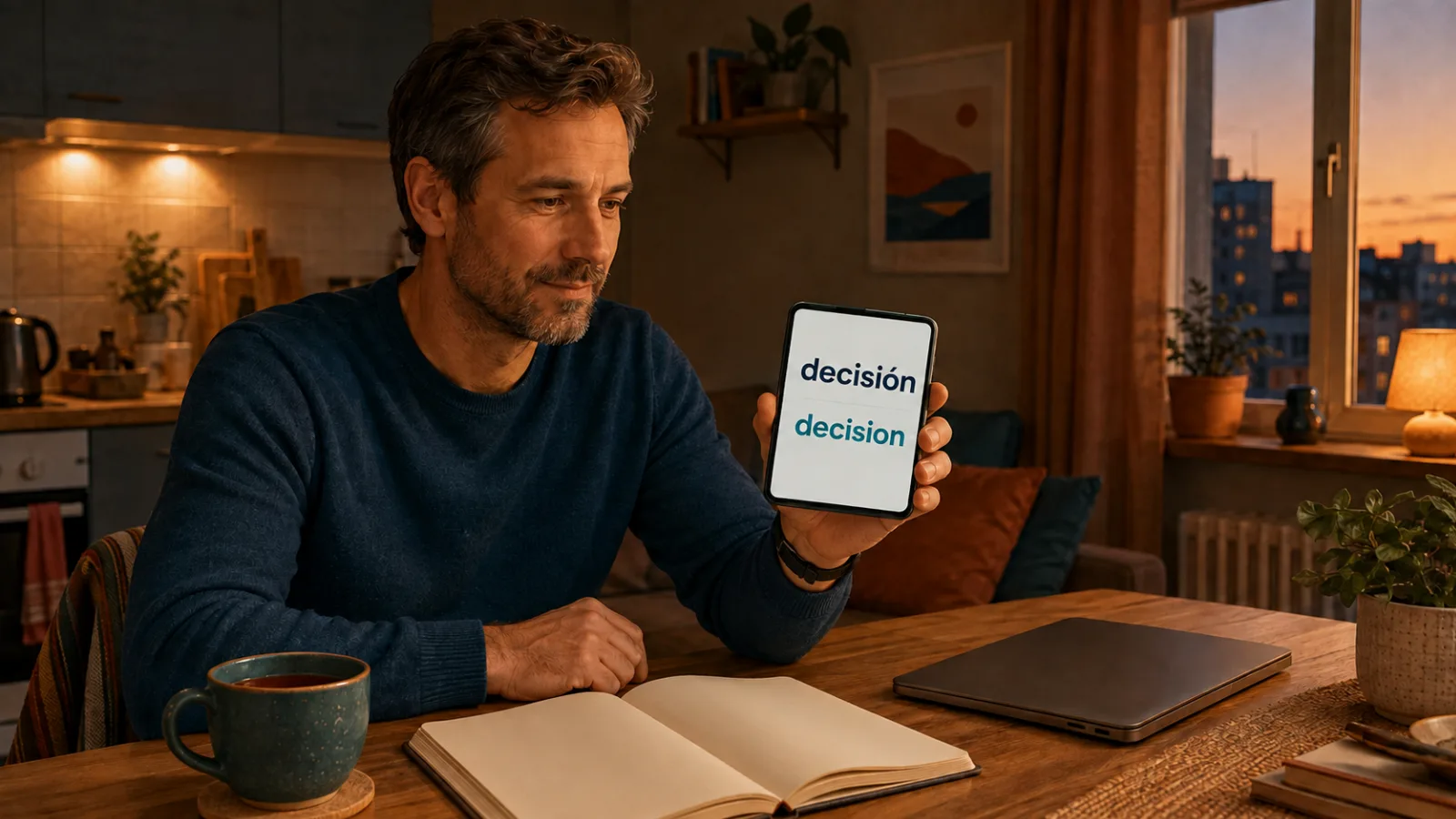
Waiting until you have "enough" level is pointless: speaking is a separate skill and it does not appear on its own out of reading and listening. Start with the simplest version — say out loud what you are learning. You see decisión: say not just the word but a phrase around it, necesito tomar una decisión. Three or four sentences like that a day do more than an hour of silent reading.
A useful five-minute exercise: take something that happened today and try to describe it out loud in Spanish, with whatever words you have. The places where you get stuck are your next word list.
After a month or two you add another person: a language exchange, a cheap tutor once a week, a conversation group. But talking to yourself can start on day one, and it noticeably speeds up the moment when speaking stops being frightening.
A plan for the first eight weeks
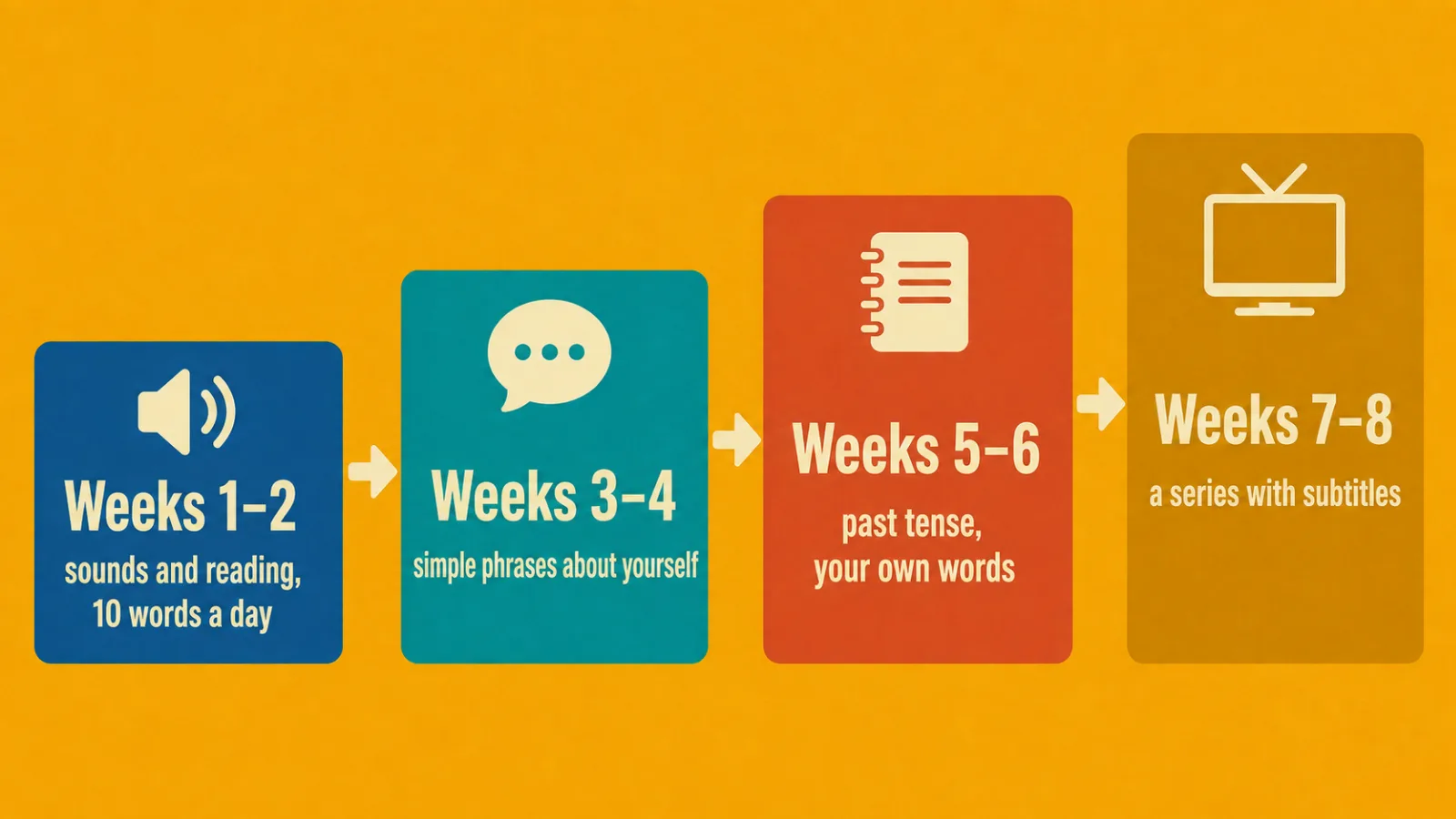
| Weeks | Words | What else | Result |
|---|---|---|---|
| 1–2 | 10 new words a day from a frequency list | Reading and sounds, audio on every word | You read an unfamiliar word out loud roughly right |
| 3–4 | 10–15 a day, your own words added | Present tense, question word order | You put together simple sentences about yourself |
| 5–6 | 15 a day, half from personal sources | Preterite, constructions with an infinitive | You tell someone what happened yesterday |
| 7–8 | 15–20 a day | First series with Spanish subtitles, words caught on the fly | 350–600 words in active use, simple speech on familiar topics understood |
The numbers are approximate: 10 words a day is a normal pace for someone with a job and a family, and 30 is a way to quit in three weeks. Better to hold the lower bound and not skip days.
What adults do that is unnecessary
- Starting with a grammar book cover to cover. By the time speaking comes up, the motivation is already spent.
- Waiting for perfect pronunciation. An accent does not stop people understanding you; missing words do.
- Measuring progress in time. "I've been studying three months" means nothing; what means something is the words you can pull out of memory and the sentences you have already said.
- Switching between apps. Each new one resets the review history you built, and the words start being learned from scratch.
- Learning words without context. An isolated word from a list has to be assembled into a phrase on the spot; a word learned inside a phrase arrives already assembled.
Where to start today
Write down twenty words you personally need: what you do at work, what you talk about most often. Add the first hundred frequency words to them. Put 15 minutes a day in your calendar rather than in your intentions. And set up one place where those words live and from which they come back to you for review — an app for learning Spanish words handles that part on its own: save a word, get the translation, the pronunciation, the audio and examples, then meet it again exactly when you have almost forgotten it.
Age has almost no effect on how fast you memorise words. What has an effect is how many days in a row you come back to them.