Which Language Should You Learn in 2026?
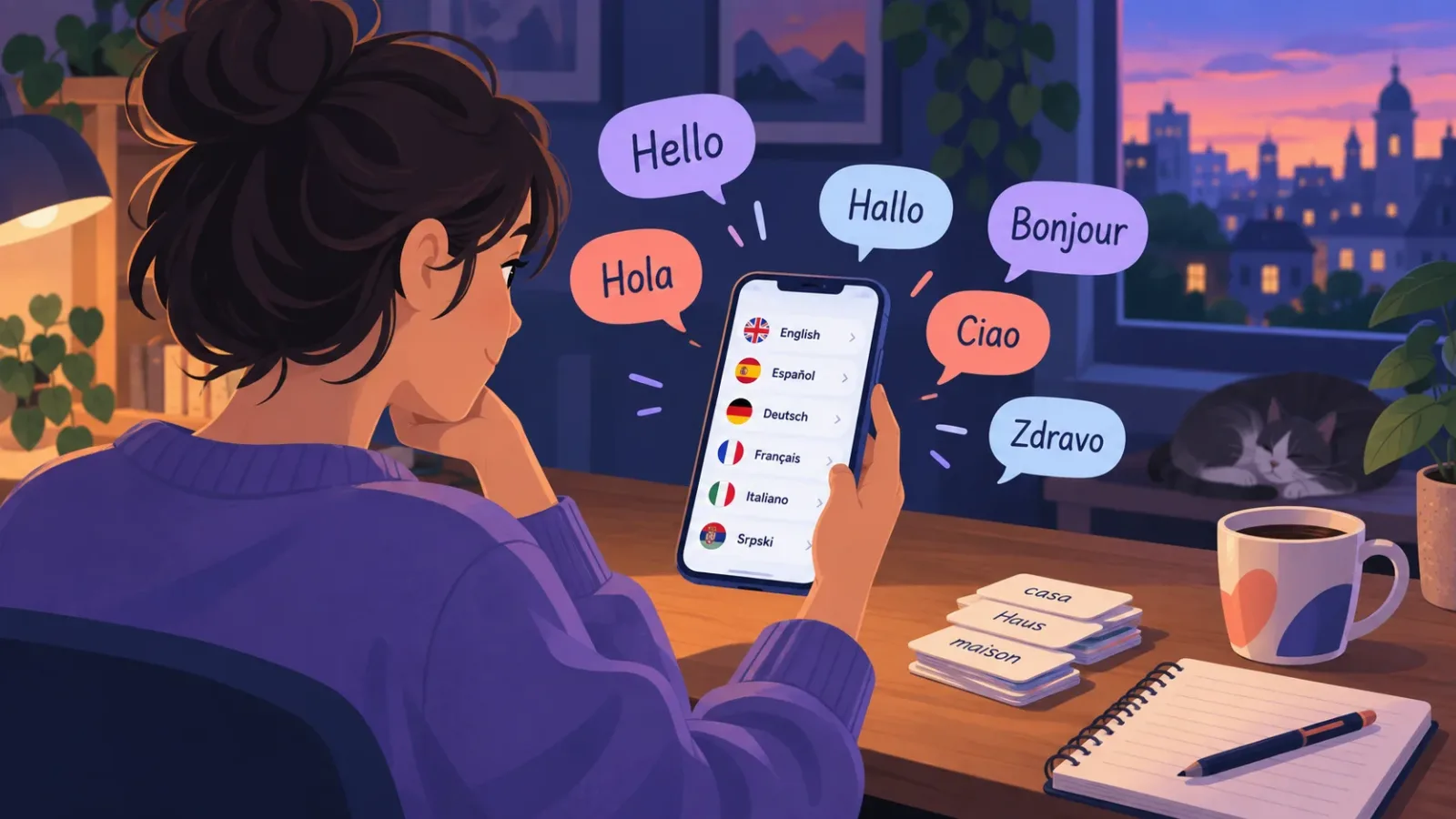
People usually ask "which language should I learn" as if there were one right answer for everyone. Lists of "the most useful languages" happily provide it: Spanish, Mandarin, German, French. The trouble is that a list like that says nothing about you. A language that is "useful in general" turns, three months later, into an app you stopped opening, because you never actually needed it for anything.
I live in Serbia. English is for work, Serbian is for everything else: rent, the clinic, a chat with the neighbour. I also tried Turkish, because I used to travel there a lot, and it is the only one of the three that never took. Not because it is harder. The trips ended, and the reason ended with them. So what follows is not a ranking of languages but a way to pick yours, so that a year from now you actually have it instead of one more abandoned project.
Three questions that decide everything
Before you compare languages with each other, answer three questions about yourself. They matter more than any ranking.
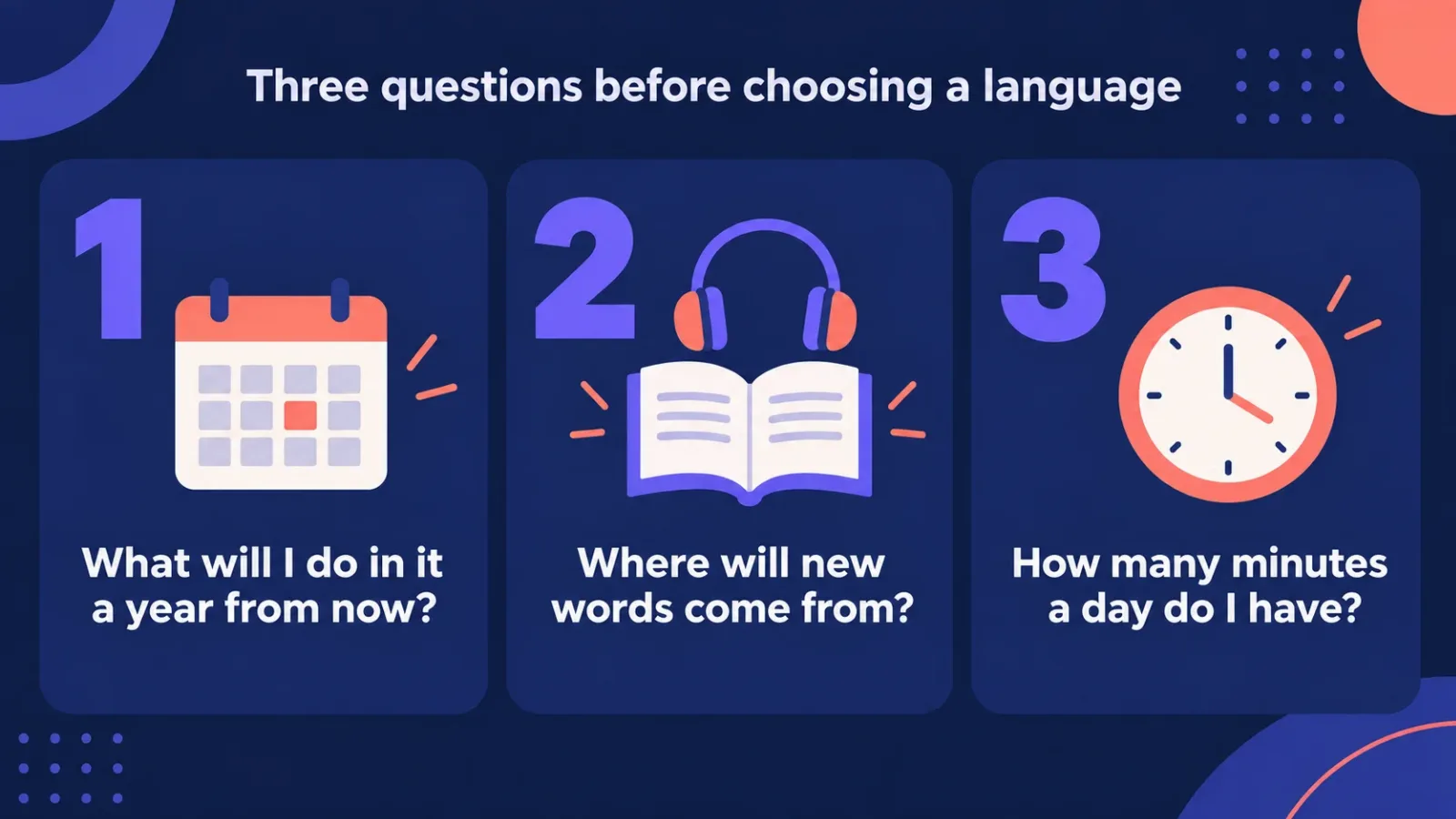
1. What will you do in this language a year from now?
Not "why is it useful in principle", but a concrete action: pass a job interview, read documentation, talk to relatives, order food on holiday, watch a series without subtitles. If nothing comes to mind within a minute, there is probably no real reason yet. That does not forbid learning a language "for yourself", and an honest "for myself" counts too: it means you need a language with a lot of content you enjoy, not one with a big economy.
2. Where will new words come from?
A language grows from input: from what you read, listen to and hear around you. For a second language you have to choose that source on purpose. Are there series in it you will genuinely watch? Podcasts on your topic? People you will talk to at least once a week? If the answer is "no" on every count, the language will stall no matter how many flashcards you review. I went through this in the article on learning two languages at once: one language grew from emails and calls, the other sat at thirty words for a year because there was nowhere for new words to come from.
3. How much time can you give it every day?
Not in your best week, in a normal one. Fifteen minutes a day that are always there beat two hours on Sundays that happen every other week. The honest answer also affects the choice of language: one close to English, or to a language you already know, gives you first results faster, while a distant one needs time before you understand anything at all by ear. There is a separate article on how long it actually takes.
If it is your first foreign language, Spanish is the safe default
For an English speaker starting from zero, Spanish is hard to argue with. It is spoken across two continents, its spelling is almost phonetic, thousands of words look like their English cousins, and the amount of series, music and podcasts is practically unlimited. The cheapest input of any language: you will run into Spanish even if you do not look for it, from Netflix to the menu at the taqueria.
The common mistake here is different: someone "took Spanish in high school", assumes they sort of have it, and starts Italian. Then it turns out they cannot string two sentences together in a restaurant in Madrid. If in doubt, test yourself the simple way: open any article in Spanish about your job and read a paragraph aloud. If every third word is unfamiliar, the second language can wait.
If you already have one language: languages by goal
From here on there is a real choice, and it depends on the first question. Below is not a ranking but a match between typical goals and the languages that fit them best.
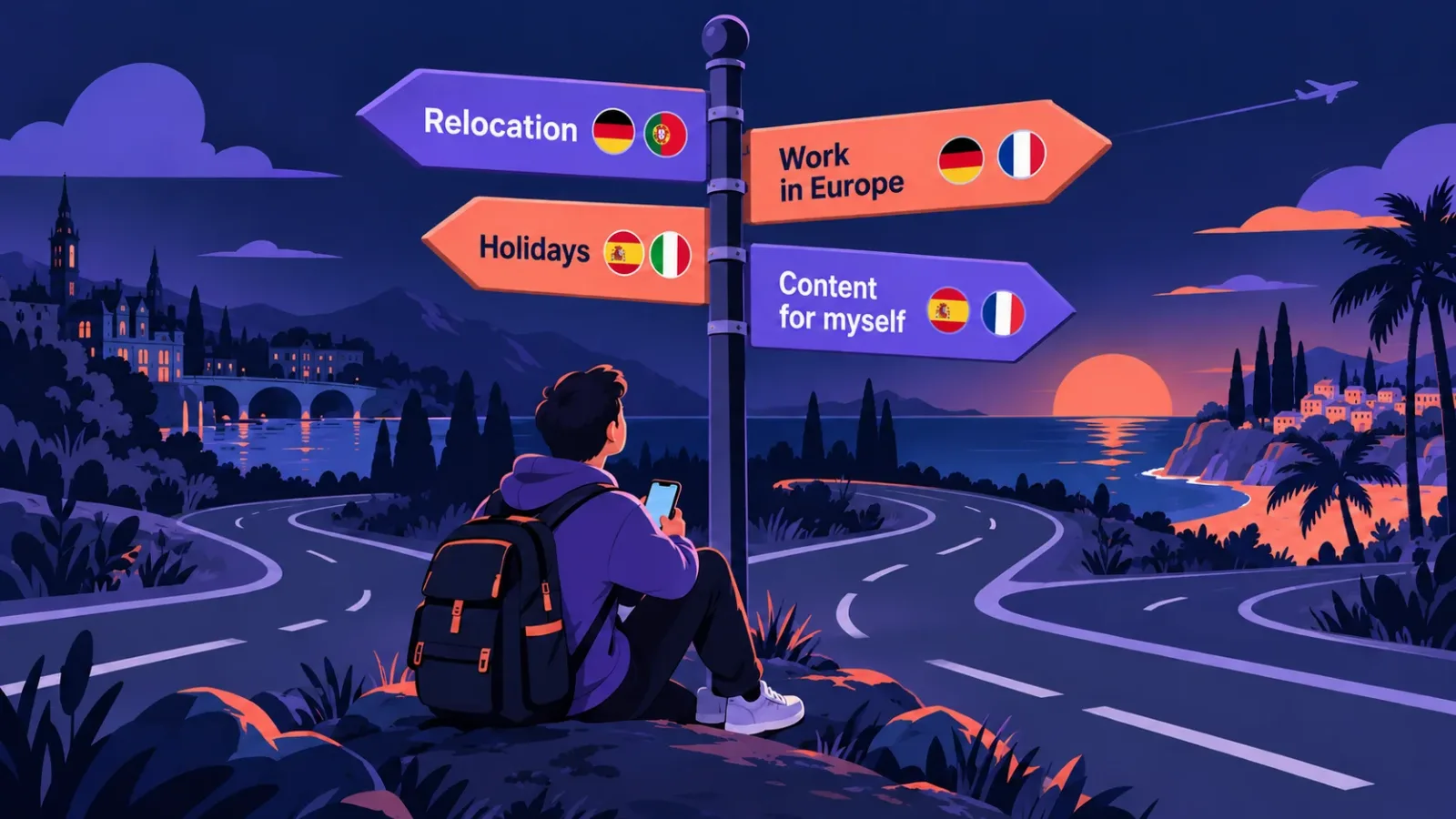
| Goal | What fits | Why |
|---|---|---|
| Relocation or living in a country | The language of that country, no exceptions | Daily life, paperwork, doctors and neighbours do not switch to English. Even Serbian or Romanian, which appear in no ranking, matter more here than any "global" language |
| Work in Europe | German, French | Large job markets where knowing the local language noticeably widens your options and removes the ceiling on your career |
| Travel and holidays | Spanish, Italian, Portuguese | The countries people visit most, and languages whose speakers will happily understand you with a hundred words |
| Lots of content for yourself | Spanish, French | A huge amount of series, music, books and podcasts for every taste; easy to find input on your own topic |
| A fast first result | Spanish, Italian, Portuguese | Transparent reading, simple phonetics, many familiar roots. You start understanding simple texts within a few weeks |
| A second language after Spanish | Portuguese, Italian, French | Romance languages support each other heavily in vocabulary: half the words you will recognise rather than learn |
Notice that the same languages appear in the table several times. That is how it should be: the choice is rarely between "Spanish" and "German" in the abstract. It is between "I will keep going to Mexico and watching Spanish series" and "I want to work in Berlin". Those are very different answers, and you already have yours.
On difficulty: it is not where it seems
Languages get ranked by difficulty, and those rankings talk many people out of the language they actually need. In practice the difficulty of a language barely affects the result. What affects it is having a reason and having input. I dropped Turkish, which counts as hard for Europeans, but not because of its grammar: the trips stopped. Serbian is not easy either, and I keep going, because it is what people speak in the queue at the shop.
There is one more detail. Languages of different shapes need a different unit of learning. In German a word without its gender and plural is only half learned. In Spanish and Italian half the work goes into verb forms. In Turkish a word is one thing, but the versions with endings come in dozens. This does not make a language harder or easier; it changes what exactly you write into your dictionary and what you review. Better to understand that in the first two weeks than after six months.
What not to do when choosing
- Start two new languages at once. Two from scratch almost always end up as one, and it will be whichever happened to get more input. A second one can be added once the first is being carried by daily content.
- Choose by forecasts of "the languages of the future". Mandarin can be as promising as you like, but if a year from now you have nobody to speak it with and nothing to speak about, it will not survive that year.
- Choose by app. Some people start a language only because a service has a pretty course for it. The course ends, and the language is left attached to nothing.
- Wait for the "perfect moment". The first hundred words of any language take one or two weeks at fifteen minutes a day. That is a cheap way to find out whether the language pulls you in, before you buy a textbook and a course.
How to start in the first week
Once the language is chosen, do not start with grammar. Start by collecting words from your actual goal. Going to Italy on holiday: the first words are about cafés, directions and accommodation. Preparing to move to Germany: paperwork, renting, the bank. That way even your first hundred words are tied to something real, not to an abstract list of "most frequent".
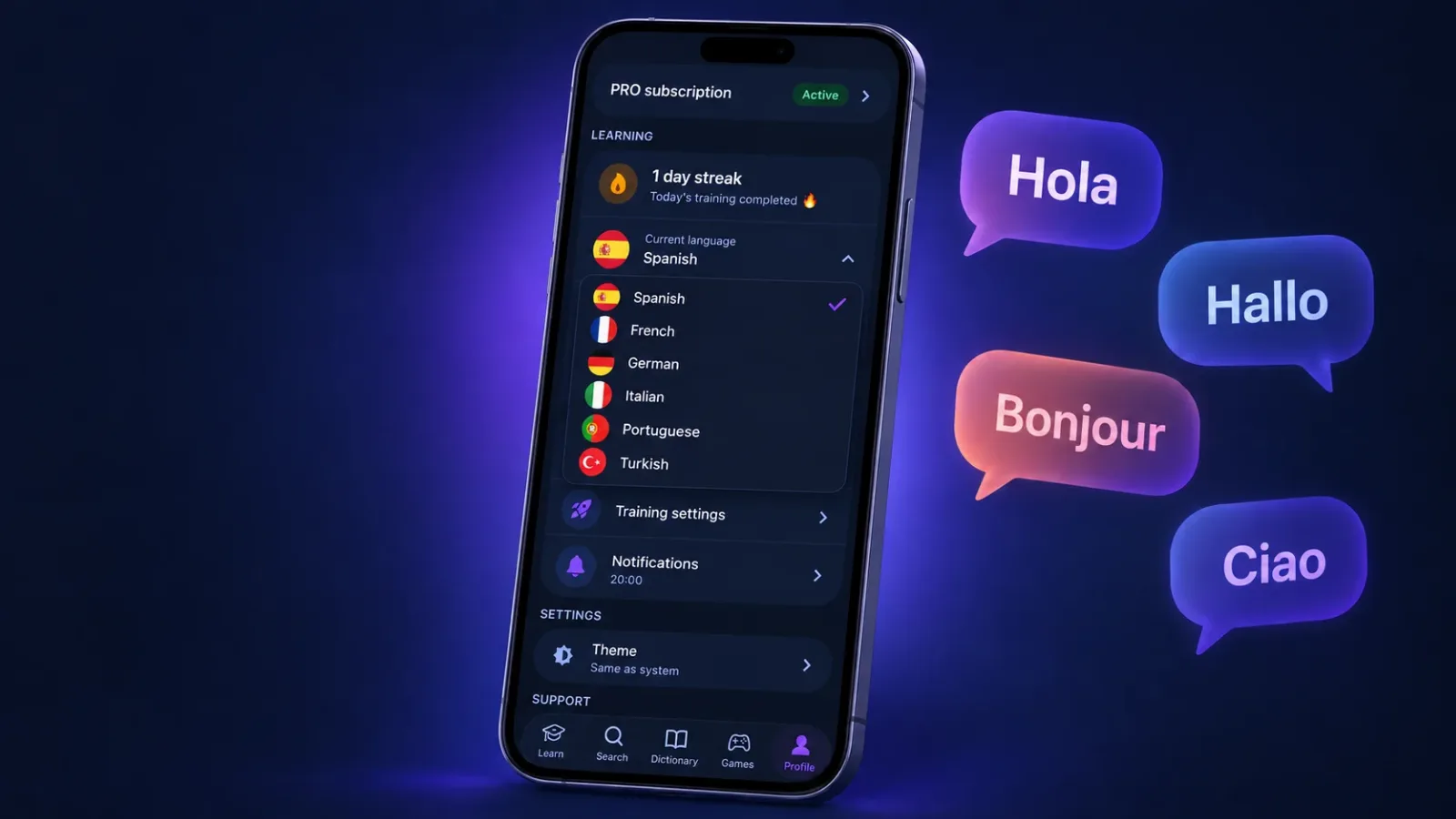
In VibeLing switching the language takes one tap in your profile: the dictionary, the training sessions and the word packs rebuild around the language you picked, and Spanish, French, German, Italian, Portuguese and others live in a single app. To get going there are ready-made collections by goal: travel words, relocation words, the top 100 verbs. Then you add your own: you spot a word in a series or on a menu, type it in, get the translation, examples and audio, and it lands in your daily review. Exactly what a language needs so that it does not stay "chosen" but starts growing.
In short
There is no language everyone should learn in 2026. There is the language that has a reason in your life, a source of words, and fifteen minutes a day. If you are starting from zero, Spanish is the safest bet. If you already have one language, answer the three questions above and look at the table: the answer usually finds itself. And the cheapest way to check your choice is in practice: collect your first words for your own goal, train them for a week in VibeLing and see whether you want to keep going. That will tell you more about the choice than any ranking.