How to Stop Translating in Your Head When Speaking Spanish

Anyone who took Spanish in school knows the routine. Someone says something, you translate it into English in your head, come up with an answer in English, translate that back into Spanish, check the verb endings and the gender of every noun, and only then open your mouth. By that point the conversation has moved on. On paper this works well enough. In a real conversation it almost never does.
The good news is that translating in your head isn't a personality trait. It's a habit, and it grew out of the way you learned your words. Habits can be rebuilt. Below is where this one comes from and what to do so that Spanish words come to you on their own, without a stop in English first.
Why your brain translates
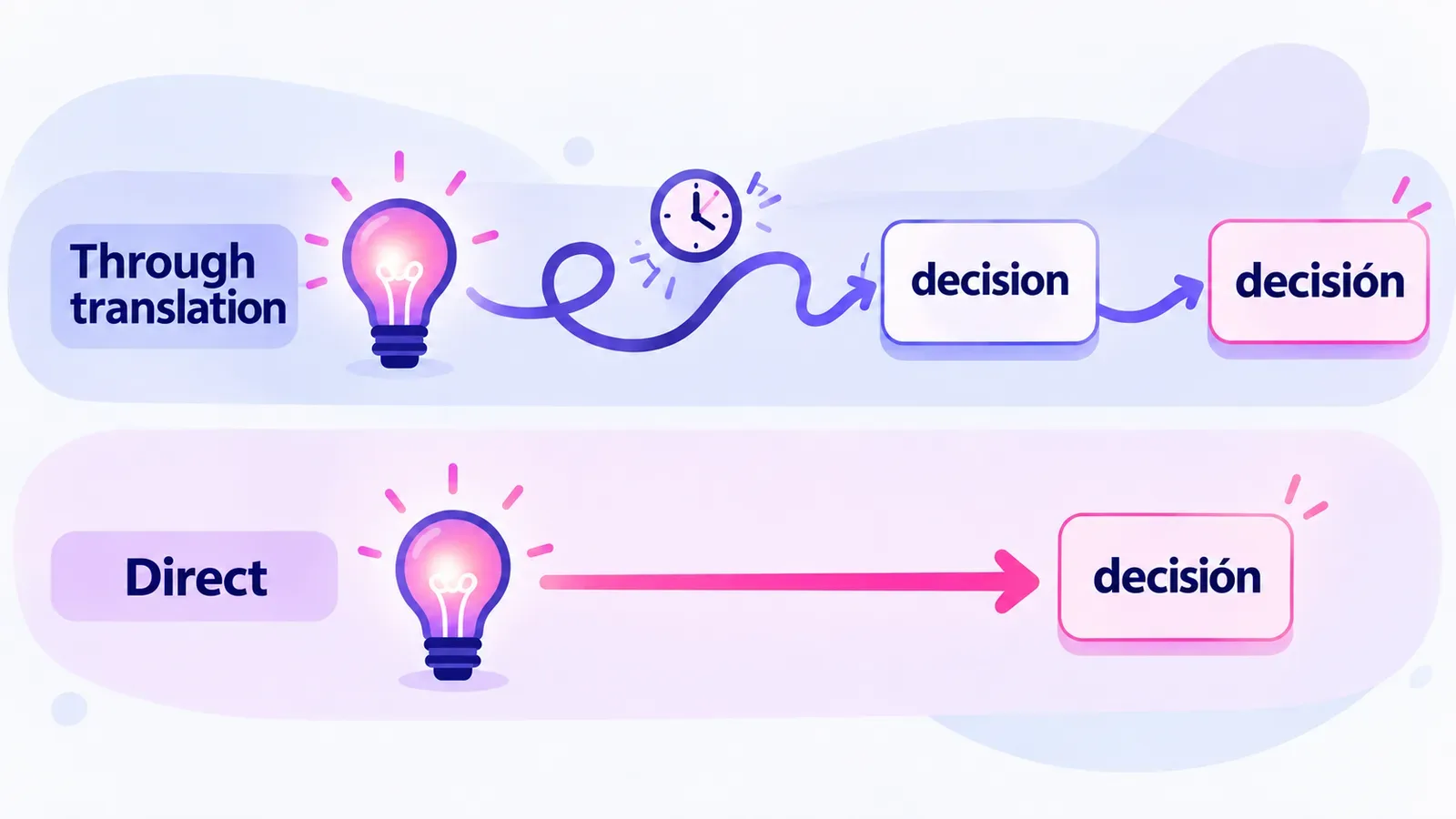
If you learned a word as "decisión = decision", your memory stores it as a pair. The Spanish word isn't attached to the idea itself, it's attached to the English word. To pull it out mid-conversation, your brain has to take the long way round: thought → English word → Spanish word. Each step takes a fraction of a second, but across a ten-word sentence those fractions add up to a noticeable pause.
A native speaker's path is shorter: thought → Spanish word. There's no stop in between. The goal isn't to "forbid yourself from translating" (that doesn't work). The goal is to gradually build a direct route from meaning to the Spanish word. Once it's there, the long route simply stops being needed.
There's a second reason too: we often build Spanish sentences on an English template. "I'm 20 years old" turns into Soy 20 años, and "make a decision" into hacer una decisión, when Spanish speakers say tengo 20 años and tomar una decisión. Word-for-word translation isn't just slow, it also produces mistakes that are hard to get rid of later.
What actually changes the habit
1. Learn a word through its definition, not just its translation
A translation is useful the first time you meet a word: it tells you quickly what it's about. But if you stop there, the word stays a pair. The second step is what helps: read a simple definition in Spanish. For example:
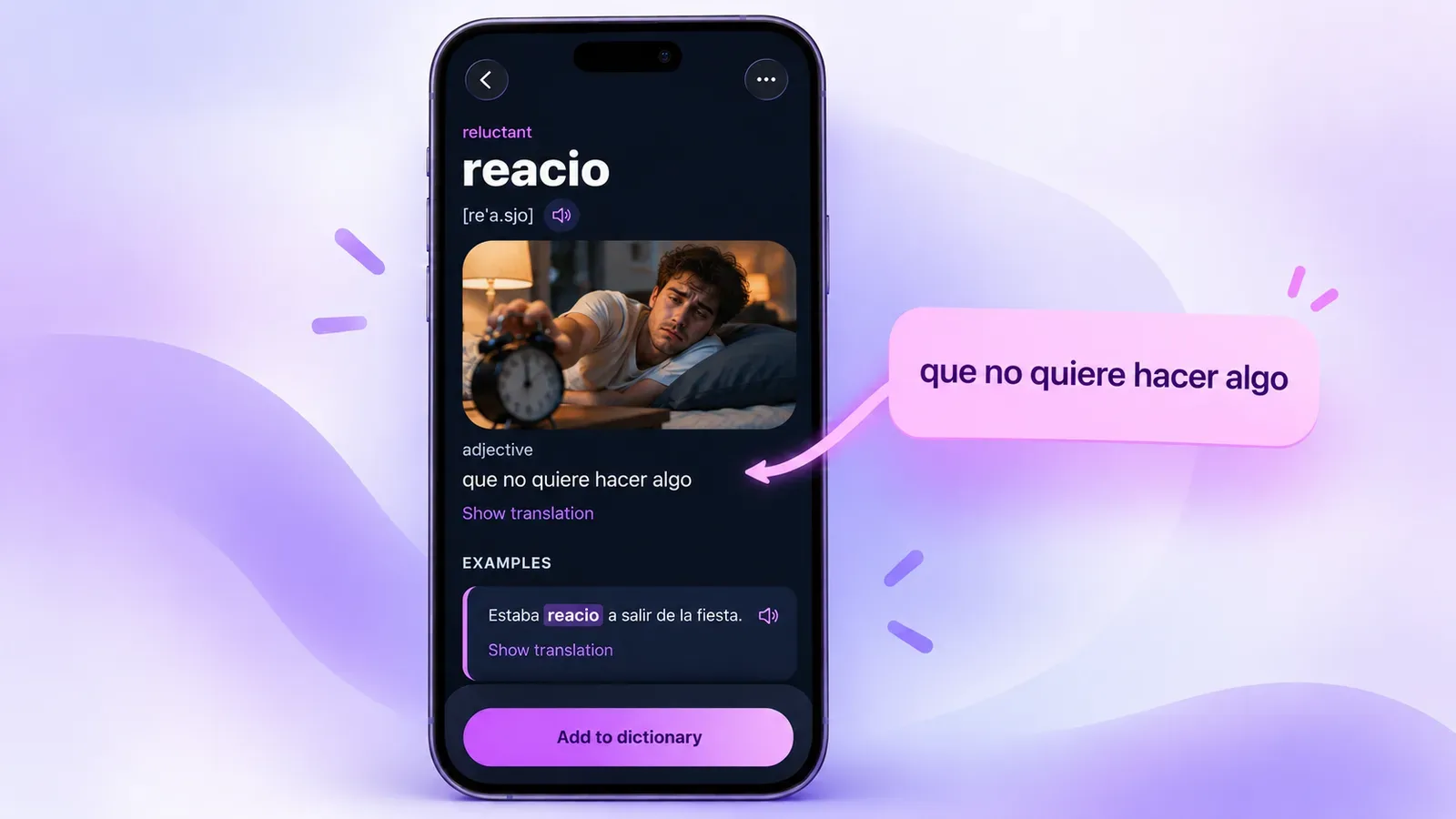
reacio — que no quiere hacer algo
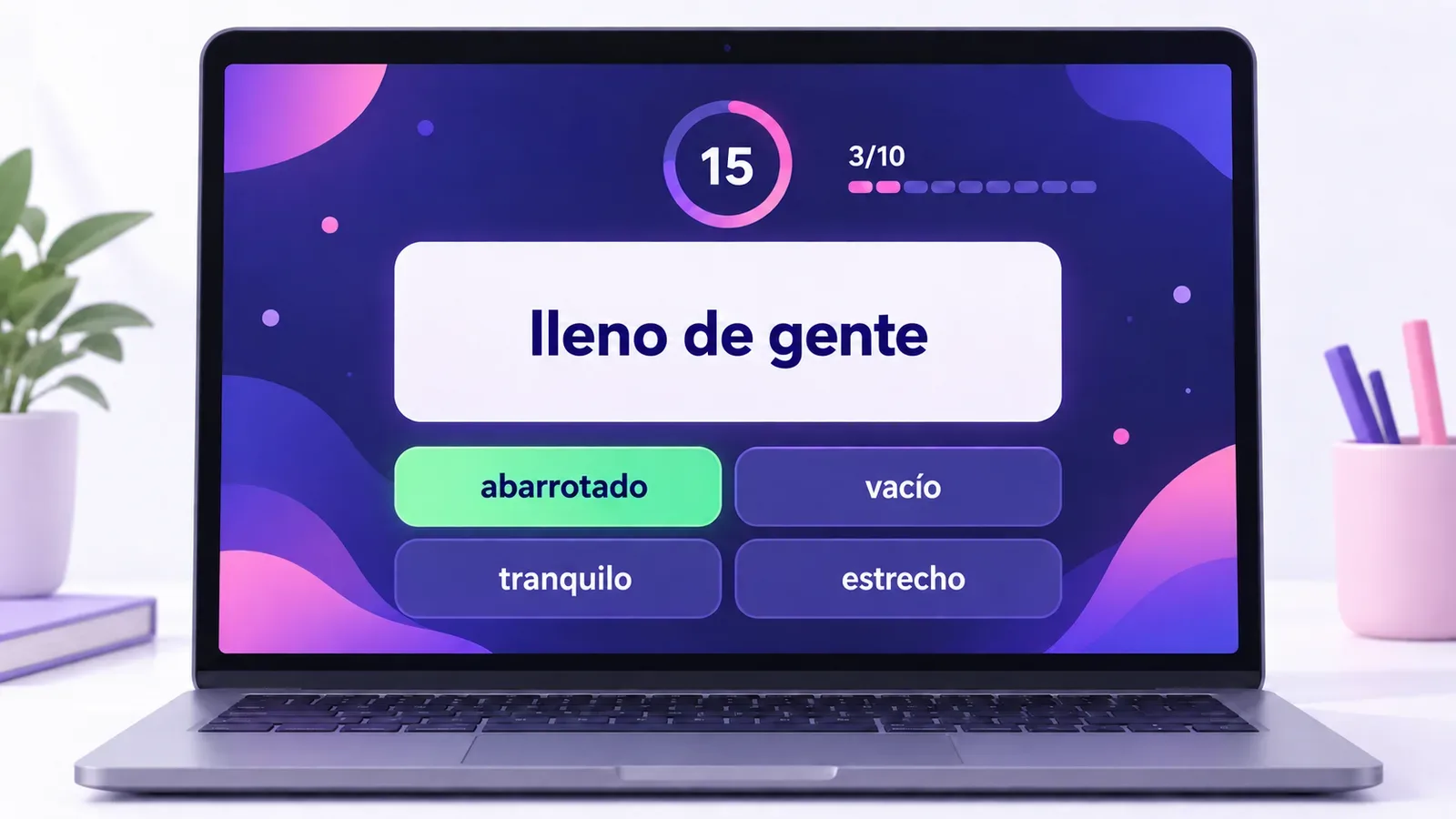
abarrotado — lleno de gente
prestar — dar algo a alguien para que lo devuelva después
Learner dictionaries write their definitions with basic vocabulary, so you can follow them from around A2–B1. When you've read the explanation in Spanish, the word hooks onto the meaning rather than onto an English equivalent. Over time the translation fades into the background, and what you remember is the situation where the word fits.
In VibeLing, every word card has more than a translation and pronunciation: there's also a definition, a picture and example sentences. Read the translation to get your bearings, then linger on the definition and the examples. Those few extra seconds are exactly what builds the direct connection. Take reacio: once you've read "que no quiere hacer algo" and a couple of examples, you stop needing "reluctant" to reach it.
2. Practice recognizing a word from its description
Reading a definition once isn't enough. You want the word to come back from its meaning with no prompt. The reverse exercise works well for this: you're given a description in Spanish and you pick the word. There's no English anywhere in the task, so there's simply nothing to translate.
That's how the free game Guess by definition works: ten Spanish definitions, fifteen seconds each, four words to choose from. You might see "lleno de gente" and need to find abarrotado among the options. The fifteen seconds matter: it's enough time to understand the description, but not enough to translate it piece by piece. You can play right in the browser without signing up, and there are more short drills on the word games page.
3. Memorize ready-made phrases as a whole
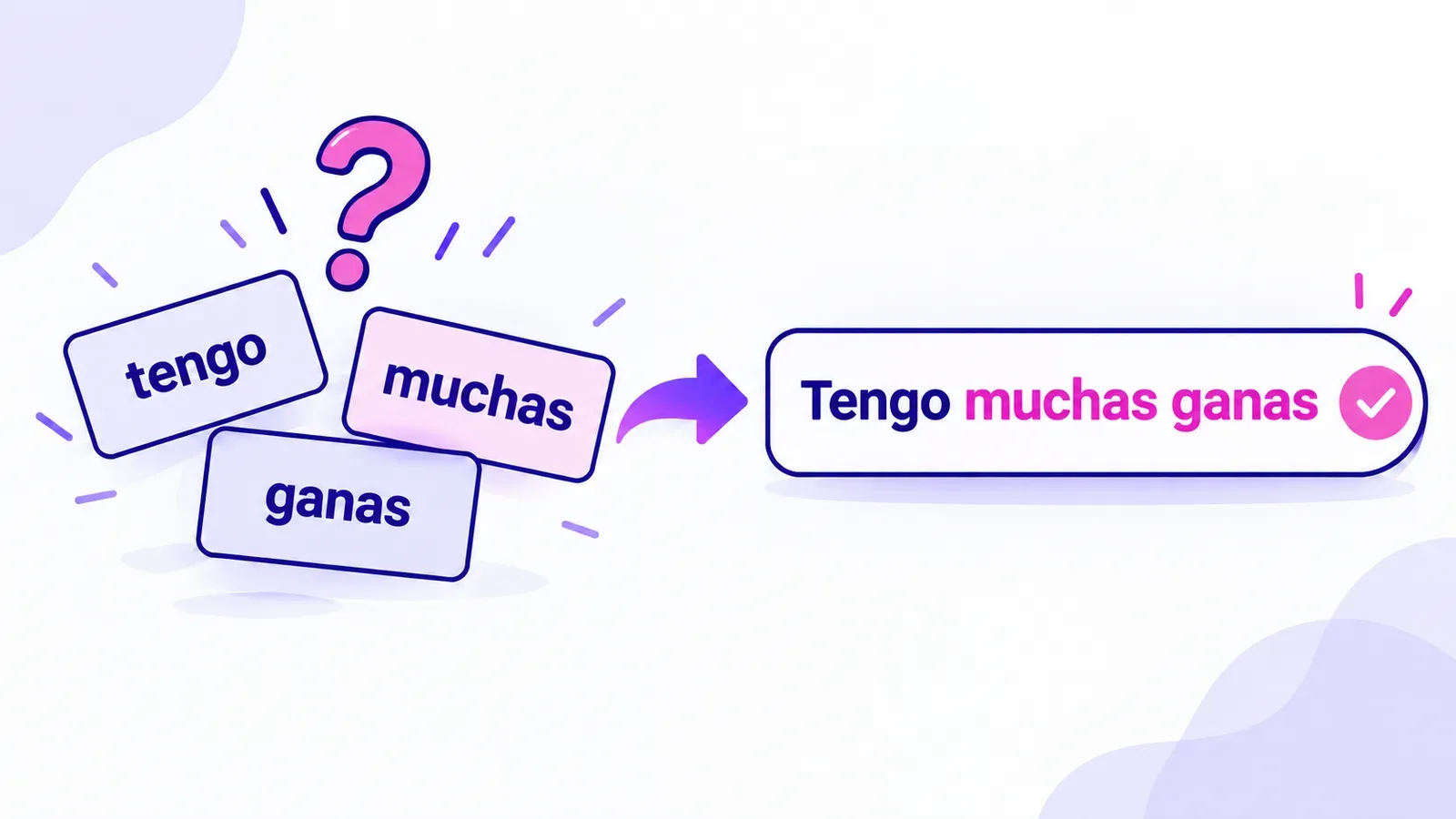
A lot of pauses in speech come not from single words but from putting the sentence together. If Tengo muchas ganas is stored in your head as one piece, you don't have to assemble it from "tengo", "muchas" and "ganas". It comes out in one go, the way "I can't wait" does in English.
| What you want to say in English | Word for word | What Spanish speakers say |
|---|---|---|
| I am 20 years old | Soy 20 años | Tengo 20 años |
| I'm hot | Estoy caliente | Tengo calor |
| Make a decision | Hacer una decisión | Tomar una decisión |
| I miss you | Te pierdo | Te echo de menos |
| It depends on you | Depende en ti | Depende de ti |
Don't write down single words; write down the combinations they live in: tomar una decisión, prestar atención, quedarse sin tiempo. For more on why a word without its surroundings doesn't stick, see the article on how to learn words in context.
4. Link a word to a picture and a situation
You already don't translate the simplest words: when you hear perro, you see a dog, not the English word "dog". You can get the same effect with harder words. When you learn abarrotado, picture a specific packed subway car you've actually ridden in. When you learn reacio, picture yourself dragging out of bed to the Monday alarm. The image takes over the job of the "anchor" from the English word.
5. Listen and read a lot at a level you understand
When you understand about 90% of a text or video, your brain has no time to translate: the meaning flows, and words start landing directly. If every other word is unfamiliar, you inevitably switch into decoding mode. So the right practice material isn't hard news but shows and books slightly above your level, where there aren't many unknown words.
6. Talk to yourself in Spanish
It sounds odd, but it works. Narrate simple actions out loud or in your head: Estoy haciendo café. El agua está muy caliente. Tengo que salir en diez minutos. Nobody is listening, mistakes don't matter, and your brain gets used to starting a thought in Spanish right away. Whenever you're missing a word, that's a great list for tomorrow's review.
How to tell it's starting to work
Translating in your head doesn't switch off in a day. It usually goes like this: first the most frequent words and phrases stop getting translated, then short replies like Me parece bien or No estoy seguro, then whole simple sentences. On hard topics you'll still slip back into English now and then, and that's normal. People who have lived abroad for years do it too.
| Stage | What happens |
|---|---|
| At the start | Every word goes through English, and answers take a long time to put together |
| After a few weeks | Frequent words and ready-made phrases come to mind right away |
| After a few months | Simple sentences come without translating; you only need English for the hard parts |
If you want to dig into how to train words for conversation rather than for a test, there's a separate article: how to learn Spanish words to actually speak.
A short daily plan
- Add 5–10 new words, and for each one read the Spanish definition and examples, not just the translation.
- Write words down in combinations: a verb together with its usual neighbors.
- Play one round of Guess by definition a day. It takes a couple of minutes.
- Review words on a schedule so the direct connections don't have time to fade.
- Spend five minutes a day talking to yourself in Spanish about what you're doing.
Everything except the last point is easy to do in one place. In VibeLing you can save a word from a show or a book, see its definition, picture and examples right away, and the app brings it back for review at the right moment. Give VibeLing a try, and in a couple of weeks you'll notice that some words reach you before their English translation does.