How Long Does It Take to Learn a Language
This question does have a numeric answer, it just comes in two parts: how many hours you need to accumulate, and how fast you accumulate them. The first part is fairly well established and barely depends on the person. The second depends entirely on your schedule, and it explains why some people get there in a year while others don't get there in five.
How many hours you need
The best known estimate comes from the US Foreign Service Institute, which has been teaching adults from scratch to working proficiency for decades and counting the hours. For English speakers it works out roughly like this: Spanish, French and Italian take 600–750 hours of instruction, German around 750, Russian and Polish about 1,100, and Japanese, Chinese, Korean and Arabic around 2,200.
Those numbers describe intensive classroom study, so you can't map them onto yourself one to one. But they get the scale right: the gap between a close neighbour language and one with a different writing system is a factor of three or four, not a few percent.
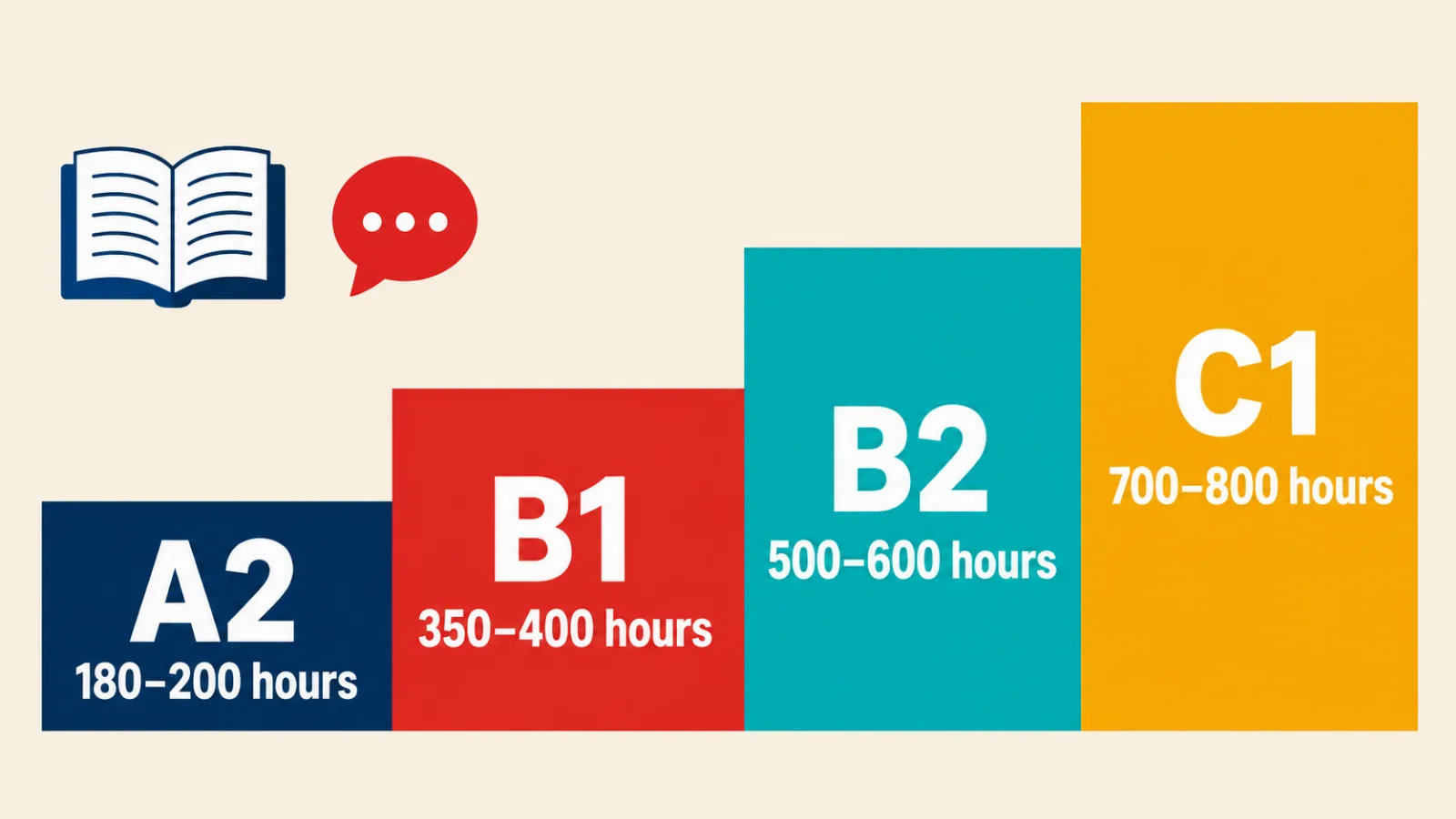
The second useful scale is the Cambridge English estimate by level. It shows roughly how many hours of study it takes to reach each step:
| Level | What it means in practice | Total hours |
|---|---|---|
| A2 | Simple everyday topics, short phrases | 180–200 |
| B1 | You can get your point across, with plenty of mistakes and slow speech | 350–400 |
| B2 | Working level: email, calls, shows without subtitles | 500–600 |
| C1 | Fluent, with nuance, almost no pauses to search for a word | 700–800 |
Which brings the first important clarification: "learning a language" is not a single point. There are roughly 400 hours between "I can order coffee" and "I can run a meeting", and someone asking about timelines usually means something in between.
Convert the hours into a calendar and everything falls into place
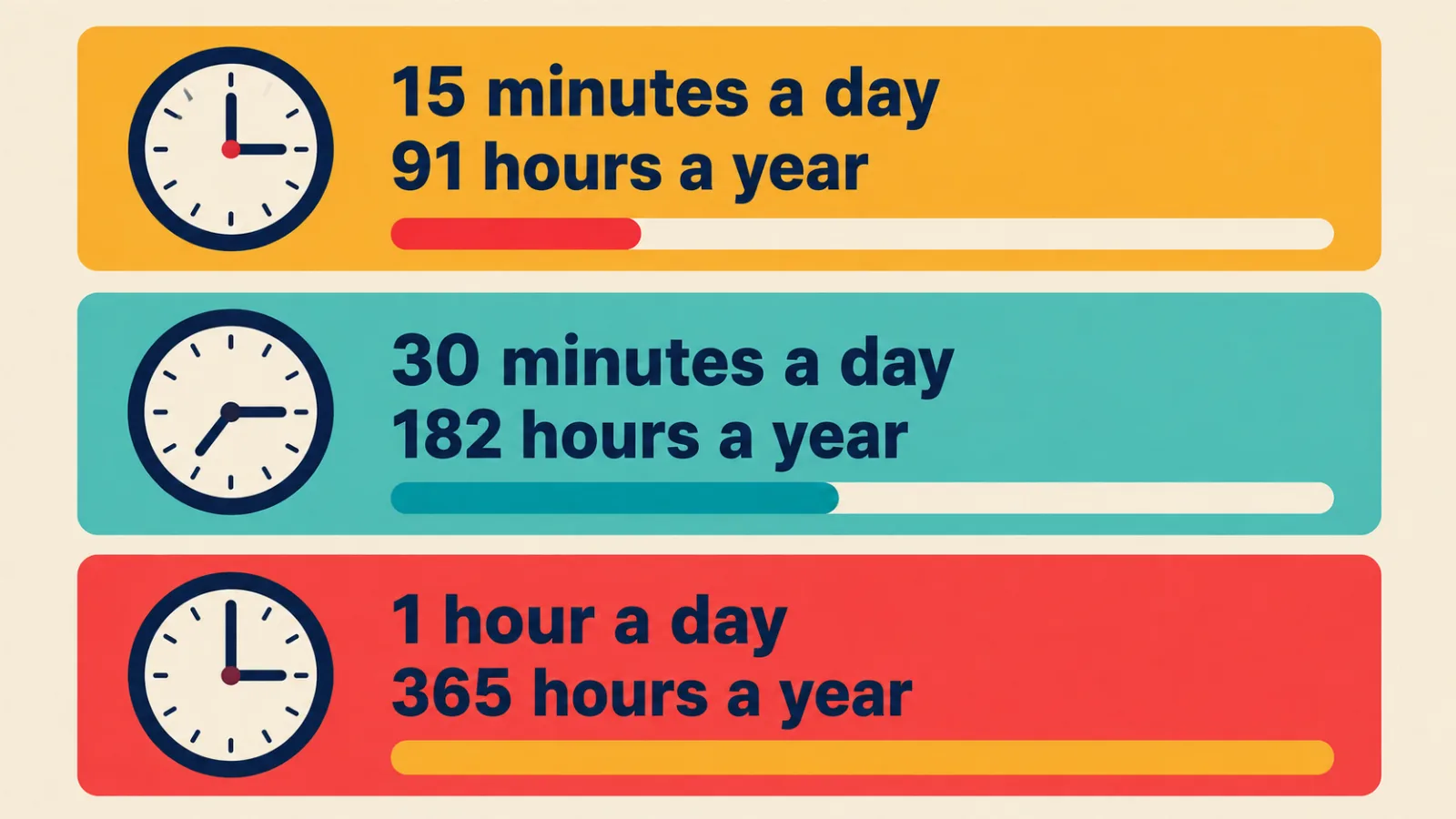
Hours on their own tell you nothing until you divide them by your own schedule. The arithmetic is simple and a little sobering:
| Study habit | Hours per year | To B1 (≈400 h) | To B2 (≈600 h) |
|---|---|---|---|
| 15 minutes a day | 91 | about 4 years | about 6.5 years |
| 30 minutes a day | 182 | a little over 2 years | about 3 years |
| 1 hour a day | 365 | about a year | about 1.5 years |
| 2 hours on weekends | 208 | about 2 years | about 3 years |
Two things are immediately visible in that table. First, if you are not starting from zero — a couple of years of Spanish at school still counts, and it usually leaves people somewhere around A2 — the real timeline is shorter. Second, the difference between 15 minutes and an hour is the difference between four years and one, not between "slow" and "slightly faster".
And a third, less obvious one: the weekend row racks up almost as many hours as half an hour a day, but it works noticeably worse. The reason is not the quantity. It's the gaps.
Why short daily sessions beat long rare ones
Memory works in such a way that forgetting starts the moment you close the book and moves fastest in the first twenty-four hours. A review that lands in that window is cheap and holds the word for a long time. A review a week later is close to learning it again from scratch.
The practical consequence: two hours on Saturday lose more than twenty minutes every day, even though the weekly total looks similar. Over six days without contact, half of the new words drift away, and part of Saturday goes into rebuilding what you already studied. That mechanism is unpacked in more detail in the article on why consistency beats cramming.
There is a second, more mundane reason. A two-hour session requires you to find a two-hour window in advance, and those windows are the first thing to get cancelled. A fifteen-minute one requires nothing: it fits into a queue, a commute, a gap between calls. A session you don't have to plan is much harder to cancel.
What fits into a short session
A short session only works if you put a sensible amount into it. A guideline for ten to fifteen minutes:
- 5–7 new words, no more. Twenty new ones in a single sitting look like a record and usually don't survive the night.
- 15–25 reviews of what you studied earlier. This is where most of the time goes and where most of the result comes from.
- One retrieval exercise: recall the word from its translation rather than recognising the translation of a word you're shown. Recognition is always easier and always flattering.
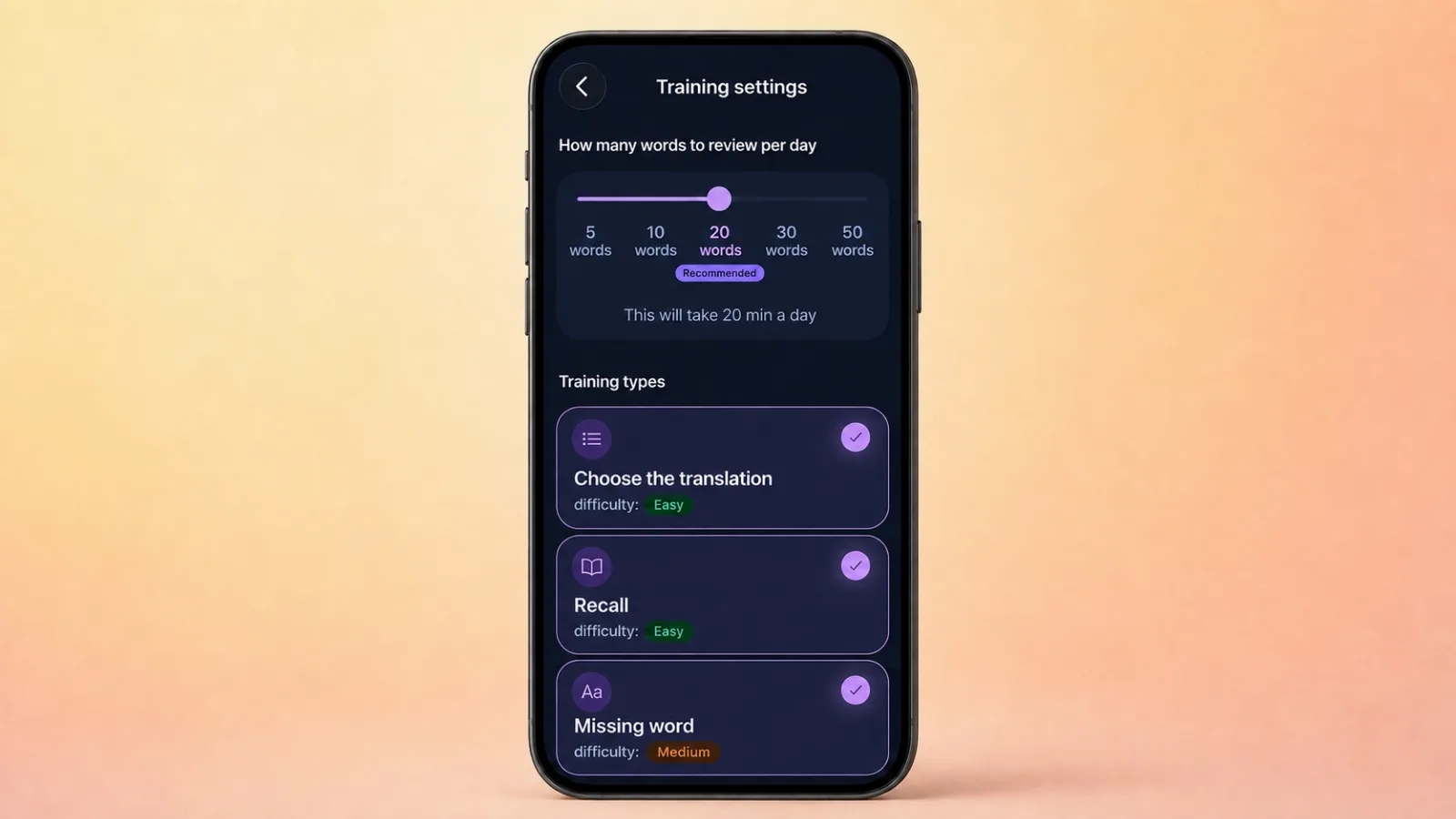
Twenty words a day is roughly twenty minutes, and that is already a fast pace: 7,000 words in a year if you never skip. You will skip, so plan for a realistic 60–70% of days.
How to tell whether you're on schedule
Counting hours is inconvenient, and progress over a year is invisible from the inside. Two simple indicators do the job.
The first is the streak. Not as a game badge but as an honest counter: 200 days out of 365 at twenty minutes is about 70 hours, and at that pace B1 is a long way off. 320 days is a completely different story.
The second is the size of your active vocabulary — not how many words you have seen, but how many you can produce yourself. The gap between those two numbers is usually two- or threefold, and it's the second one that decides whether you'll be able to speak. There is a separate piece on how to track vocabulary progress if you want a method rather than a guess.
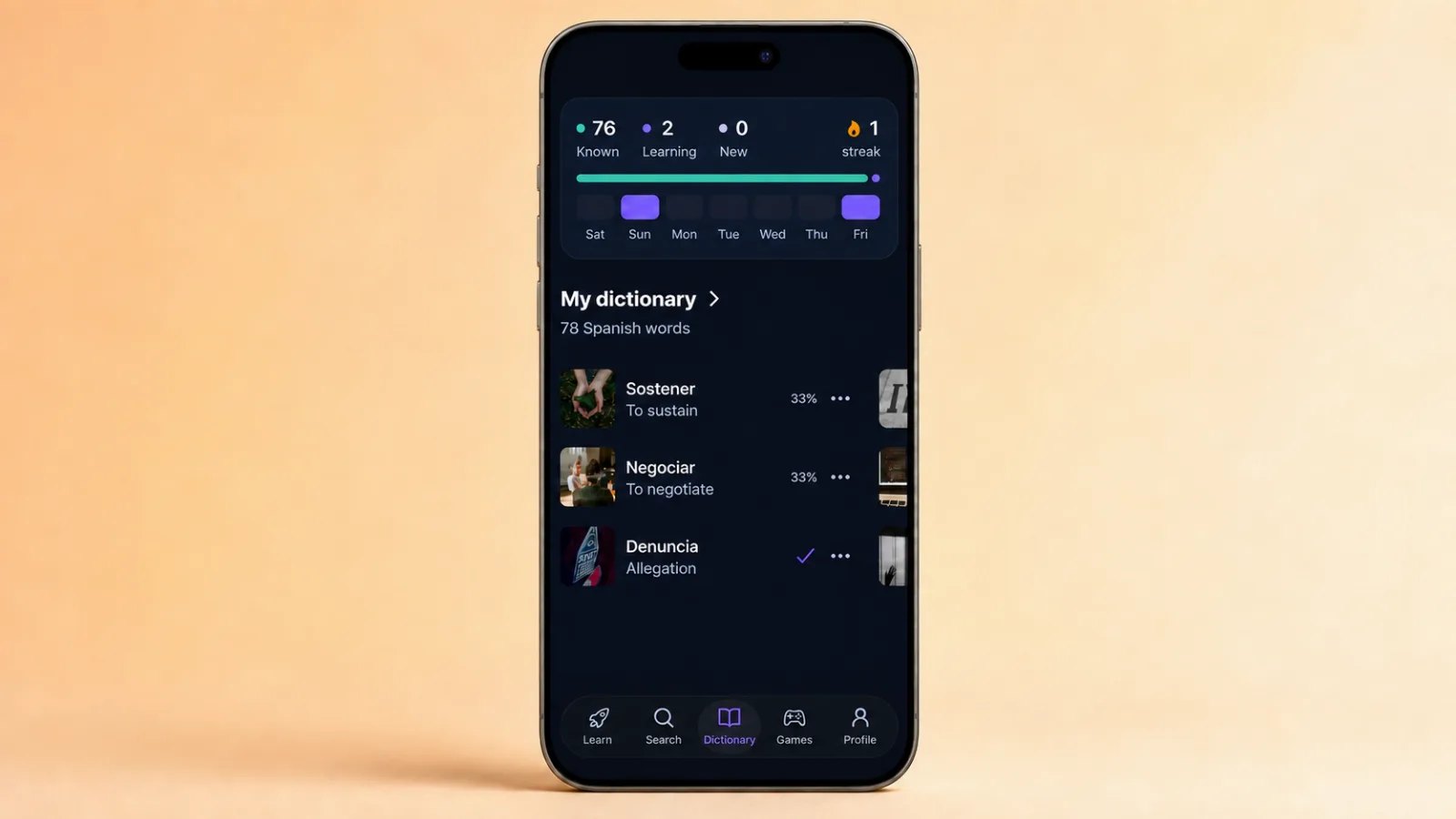
It's easiest when the app counts both for you. In VibeLing the daily target is set with a slider and the app tells you right away how many minutes it will take, while the dictionary screen shows your streak, your weekly activity and the split between "new", "learning" and "known" — exactly the two numbers that tell you whether you're on schedule or standing still.
The short answer
Getting to the level where you can handle a trip and a work chat takes roughly 350–400 hours, which is a year at an hour a day or two years at half an hour. A confident working level is 500–600 hours. Distant languages such as Japanese stretch that by a factor of three or four.
You can't speed the process up dramatically, but you can slow it down with gaps very easily — and almost everyone who has been "learning a language for five years with nothing to show" slowed it down exactly that way. So pick the schedule you can actually keep every day rather than the most ambitious one: fifteen minutes that happen beat an hour that doesn't.
The simplest way to start is a small daily target and an app that remembers what you owe today — give VibeLing a try and look at your own numbers a month from now.