The 1000 Most Common Spanish Words: Do They Really Cover 80%?

The number circulates in the same form everywhere: learn the 1000 most common Spanish words and you'll understand 80% of speech. It sounds like a cheat code. A thousand words is two months at ten minutes a day, and after that you're apparently set.
The number is almost true. The conclusion drawn from it isn't. Let's look at what was actually counted and why it doesn't imply what it seems to.
Where the 80% comes from
Behind the figure is a real property of language: words are distributed extremely unevenly. A handful appear constantly, while an enormous tail shows up once every few hundred pages. The pattern is known as Zipf's law and holds in every language.
Hence the result from large corpora: the first thousand most frequent words really do cover something like 80–85% of all word occurrences in casual speech. In writing and more formal registers the share is lower, around 70–75%, but the order of magnitude is the same.
The key word here is occurrences. What was counted wasn't meanings or sentences, but how many times a word showed up in a text. Out of ten words in a row, eight will come from the first thousand. That is what has been measured.
Why 80% isn't "I understand"
80% coverage means every fifth word is unfamiliar. Not every fifth sentence — every fifth word.
Research on reading comprehension gives a fairly hard benchmark: to read without a dictionary and understand everything you need coverage around 98%, with roughly 95% as the minimum workable threshold. At 80% the text turns into fragments with guesswork stitched between them. Sometimes the guess is right, sometimes not, and you have no way to check.
| Coverage | Words needed (order of magnitude) | What it feels like |
|---|---|---|
| 80% | ~1,000 | Every fifth word missed. You catch the topic, lose the content |
| 90% | ~2,000–3,000 | One word in ten. Readable, but heavy and slow |
| 95% | ~4,000–5,000 | The working minimum. Almost everything is clear, the dictionary is occasional |
| 98% | ~8,000–9,000 | Comfortable reading with no dictionary |
The numbers in that table are orders of magnitude, not precise values — and here's why you can't take them literally.
First substitution: what counts as a word
Across studies, "word" means different things, and the difference is enormous.
- Word form. hablo, hablas, habló, hablaba, hablaría — five units.
- Lemma. All of those forms — one unit, hablar.
- Word family. The lemma plus derivations: nación, nacional, nacionalidad, nacionalizar, internacional — also one unit.
Spanish makes this gap especially brutal, because a single verb has dozens of conjugated forms. An estimate like "you need 8,000 words" is almost always counted in families. In word forms it's far past thirty thousand. When you see a tidy number with no note about what was counted, that number can be off by a factor of three or four.
Second substitution: knowing a word isn't knowing this sense of it
The most frequent words are the most polysemous, and that isn't a coincidence. A word gets into the top of a frequency list precisely because it serves dozens of different situations.
The verb quedar is in the first few hundred of any Spanish frequency list. Here it is in six senses:
Quedamos a las ocho — we're meeting
Ese abrigo te queda bien — it suits you
No queda pan — there's none left
Se quedó en casa — he stayed
Quedó claro — it became clear
¿En qué quedamos? — so what did we agree?
In a frequency list that's one line. In your head it's six separate pieces of knowledge, and most people confidently own two of them. Formally the word is "in the first thousand and learned"; in practice four sentences out of six stay opaque.
Third substitution: the 80% isn't where the content is
This is the important one. The first thousand words are mostly functional and generic: el, de, que, y, a, en, ser, haber, hacer, muy. They hold the sentence's structure together but carry none of its meaning.
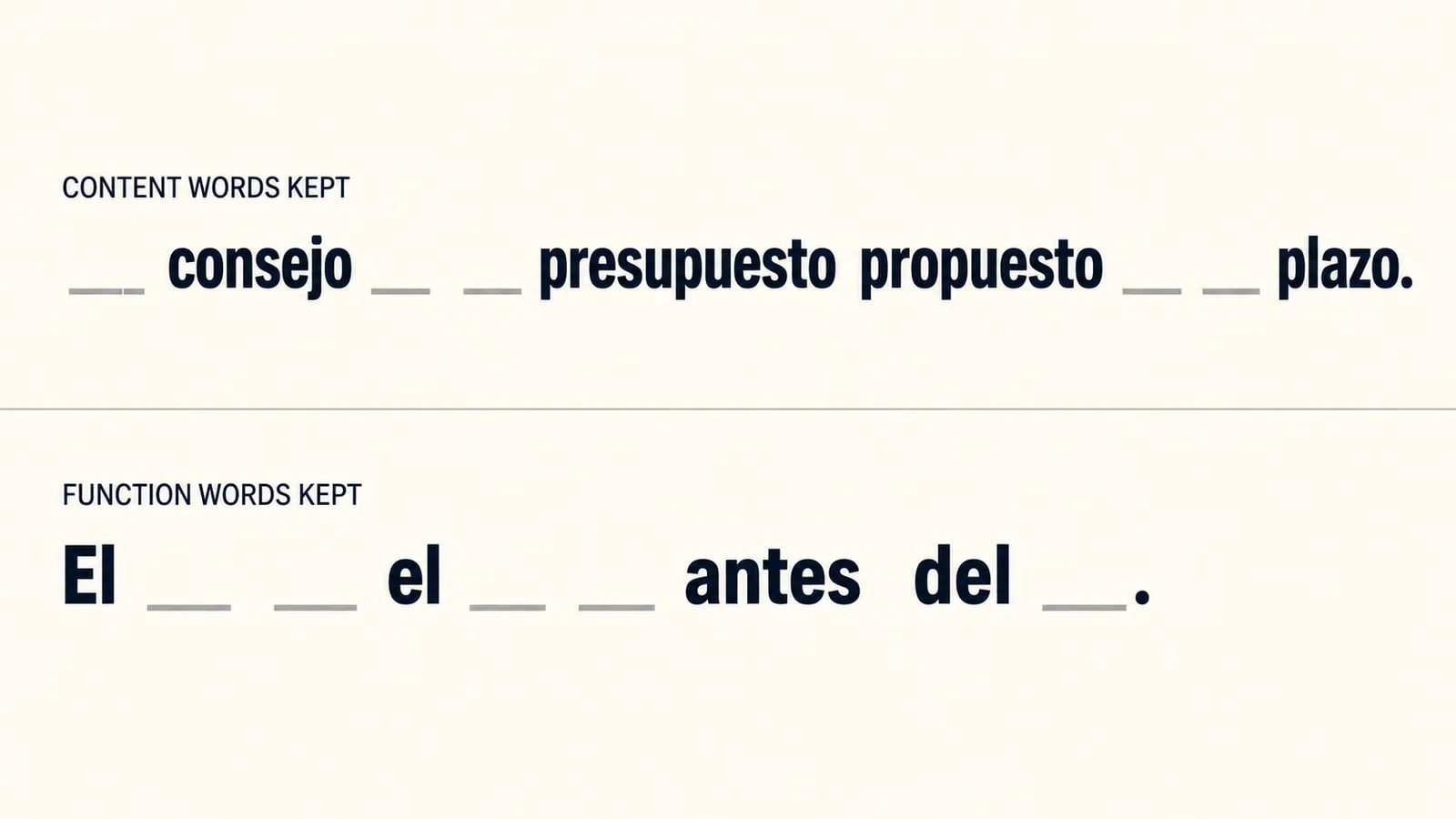
The meaning sits in topic-specific nouns and verbs — which live in exactly the remaining 20%. Look at the same sentence with different halves blanked out:
Function words removed:
___ consejo ___ ___ presupuesto propuesto ___ ___ plazo.
Clear enough: a council, a proposed budget, a deadline. The gist reconstructs.Content words removed:
El ___ ___ el ___ ___ antes del ___.
Clear: nothing.
So the feeling of "I know the words but I don't know what they're talking about" isn't an illusion or a lack of practice. You genuinely do know 80% of the words and genuinely don't know what the sentence is about.
So learn the first thousand or not?
Learn them. Just with the right expectations.
The first thousand pays off better than anything else you could possibly learn. These words appear in every sentence, they repeat on their own, and nothing works without them: you can't read with context or guess at new words. It's the foundation, and two months on it is not wasted.
The second thousand pays off too, though noticeably slower: moving coverage from 80% to 90% takes twice as many words as the first 80% did.
Past that, general frequency stops being the right selector. After roughly two thousand words, items from a general list start showing up in your life more and more rarely, while words from your own topics show up constantly. A developer needs one set, a doctor another, someone who watches crime dramas a third. A general frequency list knows nothing about that.
From there, what works better than a list is a collection you build yourself out of what you actually read and watch. Its frequency is calculated over your life rather than an averaged corpus.
What this looks like in practice
- The first thousand: from a list, deliberately. A ready-made frequency list is ideal here — the words are unavoidable anyway and the order barely matters.
- For frequent words, learn senses rather than words. Met quedar in a new sense? That's a new card, not "already know it".
- After two thousand, switch to capture. Anything that tripped you up in real text goes into your personal list.
- Count coverage, not words. The useful question isn't "how many words do I know" but "how many unknown ones per page". There's a separate breakdown with a counting procedure.
Step three is usually where it all falls apart: words turn up but don't get saved, and a month later you meet them again from scratch. In VibeLing it works like this: you add the word the moment you meet it, the app fills in the translation, examples and pronunciation, and then brings it back on a spaced schedule — before it has a chance to fade.
The short answer
Is it true that a thousand words gives you 80% of speech? Yes, if you're counting occurrences.
Does that mean you'll understand 80% of what's said? No. You'll recognise 80% of the words and understand considerably less, because the ones you miss are exactly the words the sentence was said for.
A thousand isn't the finish line and it isn't 80% of the way. It's the launch pad without which nothing else works, and it's worth clearing as fast as you can. After that what grows isn't the list — it's your own vocabulary.