Why Consistency Beats Cramming for Spanish Vocabulary

A familiar story: the trip is two weeks away, you open a list of a hundred words and sit down to learn them. Three evenings in a row, an hour and a half each, and by the end of the list you know almost all of it. Ten days later you are standing at the till — and you cannot produce el recibo. Even though you definitely learned it and even ticked it off.
It is not that you did not try hard enough. Ninety minutes of cramming and ten minutes a day are not the same amount of effort arranged differently. They are two different processes, and only the second one stays.
Why cramming evaporates
Memory does not store everything it meets — it filters out whatever turned up once and was never needed again. A word you repeated twenty times in a single evening looks, to the brain, like one episode: intense, but one.
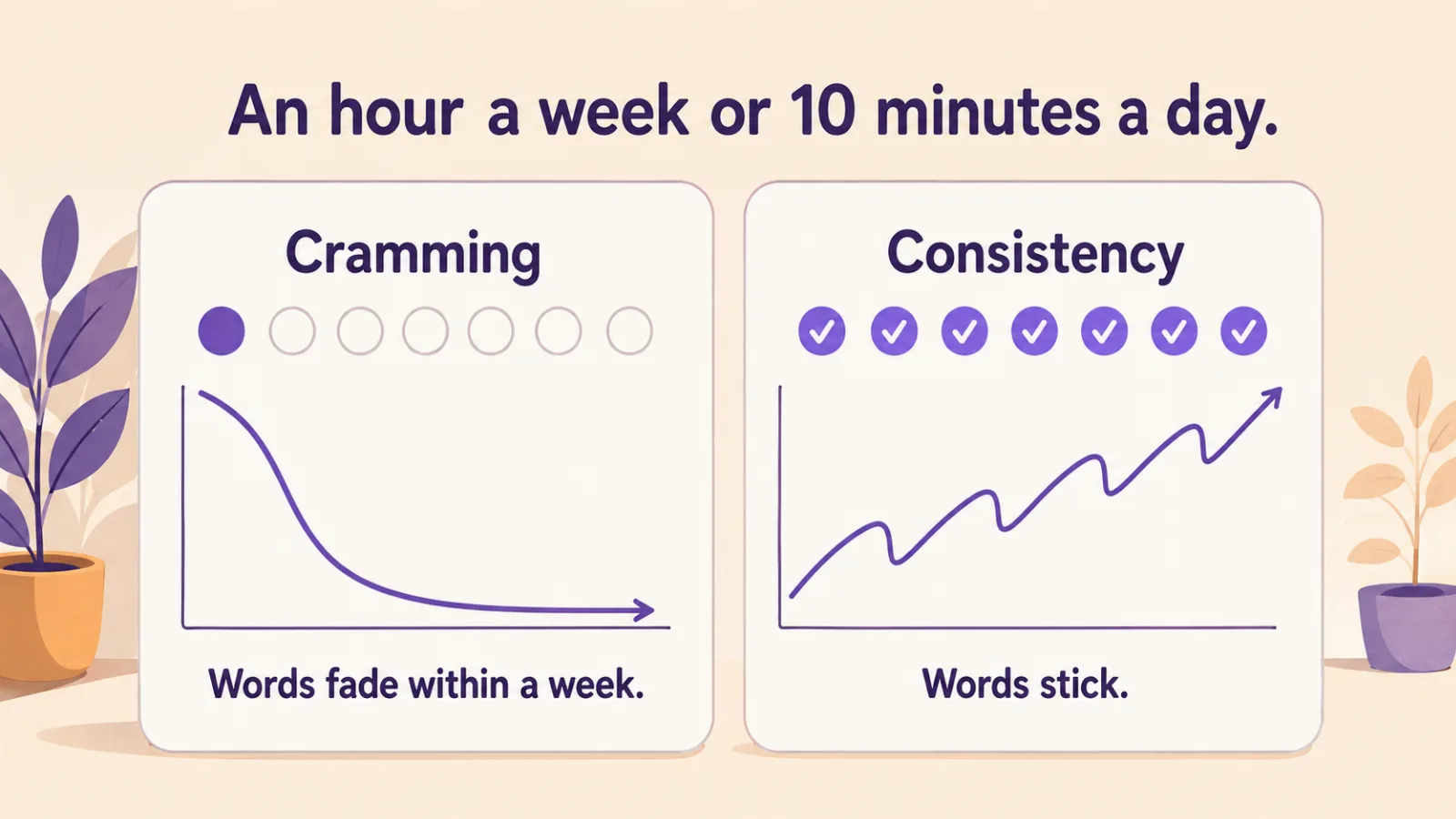
Hence that familiar feeling of ease at the end of a marathon. After an hour of cramming the words really do come instantly — but they come out of short-term memory, where they have just been loaded. That state lasts an evening, maybe a couple of days, and then the list has to be learned almost from scratch. We went through the mechanism itself in the piece on why you forget new words.
Consistency works differently. When you come back to a word after a day, then after three, then after a week, each time the brain has to pull it out with some effort. That effort — trying to recall rather than rereading — is what makes the trace stronger. The word keeps getting the signal that it is needed regularly, not once.
An hour a week against ten minutes a day
On the clock they are nearly identical: 60 minutes against 70. In outcome they are not close.
| An hour once a week | 10 minutes every day | |
|---|---|---|
| How often a word surfaces | One sitting, then a week of silence | Seven short contacts |
| What state you study in | Attention sags by minute 40 | All 10 minutes on a fresh head |
| What happens in between | Words have time to fade completely | The review lands while the word is still on the edge |
| What a skip costs | Two weeks gone at once | One day gone, the streak resumes tomorrow |
There is a practical difference too. An hour has to be found; ten minutes are already there — on the bus, in a queue, while the coffee brews. A session that does not require clearing an evening does not get postponed.
How to build consistency rather than willpower
Consistency usually breaks not because of laziness but because the bar was set too high. Someone promises themselves half an hour a day, holds out for three days, gets tired on the fourth and does nothing at all. The opposite approach works.
- Set a quota you cannot fail to hit. Ten words or five minutes. The point is that a day when you have nothing left still closes.
- Attach the session to something that already happens daily. Morning coffee, the commute, the time before bed. You do not need a new slot in the calendar — you need an anchor.
- Do not try to catch up. After a skip the temptation is to do a double portion, and that turns into a marathon again. Just go back to the normal quota.
- Keep the one-skip rule. A single day off breaks nothing. Two in a row is already the beginning of a new habit, and that is the one worth avoiding.
- Count days, not words. While the streak holds, the vocabulary grows on its own. On staying with it over a long stretch we have a separate piece — how to stay motivated.
What consistency actually gives you
Ten words a day is roughly three hundred a month. Six months at that pace leaves you with a vocabulary that covers everyday conversation and series without constant pausing. And these are words that stayed, not words that were once gone through.
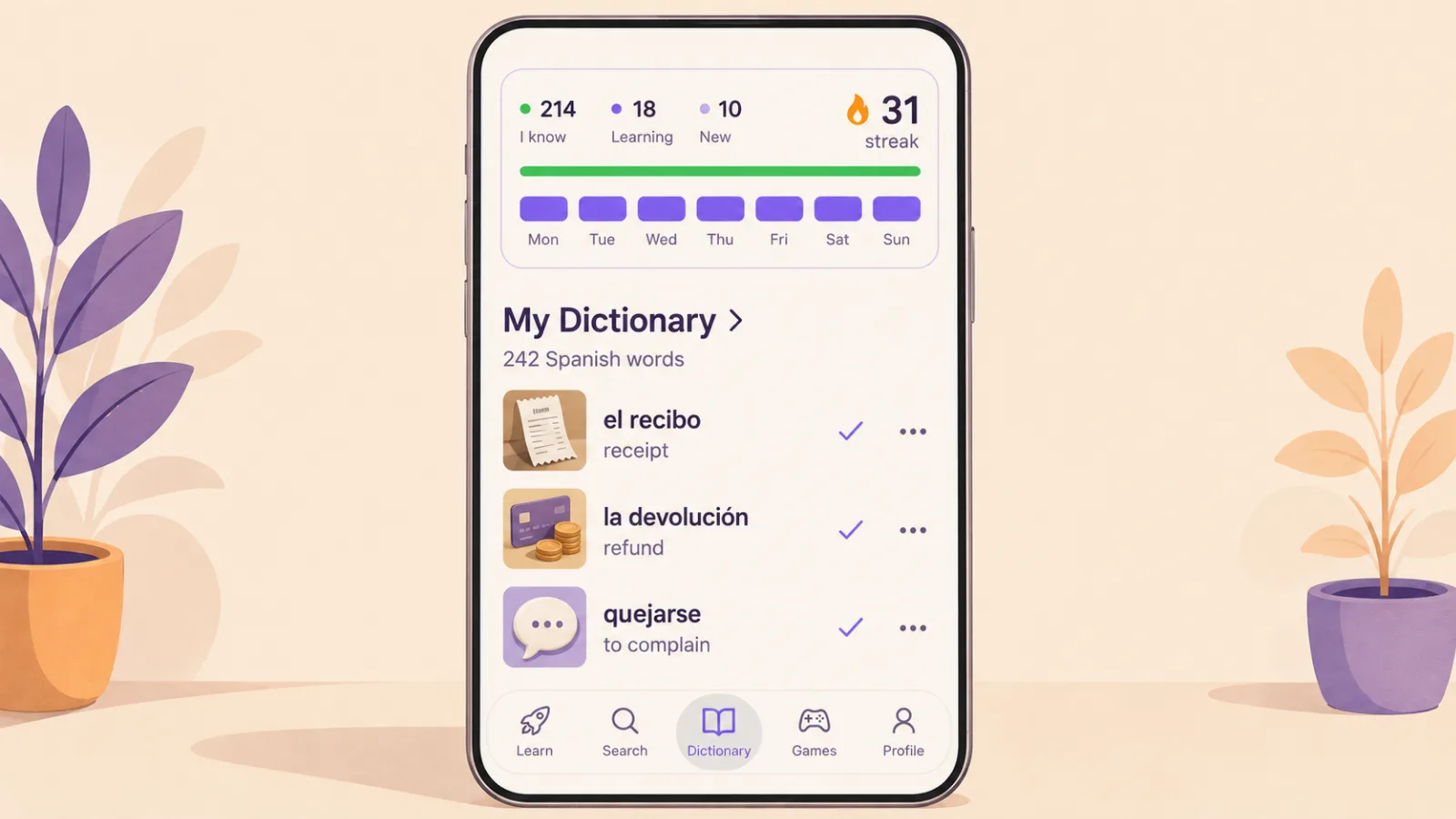
There is a second effect you notice later: with daily short sessions, words start surfacing on their own at the right moment. When el recibo, la devolución and quejarse have come up seven times in a week across different exercises, they arrive at the till without an internal translation from English.
How this works in VibeLing
The app takes over exactly the part people dislike doing — deciding what to review today and keeping an eye on continuity.
- The day streak on the home screen shows how many days in a row you have practised. It is the one counter worth watching: while the streak is alive, the rest follows.
- A short session is built to close in a few minutes rather than turn into an evening with a textbook.
- Spaced repetition picks today's words itself: some you saw yesterday, others a week ago and are about to forget.
- The "I know", "Learning", "New" counters show what is happening to your vocabulary, so progress is visible even on days when it feels like nothing is moving.
Where to start
- Pick the moment you will attach the session to: the first coffee, the commute, ten minutes before bed.
- Set the quota deliberately low — five to ten words.
- Practise seven days in a row without increasing the portion, even when you feel like it.
- On the eighth day look at the streak. If it is holding, change nothing — just keep going.
Spanish accumulates in the background rather than in sprints before a trip: a little at a time, but every day. For that to happen by itself you need a short daily session and an app that remembers which words are due. Start a streak in VibeLing today and let it survive a week.