Vocabulary Exercises That Actually Work
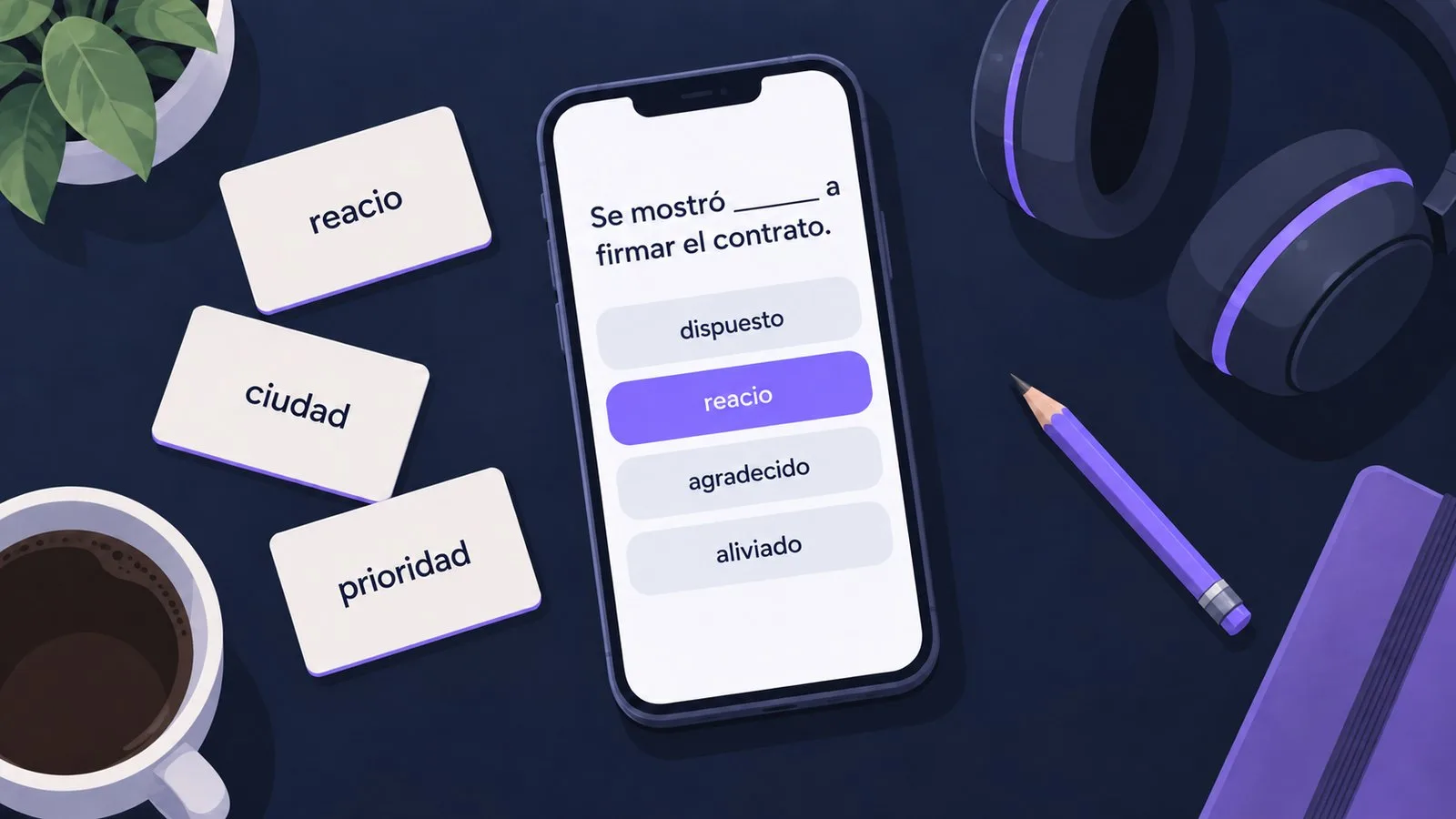
You can recognize a word in a text and still fail to produce it in a conversation. Those are two different skills, and most exercises train only the first one: they show you a word and ask you to pick its translation out of four. A week of that and the quiz is passed, but the word never shows up when you speak.
Below is a breakdown of vocabulary exercises by one criterion: what exactly they make you do with a word. Some are good for a first meeting and a warm-up, others for making the word stay. For each type there is a free online game on vibeling.app, so you can try them as you read.
The main criterion: how much effort the exercise demands
Memory strengthens a word not through the number of exposures but through the effort of retrieving it. When you have to pull a word out of your head with no hint on screen, the connection gets stronger than when you only need to recognize it among options. The mechanism is covered in recall or reread; the takeaway here is simple: the more hints there are on the screen, the less an exercise gives you.
So it helps to arrange exercises on a ladder of effort:
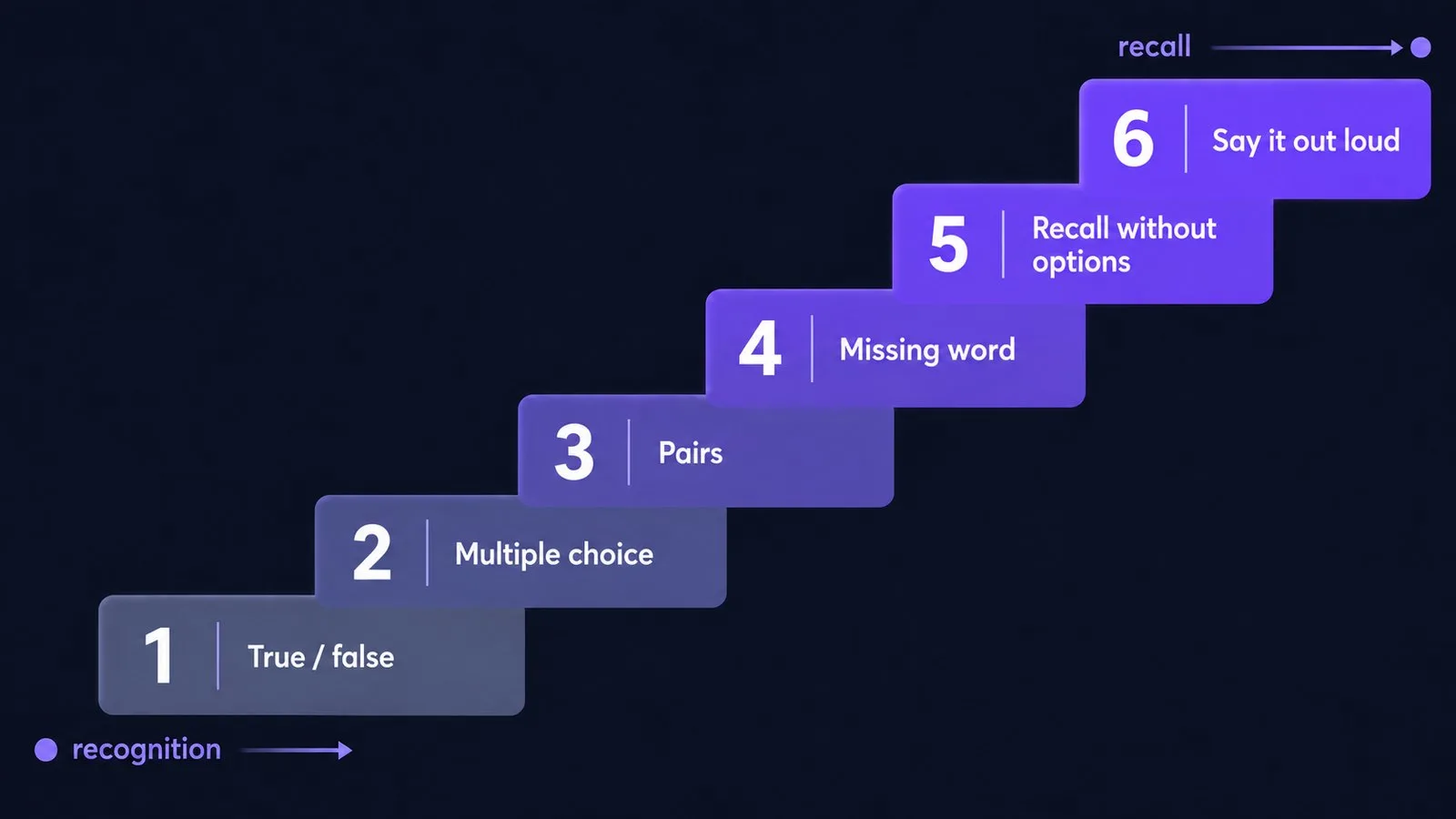
| Step | Exercise | What you do | When it fits |
|---|---|---|---|
| 1 | True / false | Accept or reject a given translation | First meeting, warm-up |
| 2 | Multiple choice | Recognize the right option | First days with a word |
| 3 | Pairs | Match words to translations, ruling out the rest | Consolidating a group of words |
| 4 | Missing word | Fit a word into a sentence by meaning | Once you already recognize the word |
| 5 | Recall without options | Produce the word from its translation yourself | To make it stick long-term |
| 6 | Say it out loud | Pronounce the word or a phrase with it | To get the word into speech |
Starting on the lower steps is fine. The problem starts when you stay there.
Steps 1–2. Recognition: true/false and multiple choice
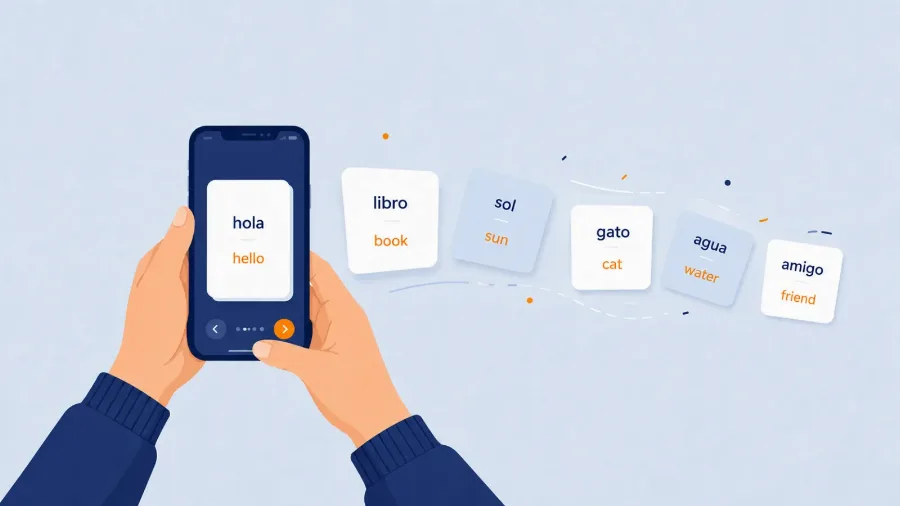
The easiest exercises. In the first, you see a word with a translation and decide whether the pair is correct. In the second, you see a word and four possible translations. Both give you the same thing: a fast introduction to a lot of words and a check that you recognize them at all. They do not build the link from meaning to word, because the hint is already on the screen.
Use them as a one-minute warm-up before the main session or to run through a batch of new words quickly. You can try it in the game True or False: sixty seconds, three lives, a Spanish word and a translation on screen, and you tap “True” or “False”.
Multiple choice has a trap. If three options clearly do not fit (wrong part of speech, too long, too short), you guess the right one without knowing the word. Apps with well-built training pick distractors so you cannot rule them out by shape, but that does not remove the underlying issue: recognizing is easier than recalling.
Step 3. Pairs
Several words and the same number of translations on a board; you connect them. It looks like the same multiple choice, but there is a difference: every pair you make narrows the field for the rest, and you have to hold several words in your head at once. It works well when you need to lock in words from one topic: ten kitchen words, ten verbs of motion.
The game Pairs gives you sixty seconds for it, and a wrong pair costs two.
Next to step 3. Picture and sound: bypassing translation
Two exercises that connect a word to something other than its translation.
Picture. A photo and four words; pick the one that fits. The word attaches to an image and stops depending on an English go-between. Especially good for objects, food, and actions, where the picture is unambiguous. Game: What's in the Picture, ten photos, ten seconds each.
Sound. A word is read aloud and you pick its translation. Recognizing words by ear does not come by itself from reading: ciudad on paper is obvious to everyone, but in fast speech, with both d’s softened almost to nothing, it is not. Game: Audio Sprint, ten words, and you can replay each one.
Step 4. Missing word: the best of the exercises with options
A sentence with one word missing and four candidates. It is still a choice, but it is built differently from choosing a translation, and it works noticeably better. Here is why:
- The word is tested through meaning, not translation. To answer, you have to understand the whole sentence and find the word that belongs in it.
- You remember the surroundings. You see which words it stands next to and in what construction: reacio on its own is harder to remember than reacio a firmar.
- The options do not give it away. All four are the same part of speech and all fit the gap grammatically. You cannot rule them out by shape, only by meaning.
- That is how words show up in real life. In text, in speech, in writing, a word arrives inside a sentence, not paired with its translation.
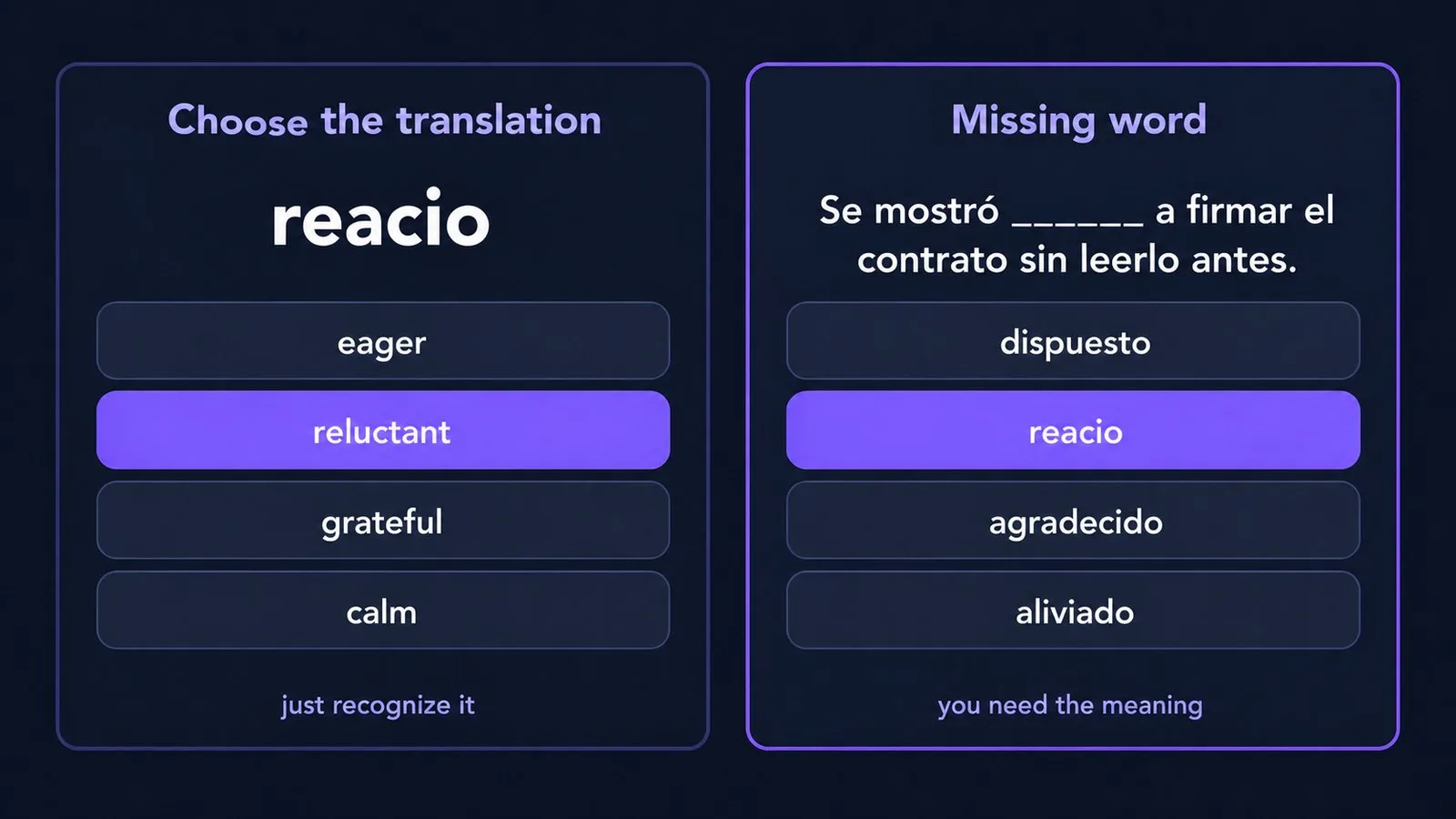
Compare two tasks on the same word:
Choose the translation: reacio — a) eager, b) reluctant, c) grateful, d) calm
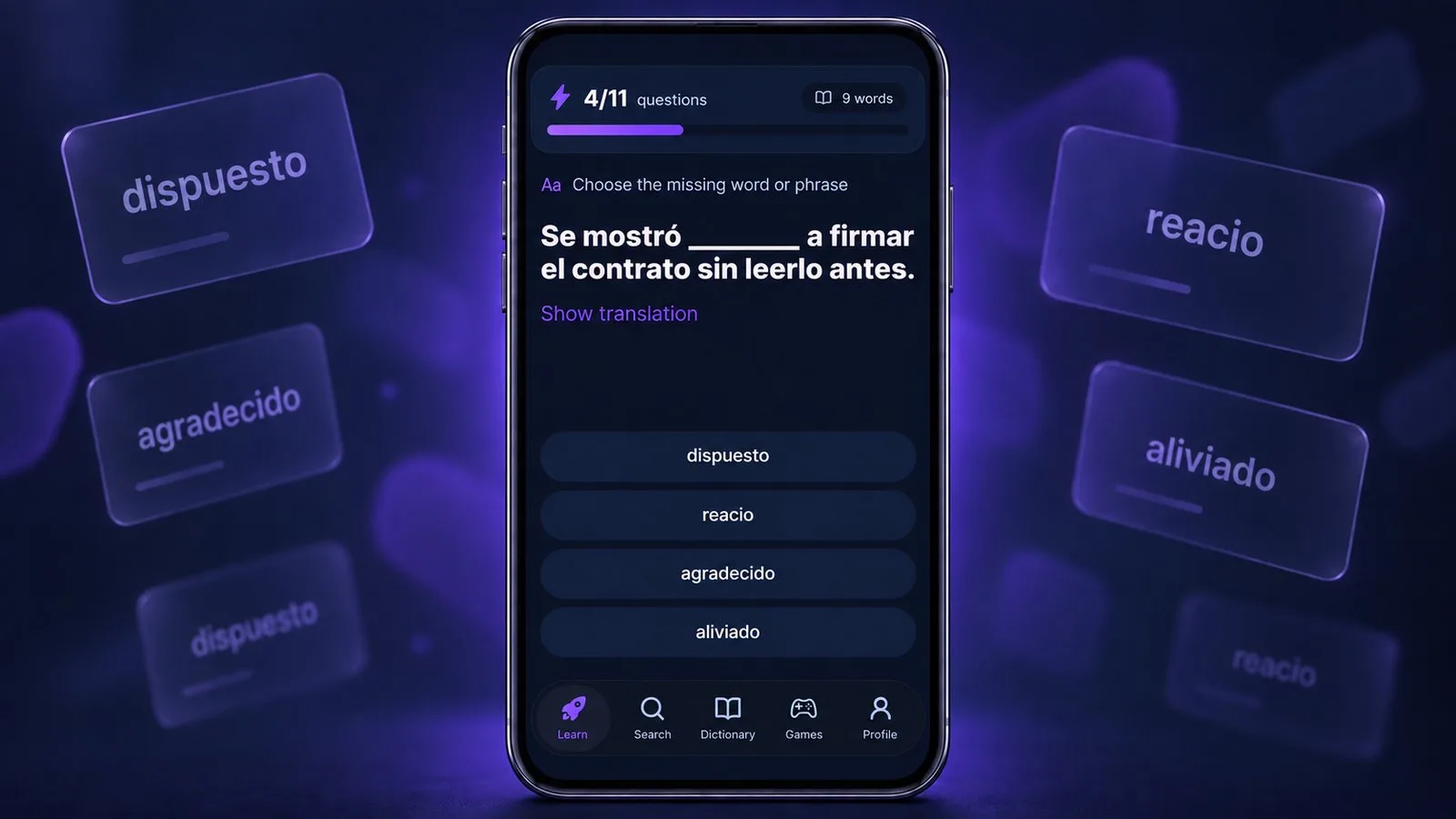
Missing word: Se mostró ______ a firmar el contrato sin leerlo antes. — dispuesto · reacio · agradecido · aliviado
In the first case, recognizing the word is enough. In the second, you need to know the word, how it behaves in a sentence, and to notice that dispuesto means the opposite and clashes with sin leerlo antes. The second task is harder, and that is exactly why the word lasts longer after it.
Try it: the game Missing Word, ten sentences, twenty seconds each. In the VibeLing app the same mode runs on your own words: every saved word comes with example sentences, and the exercise takes the sentence from there.
Two related exercises: odd word and sentence building
Same principle, the word in context, turned a different way.
Odd word. One extra word has been slipped into a sentence, and you have to find it. It trains a feel for sentence structure: you learn to notice that this word cannot stand here. Game: Find the Odd Word.
Sentence building. The words of a sentence are shuffled and you put them back in order. It trains word order and fixed combinations, the things you cannot learn word by word. Game: Build the Phrase, five sentences, thirty seconds each.
Both are useful once the words are familiar and it is time to learn to string them into speech.
Guess by definition
A definition in Spanish and four words. This is a step toward thinking in the language: the word gets linked to an explanation in Spanish rather than to an English equivalent. It works at intermediate level and above, once definitions read without a dictionary. Game: Guess by Definition.
Step 5. Recall it yourself, with no options
Everything above came with options. The next step is to remove them. You see a translation, a picture, or a definition, and you have to name the word. Nothing on the screen helps. This is the most effective exercise known and the least comfortable: at first, half the words will not come. That is how it should be; the effort itself is the training.
Formats:
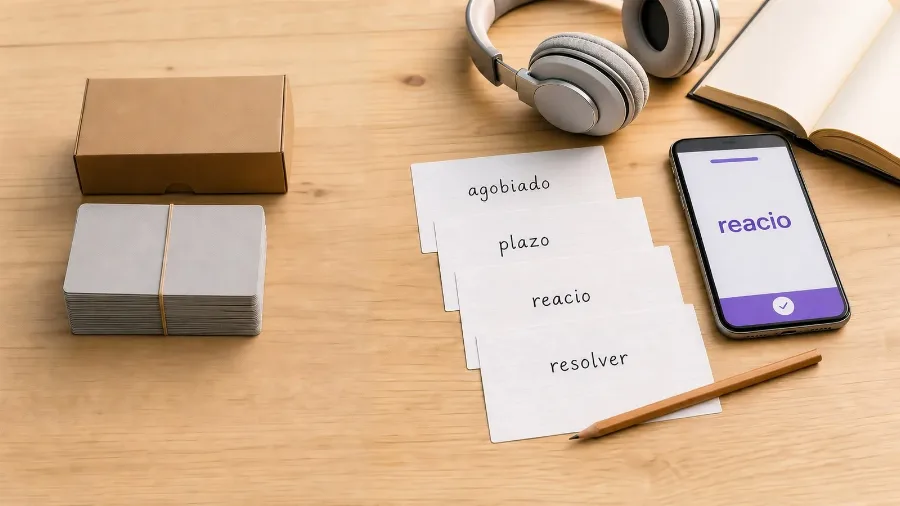
- Flashcard with self-check. Look at the translation, recall the word, flip the card, and mark honestly: remembered or not. Honesty matters more than speed here; marking “remembered” for a word that surfaced after ten seconds of struggle only fools you.
- Build the word from letters. The letters are given, the order is not. A middle ground between choosing and free recall, handy for long words where spelling matters.
- Type the whole word. The strictest version. It checks spelling as a bonus.
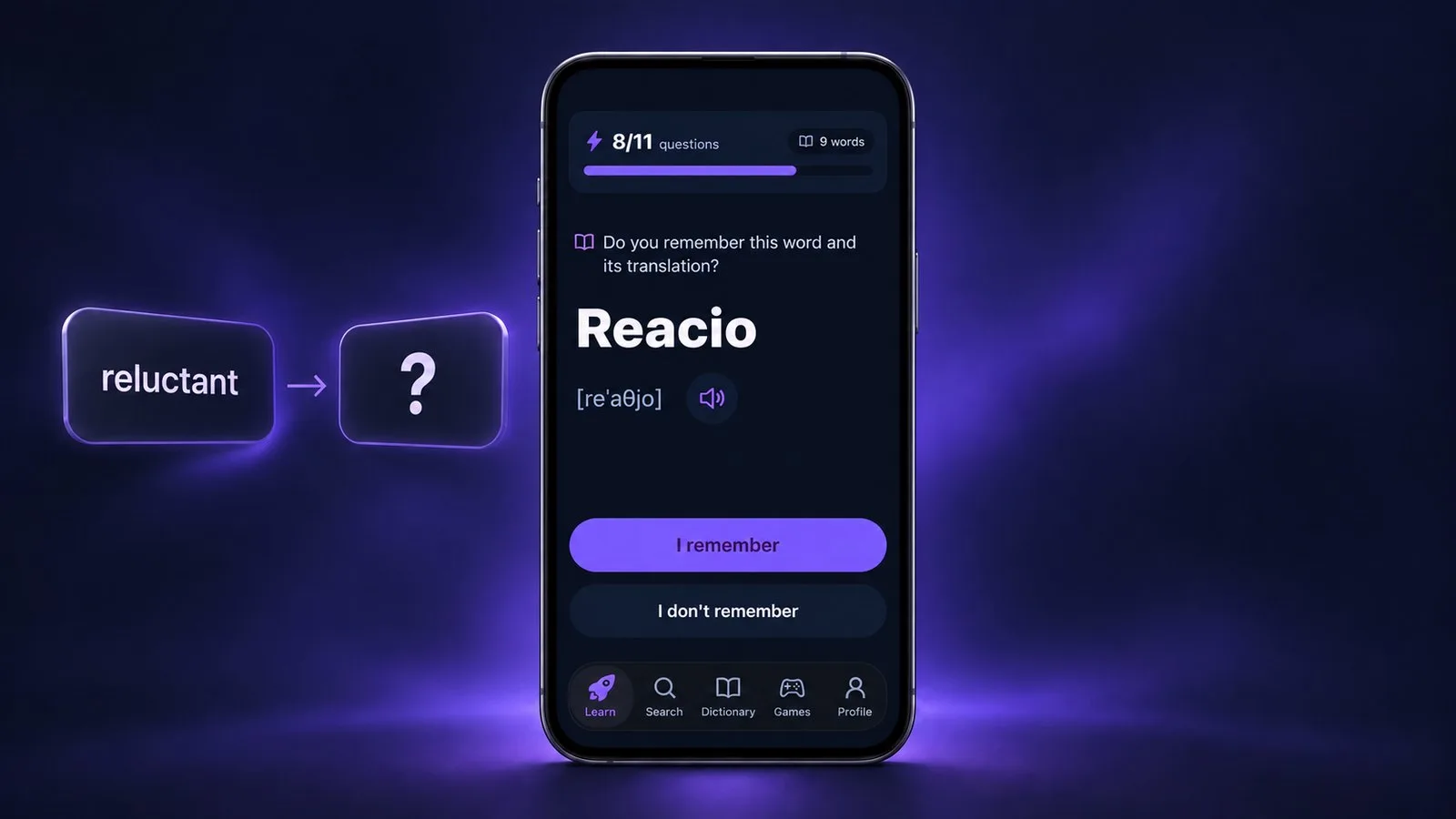
VibeLing has two modes on this step: Recall, with “I remember” and “I don’t remember” buttons, and Build the Word from letters. Words you fail to recall come back in the queue sooner, and words you recall steadily move to “known” and show up less often.
Step 6. Say it out loud
A word you recalled silently is not yet the same as a word you have said. Say it out loud, better still in a short sentence: Era reacio a llamarlo. The exercise takes seconds, but this is what moves a word from “I understand it” to “I use it”. VibeLing has a Pronunciation mode for this: you hold the microphone button, say the word, and the app recognizes and checks it.
What does not work
- Rereading a list. The words start to look familiar, and that feeling is easy to mistake for knowledge. Rereading barely affects recall.
- Writing a word out ten times in a row. The hand works, the memory rests. Writing it once from memory beats copying it ten times.
- The same easy exercise on all words forever. A recognition quiz is passed quickly, and it feels like the words are learned. Until you try to say them.
- Many new words at once with no return. Any exercise you do not follow up on a day or two later is close to wasted. How to space the returns is covered in the article on spaced repetition.
How to put this together into a routine
- A new word. One or two rounds of multiple choice or missing word, to meet it and see it inside a sentence.
- A day later. Pairs or missing word: you already recognize the word, now you have to tell it apart from its neighbors and see it in context.
- After that. Only recall without options and pronunciation. A word you recall steadily several times in a row, at growing intervals, can be considered learned.
The games on the site are handy for warm-ups and check-ins: a minute or two, words from the shared dictionary, no sign-up. The words you got wrong can be taken into the app after a run and finished off there with spaced reviews. All eight games work in nine languages: Spanish, French, German, Italian, Portuguese, Romanian, Serbian, Turkish and English, and you pick the language on the word games page. If you want to know how big your starting point is, there is a vocabulary test.
Summary
A good exercise makes you pull a word out of memory rather than recognize it on a screen. True/false and multiple choice are fine for getting acquainted, the missing word teaches a word in context, and recall without options plus pronunciation make the word stay and come out in speech. Rotate the steps instead of sitting on one.
In VibeLing all of these steps are bundled into one daily session: you add your own words, and the app alternates multiple choice, missing word, recall, word building and pronunciation, bringing each word back right when it starts to fade. Give it a try; it is free, and you can start with the words you just missed in a game.