Shadowing: What It Is and How to Practice

You can know thousands of Spanish words, read articles without a dictionary and still stumble the moment you open your mouth. The sentence is ready in your head, but it comes out slowly, with pauses and the wrong melody. Shadowing is one of the few techniques that trains exactly this: not knowing words, but being able to say them quickly and naturally.
What shadowing is
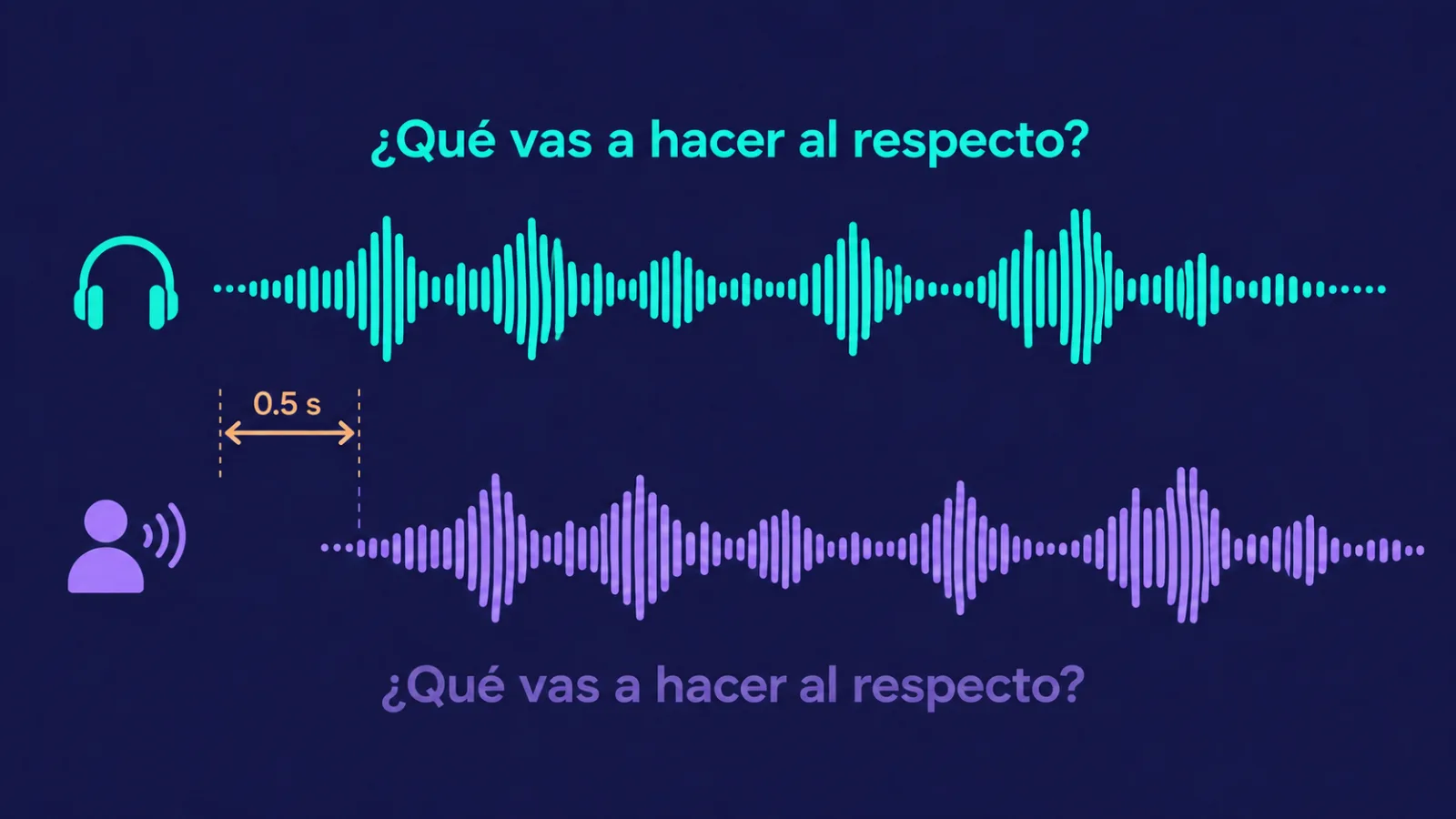
The name says it all. You play a recording of a native speaker and repeat after them out loud almost at the same time, about half a second behind, like a shadow following them. You don't wait for the end of the sentence and you don't hit pause: you speak along with the speaker, using the same words, the same pace and the same intonation.
The technique didn't come from language courses: it's how simultaneous interpreters train. It became widely known among language learners thanks to the polyglot Alexander Arguelles, who recommended shadowing on the move, walking briskly outdoors with headphones on.
What shadowing does and doesn't do
An honest look at the benefits. Shadowing is good at training:
- pronunciation and rhythm. You copy whole phrases with their stress and pauses, the way they sound in real speech, not isolated sounds;
- connected speech. Spanish speakers don't pause between words: va a ir comes out as one smooth chunk, and in many regions final s and whole syllables disappear. Until you've said these chunks yourself twenty times, you won't catch them by ear either;
- speed. The speaker sets the pace, not you. Your brain has to produce words faster than it's used to;
- ready-made phrases. Chunks like no estoy seguro or depende de start coming out on their own after a few rounds, without being assembled word by word.
What shadowing doesn't do: it adds almost no new vocabulary if you don't understand the material. You can repeat sounds you don't understand for hours, and that will train your mouth, not your Spanish. That's why the right technique starts with understanding the text, and only then moves on to repeating it.
What material to use
Half the result depends on the recording you choose. What works:
- Short clips, one or two minutes. You won't really work through a long recording, you'll just mumble along behind it.
- Always with a transcript. You need the text or accurate subtitles to figure out the unclear parts.
- A level you understand 80–90% of. If every third word is new, you won't manage to either understand or repeat.
- One voice and natural speech. A conversation where people interrupt each other is harder, and a narrator reading slowly syllable by syllable won't teach you anything.
Where to find it: podcasts for Spanish learners with transcripts, audiobooks together with the book text, TED en Español talks with transcripts, short scenes from Spanish-language shows with Spanish subtitles. There's a separate guide on choosing a podcast for your level: how to learn Spanish vocabulary with podcasts.
How to practice shadowing: six steps
1. Listen to the whole clip
Just listen without repeating anything. The goal is to get the gist: what it's about, who's speaking, what the mood is.
2. Work through the text
Read the transcript, find the unfamiliar words, look up their meaning. Mark the places that were unclear by ear even though you knew every word: that's usually connected speech, and it's exactly what you're practicing for.
3. Repeat with the text in front of you
Play the recording and speak along with the speaker, glancing at the transcript. At first you can do it under your breath or even mumble: what matters is matching the pace and melody, not every sound. If you can't keep up, slow the recording down to 0.75 — almost any player can do that.
4. Repeat without the text
Once it goes smoothly with the text, take it away. Now you're holding on to the sound alone. This is the most useful and the hardest part: this is where your listening gets trained.
5. Record yourself and compare
Record one run on your phone and play it next to the original. It's not pleasant to hear, but it shows exactly where you swallow endings, where you put the stress in the English way, and where your intonation goes down instead of up.
6. Come back to the clip a few days later
It's worth running the same clip three to five times over a week. The second time is easier; by the third, the phrases start sounding like your own. Take new material when the old one goes without stumbling.
Example: how a phrase really sounds
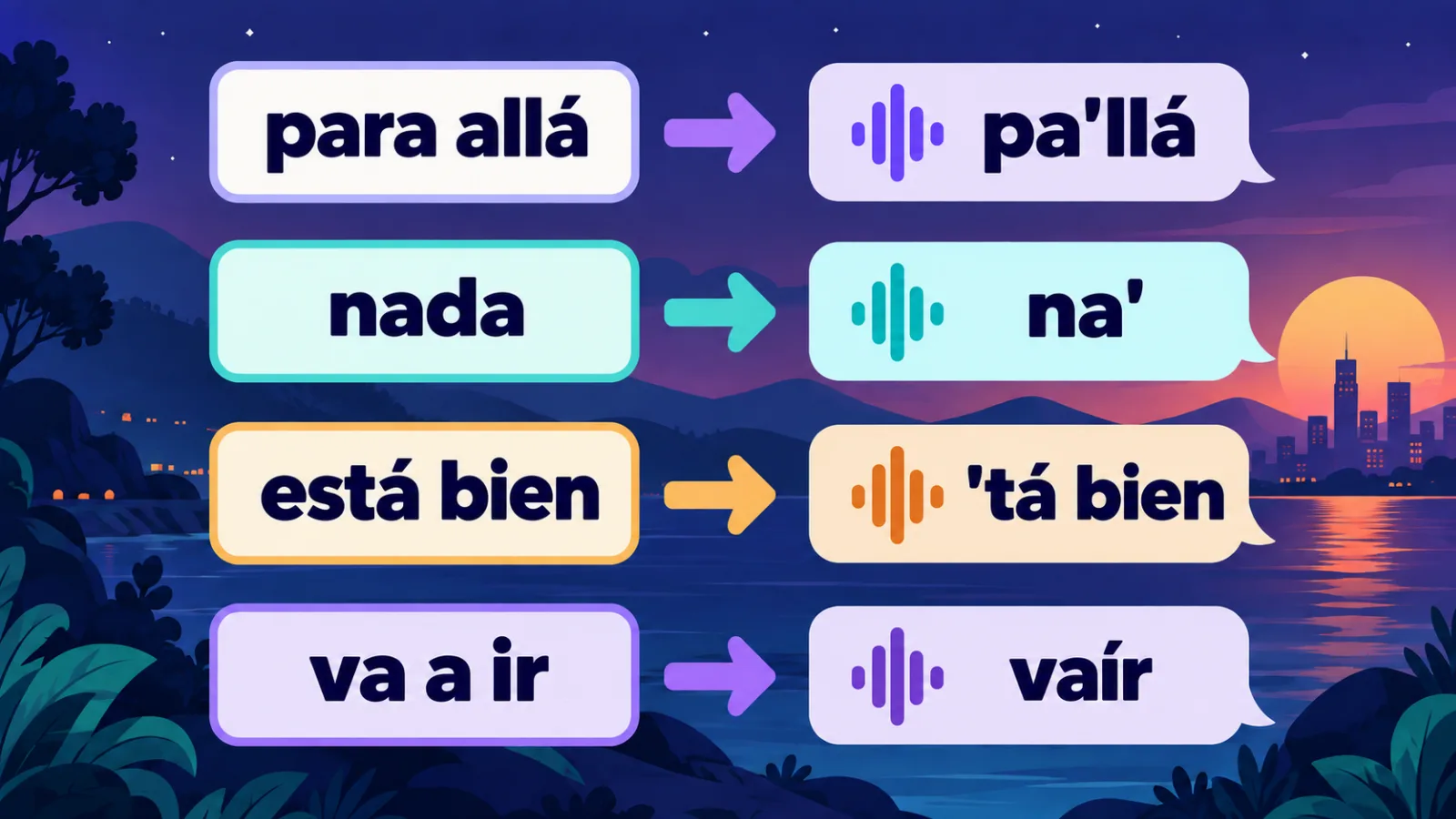
Here's what you see in the transcript and what you hear in casual speech. Keep in mind that the dropped sounds are typical of informal speech in some regions, such as the Caribbean and Andalusia; a speaker from Mexico City or Bogotá will pronounce more of them. But you'll run into these forms in shows, songs and podcasts all the time.
| How it's written | How it sounds |
|---|---|
| ¿Qué vas a hacer? | ¿Qué va' a hacer? |
| para allá | pa'llá |
| nada | na' |
| está bien | 'tá bien |
| todo el mundo | to' el mundo |
On top of that, Spanish runs vowels together across word boundaries everywhere, not just in some dialects: va a ir sounds like one word, roughly vaír, and lo hago like loago. You shouldn't write like this in a message to your teacher, but you do need to hear and say it. Shadowing gets your ear used to these blends, and in a couple of weeks pa'llá stops sounding like an unknown word. If listening comprehension is your main problem, also see how to understand spoken Spanish.
How much time it takes
Shadowing is tiring: it's active work, not background listening. Fifteen minutes a day is enough, and a little every day beats an hour on the weekend.
| Minutes | What to do |
|---|---|
| 0–3 | Listen to a new clip, work through the text |
| 3–8 | Repeat with the text, slowed down if needed |
| 8–12 | Repeat without the text |
| 12–15 | Record yourself, compare, note the hard spots |
If you're short on time, there's a lighter version for your commute: headphones on, under your breath, using a clip you've already worked through at home.
Common mistakes
- Material that's too hard. A news broadcast or a fast podcast for native speakers will only discourage you at the start. Begin with something you understand.
- Repeating without understanding. If you don't know what a phrase means, you won't learn it no matter how often you repeat it.
- Long chunks. Ten minutes of audio at a time is listening, not shadowing.
- Doing it silently. Silent "repeating in your head" trains neither your mouth nor your speed. You have to speak out loud.
- A new clip every day. The benefit comes on the third to fifth run of the same text.
How VibeLing helps with shadowing
While working through the text, you'll collect unfamiliar words and phrases. Save them in VibeLing: each word gets a translation, native audio and examples, and the app brings them back for review at the right intervals. That way the words from one clip don't disappear when you move on to the next.
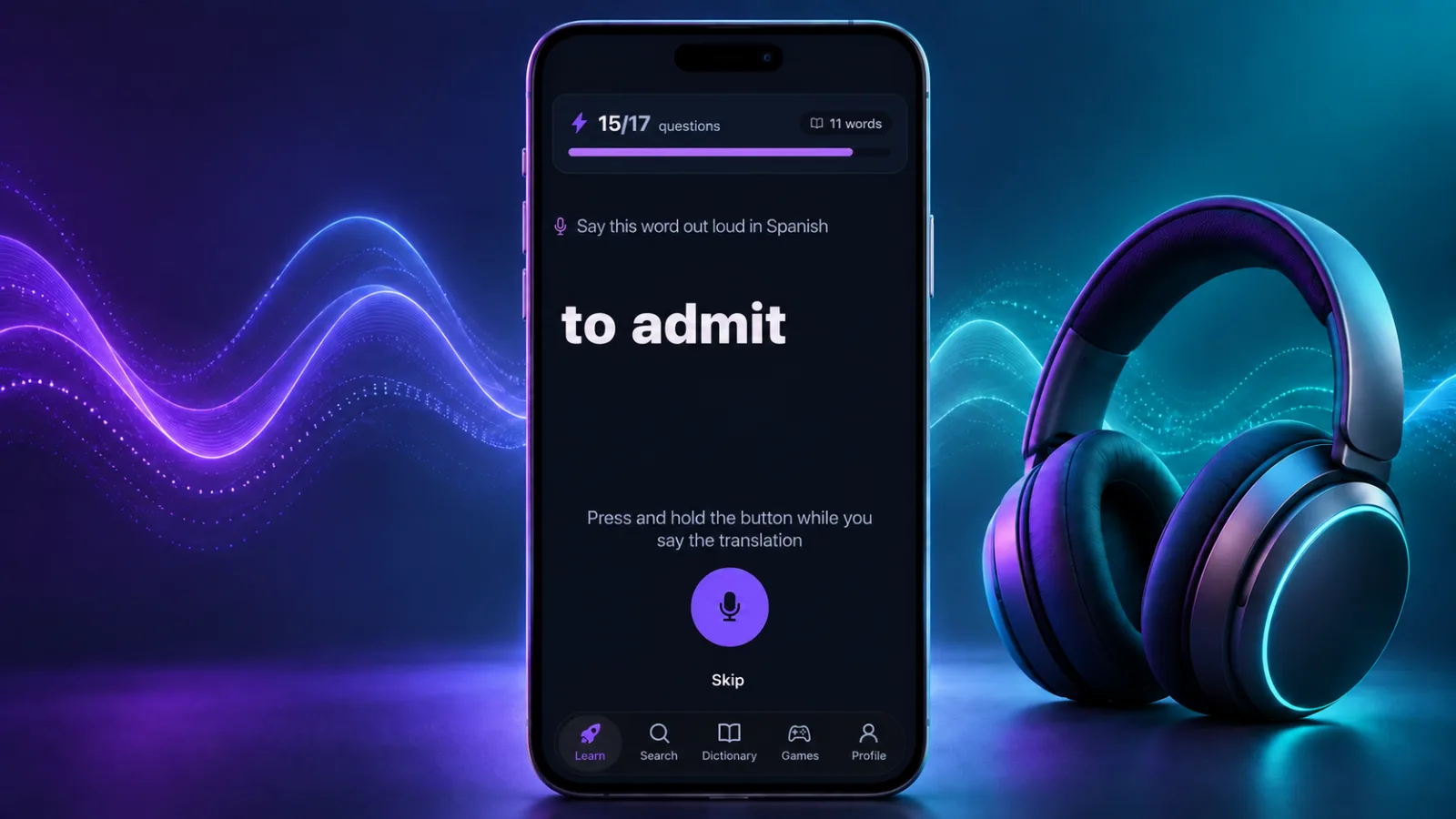
The pronunciation training is useful too: the app shows a word, you tap the microphone and say it, and speech recognition checks whether you got it right. It's a good complement to shadowing: there you work with whole phrases, here with the individual words you keep tripping over.
Pick one minute of a recording you actually find interesting today and go through it step by step. The words you meet along the way are easy to save in VibeLing and practice later, so that a week from now they sound as confident as the text you shadowed.