Learn Spanish Vocabulary by Playing Video Games
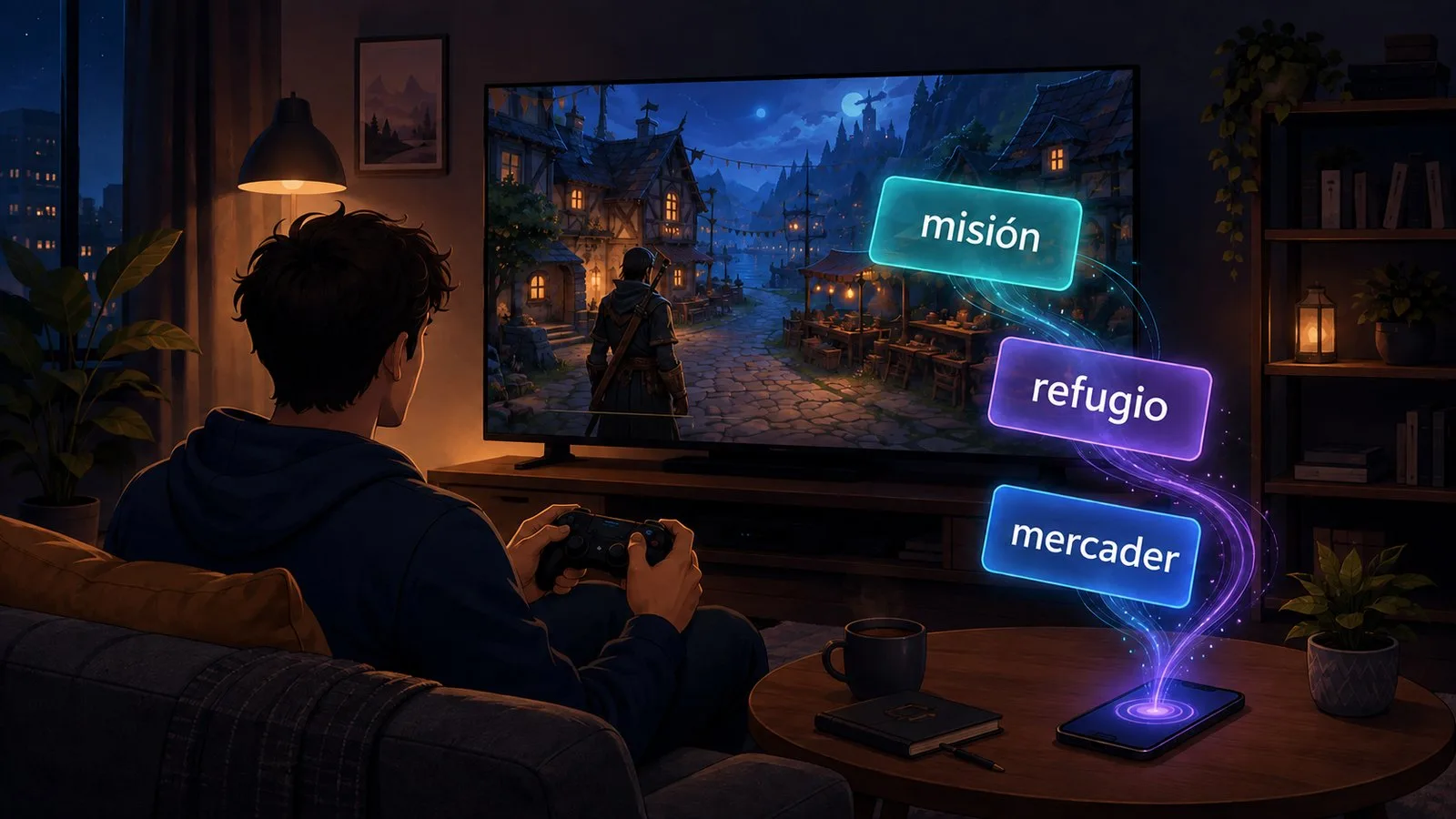
In one evening of gaming you will read several thousand words: character lines, item descriptions, quest text, loading-screen tips. Plus the interface, which repeats the same labels dozens of times per session. That is about as much reading as a chapter of a book, except you never feel like putting it down halfway through.
Games really do work as a source of language, but not on their own. Here is what they actually give you, which genres are worth playing in Spanish, which ones are useless, and what to do with the words so they don't stay locked inside the game.
Why words from games stick better than words from TV shows
In a game, the language is there to be used. If you don't understand what a character is asking for, you won't find the place and won't move on. That sentence gets processed far more carefully than a line in a series, which you can half-hear and still follow from the picture.
The second difference is that you set the pace. You can leave a dialogue box open until you've finished reading it; an item description stays on screen as long as you need; nobody runs off while you're paused. Film can't do that, which is exactly why watching shows in Spanish is harder for a beginner than playing.
The third is repetition. Over twenty hours in a single game you'll see words like misión, inventario, mejora, munición, recursos and habilidades hundreds of times. No textbook gives you that many encounters in natural context.
Which games work and which are useless
Two criteria decide it: how much language the game contains, and whether you have time to think. Genres split fairly cleanly along those lines.
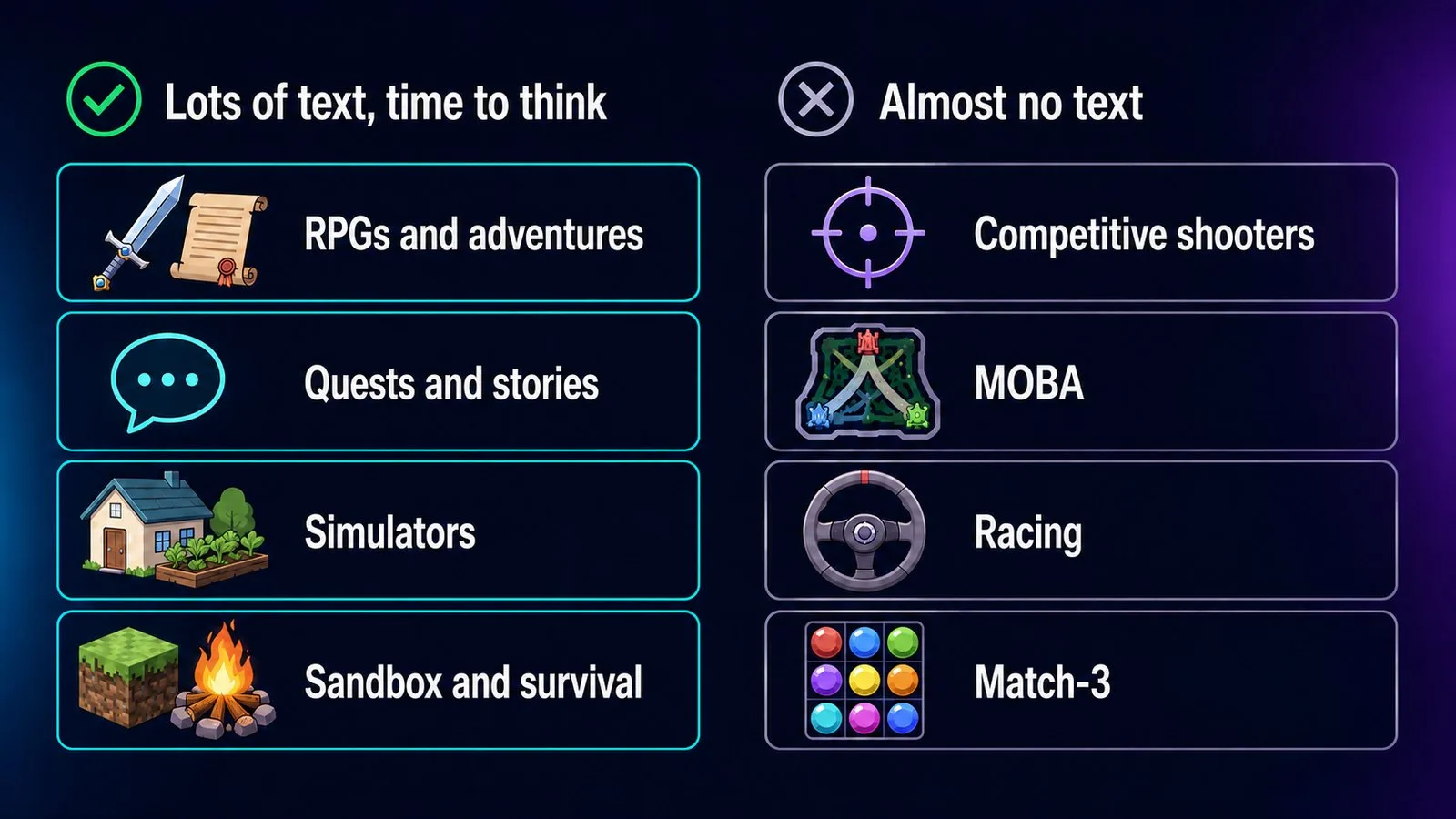
| Works well | Why |
|---|---|
| RPGs and adventures (The Witcher 3, Skyrim, Mass Effect) | Huge amounts of dialogue, read at your own pace, usually with subtitles for the voice acting |
| Narrative games (Life is Strange, Firewatch, Detroit) | Real conversational speech, simple everyday phrases, lots of repetition |
| Simulation and management (Stardew Valley, The Sims, Cities: Skylines) | Everyday, concrete vocabulary, no timer, everything is labelled |
| Sandbox and survival (Minecraft, Valheim, Subnautica) | Item and material names come up constantly, and the vocabulary is very tangible |
| Gives you almost nothing | Why |
|---|---|
| Competitive shooters and MOBAs (CS, Dota, Valorant) | Little text, no time to read it, and voice chat is ten commands plus swearing |
| Sports games and racing | A couple of dozen menu words and that's it |
| Mobile match-3 and idle games | A five-button interface, no text at all |
If you're worried about understanding nothing, there's a simple trick: pick a game you have already finished in English. You know the plot, you can predict what's happening, and the Spanish text reads almost without a dictionary because you infer meaning from the situation. That is the same principle as comprehensible input: a language sinks in when you understand around eighty percent, not twenty.
How to switch a game to Spanish
In Steam: library → right-click the game → Properties → General → Language. Some games only change the interface there and download the voice track separately, in which case the audio is set inside the game's own options. On consoles the language usually follows the system setting, and the same goes for mobile games.
A sensible starting setup: interface and text in Spanish, Spanish audio, subtitles on. Hearing and seeing a phrase at the same time is far more useful than either alone — the same reason it pays to use Spanish subtitles rather than English ones. If after half an hour you understand less than half, switch to an easier game rather than back to English.
What kind of vocabulary games actually give you
This is where it pays not to fool yourself. Games hand you three very different layers of words, and they are useful in very different degrees.
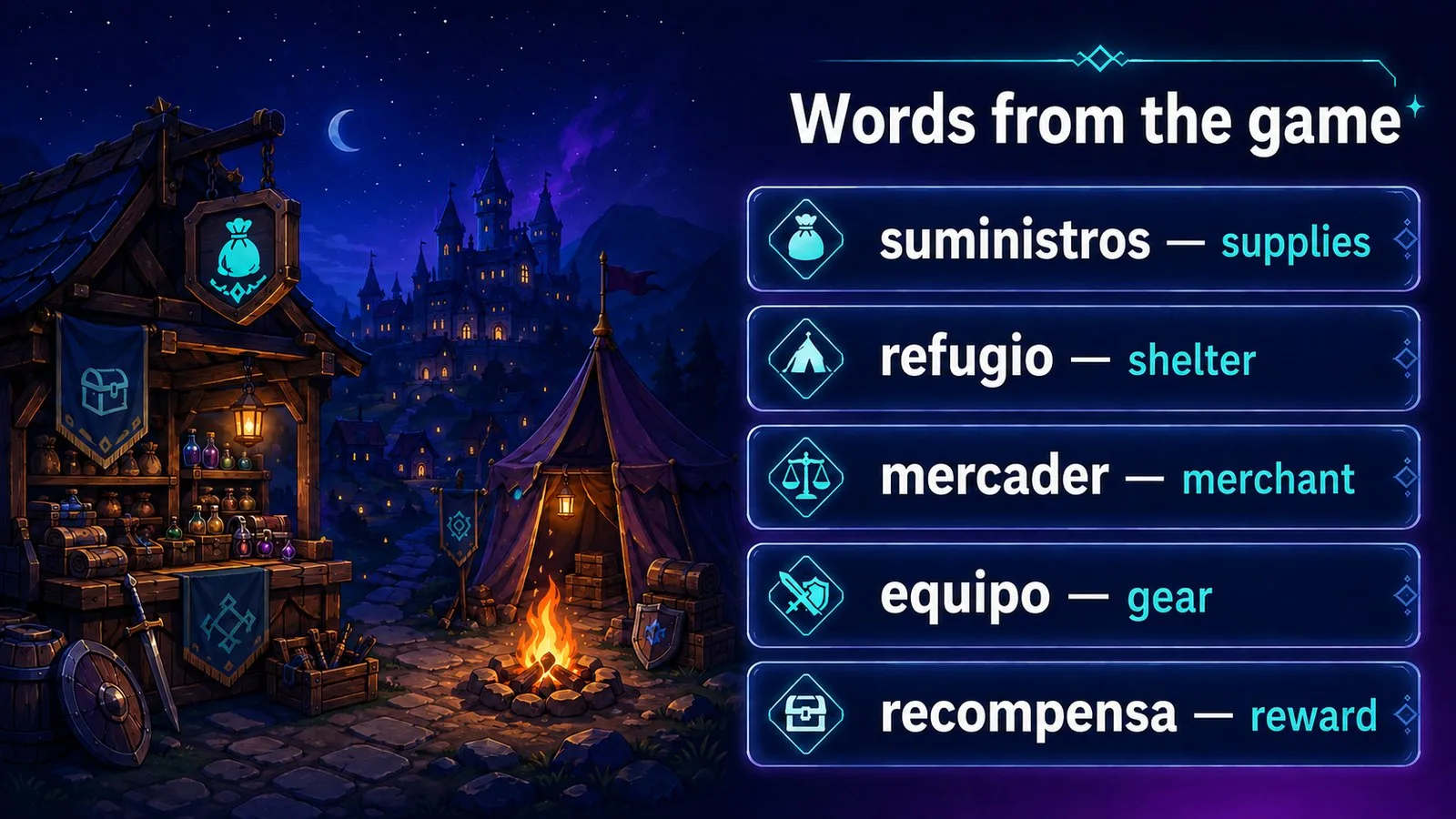
First, ordinary vocabulary you need everywhere. There's plenty of it, especially in dialogue and item descriptions:
| Word | Translation | Where it shows up |
|---|---|---|
| suministros | supplies | Survival, strategy |
| refugio | shelter | Survival, post-apocalyptic settings |
| mercader | merchant | RPGs, medieval settings |
| recompensa | reward | Quests in any game |
| equipo | gear, equipment | RPGs, shooters |
| amenaza | threat | Strategy, horror |
| asentarse | to settle | Building and colony sims |
| abandonado | abandoned | Location descriptions |
Second, the functional words of the interface. Guardar, cargar, ajustes, aplicar, omitir, continuar, dificultad, logros. These carry far beyond games: you'll meet exactly the same set in any app and on any website in Spanish.
Third, pure gaming slang: farmear, lootear, nerfear, respawnear, campear. Outside conversations with other players it does nothing for you. It's fun to know, but it doesn't deserve a place in your vocabulary list next to the first two layers.
The real trap: I understand it in the game and can't recall it anywhere else
This is the classic problem for people who have been learning through games for years. You see puesto abandonado for the hundredth time and grasp it instantly. But when you need to say "abandoned outpost" yourself, nothing comes. Inside the game you always have support: the picture, the situation, a familiar word in a familiar spot on the screen. Take those away and it turns out the word was recognisable but never really yours.
There's one cure: you have to retrieve the word yourself at least once, with no prompts, and then meet it again a few days later. That's exactly what an outside list is for. You save refugio during play, and in the evening or the next day the app asks you about it — not as text you recognise, but from the English side, where you have to produce the Spanish.
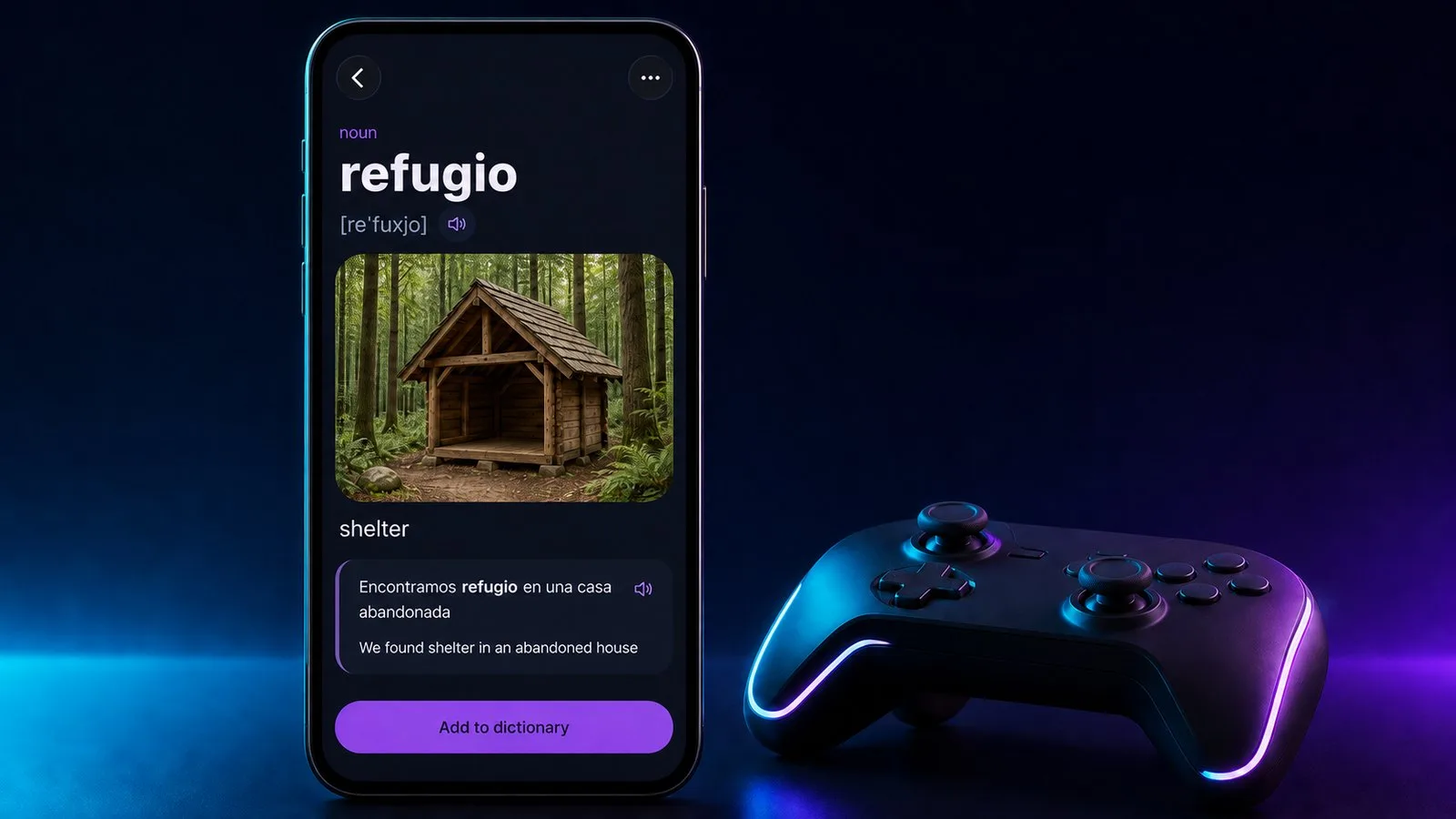
In VibeLing that takes seconds: look the word up, see the translation, transcription, audio and an example sentence, and add it to your list. From there it joins your daily practice and comes back on a spaced-repetition schedule until it settles for good.
A workable routine for one gaming evening
Don't try to translate everything as you go — you'll stop playing, and the game will stop being fun. The routine that actually works is much more modest.
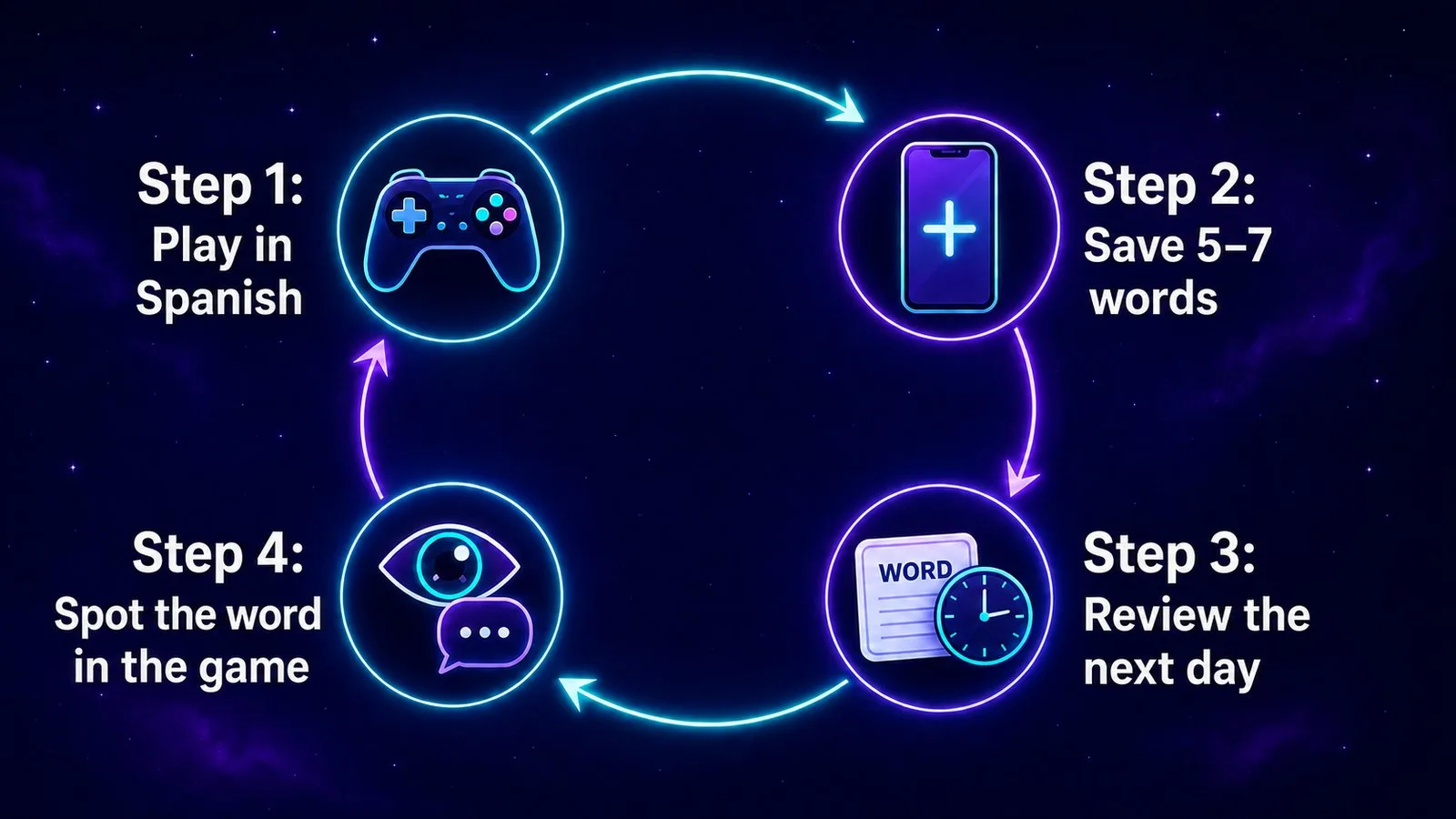
- Play the way you normally would. Unfamiliar words whose meaning is obvious from context you simply let go.
- Five to seven words per session. Stop only for the ones that block your understanding or that you've now seen more than once. Go past seven and the evening turns into dictionary work.
- Save now, study later. It's enough to drop the word into a list in one tap; examples and pronunciation can wait until after you've finished playing.
- Review the next day. Ten minutes of practice moves yesterday's words from "seen it somewhere" into vocabulary you can actually use.
- Go back to the game. A day or two later the same words turn up again, this time as old friends. That's the most satisfying part of the whole loop.
Seven words an evening, three or four evenings a week, is more than a thousand words a year — and every one of them met in real, living text.
Multiplayer: where speaking starts
Everything above is about reading and listening. Games teach speaking too, but only co-op and role-playing ones: MMO raids, building together, co-op survival runs. There you have to negotiate — warn people, ask for things, explain the plan. The speech comes out simple and functional: voy por la izquierda, espérame, necesitamos más madera, ¿me cubres?
The barrier is lower than at a conversation club: nobody is grading you, everyone is busy with the task, and a wrong gender on a noun bothers no one. If opening the mic feels like too much, start with text chat, where you have time to put a sentence together.
Where to start tonight
Pick a text-heavy game, ideally one you've already finished. Switch it to Spanish along with subtitles. Build the habit of stopping on five to seven words a session and putting them somewhere other than your memory.
What happens outside the game decides the rest: the words you save are worth practising in VibeLing so they don't dissolve along with your save file a week later. The game gives you the first encounter with a word; the app gives you the second, third and fifth.