How to Create a Language Immersion Environment at Home
People usually talk about language immersion as if it were geography: move to the country and the language comes on its own. I've been living in Serbia for four years now, and I can tell you from experience that it doesn't work that way. In my first year my Serbian barely grew, even though everyone around me spoke nothing else. At home we spoke Russian, at work I used English, my phone was in English, my shows were in English. The street was in Serbian, but the street took up half an hour a day, and the rest of the time I lived in two other languages.
Immersion isn't where you live. It's where your eyes look and what your ears hear for most of the day. And that is exactly the thing you can build yourself without moving anywhere. Below I break down the layers it consists of, what in each layer actually gives you words, and what only creates a feeling of being busy.
What a language environment really is
An environment does two things. First, it gives you a lot of comprehensible input: you keep meeting words in context, and some of them stick without any effort. Second, it creates necessity: you have to understand or say something, because otherwise you can't get on with your day. Abroad, the second part appears by itself. At home it doesn't, and that is the only real difference.
Two conclusions follow. First: the input can be organized at home entirely, and that's most of the effect. Second: the necessity will have to be simulated at home, and people often forget about that. I wrote in more detail about how input works and why it has to be comprehensible rather than just loud in the article on comprehensible input. This one is about practice.
Five layers of a home environment
I split it into five layers: screen, audio, video, text and speech. They are not equal, and you don't need to fill all of them at once. But it helps to see which of them are already taken by Spanish and which are still in your native language.
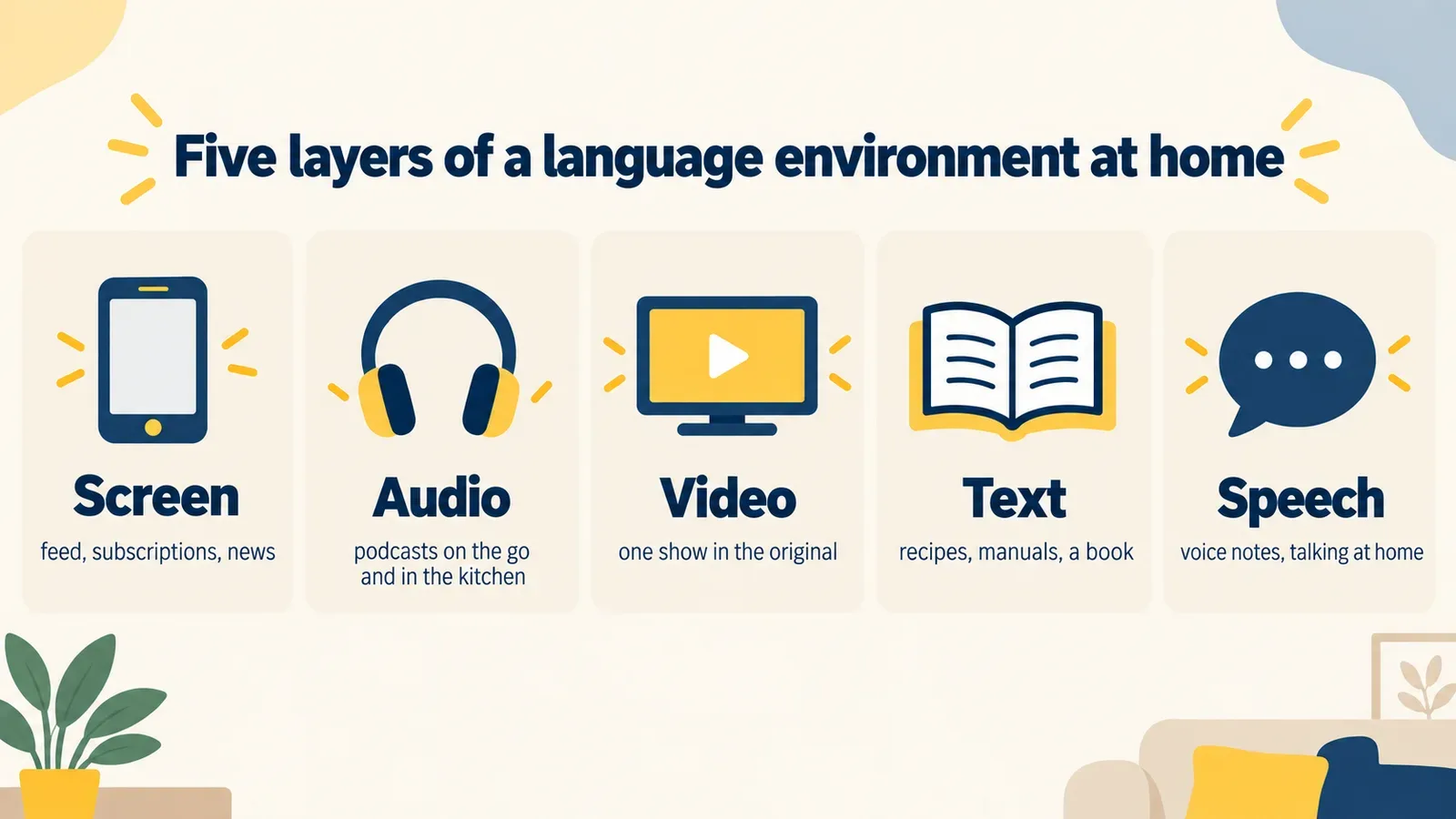
Layer 1. Screen: phone and laptop
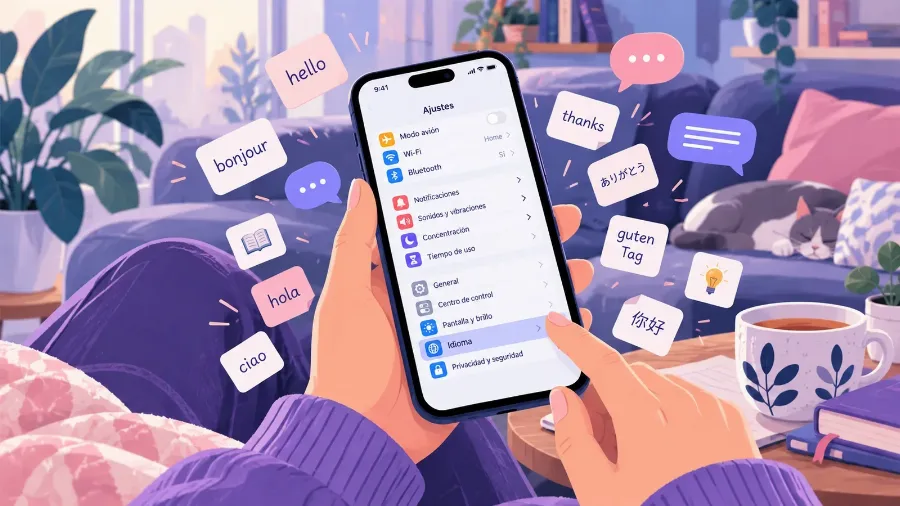
The most popular tip: switch your phone to Spanish. I did that, and honestly, your vocabulary grows very little from it. An interface is a couple hundred words like ajustes, cancelar, notificaciones, which you'll learn in a week and then simply stop noticing.
What really works on the screen is the feed. Your YouTube subscriptions, the accounts you read in the morning, the news site you open over coffee. If three out of the ten sources you look through every day are in Spanish, you'll get more input than from any app with lessons. And it will be input on topics you're already interested in, which means the words will be understandable from context.
A practical step: don't switch everything, replace two or three sources. Subscribe to a Spanish channel about your hobby instead of an English one. Read the news about your field in Spanish, if that's where it shows up anyway.
Layer 2. Audio: what plays while you're busy
Cooking, cleaning, commuting, the shower. Most people have an hour to an hour and a half a day when their hands are busy and their head is free. That is the best time for podcasts and radio in Spanish, and it's free: you're not taking it away from anything else.
One important caveat. Background listening, when you don't understand most of it, gives you little. It gets your ear used to the rhythm of the language, and that's not nothing, but words don't come that way. So one source has to be active: a podcast you really listen to and understand at least halfway. The rest can play in the background.
Layer 3. Video: a show instead of a course
A show gives you what a podcast can't: the picture. You see who is talking to whom and what is going on, and half of the unfamiliar words become clear without a dictionary. Plus, you were going to watch the show anyway.
There's only one rule here: not "all content in Spanish", but one specific show that you watch only in the original. One, because switching to the dubbed version happens at the moment you're tired, and if that show has no English version in your habits, there will be nothing to switch to. How to choose subtitles and what to do with scenes you don't understand is covered in the article on learning Spanish with movies and TV shows.
Layer 4. Text around the house
This is the most underrated layer. A book on the nightstand, a recipe in Spanish instead of English, the manual for a new device in Spanish. Sticky notes on objects belong here too, although they give less than people write about them: you'll learn the word nevera on the fridge in a day, and after that the note becomes part of the decor.
Texts you read for a purpose work better. I translated every recipe I cook by into Spanish, and in a couple of months my kitchen vocabulary assembled itself: hervir a fuego lento, batir, una pizca de sal, llevar a ebullición. Not because I studied them, but because I needed to understand what to do next with the pot.
Layer 5. Speech: simulating necessity
This is where a home environment loses to moving abroad the most. Abroad you have to speak. At home nobody makes you, and this layer is usually empty.
What you can do. Agree with someone at home that a certain topic is discussed only in Spanish: what to cook for dinner, for example. Record voice notes to yourself in Spanish instead of text ones. Say your plan for the day out loud while you get ready. It looks a bit odd, but this is exactly where words move from your passive vocabulary to the active one, and without this layer you'll understand the show and still be unable to order a coffee.
The main leak: words pass straight through
A home environment has one problem I couldn't handle for a long time. There are a lot of words around, but they don't stay in your vocabulary. You heard it in a show, understood it from context, met it again a week later and didn't remember it again. The environment works like a river: words flow past, and you need something to catch them with.
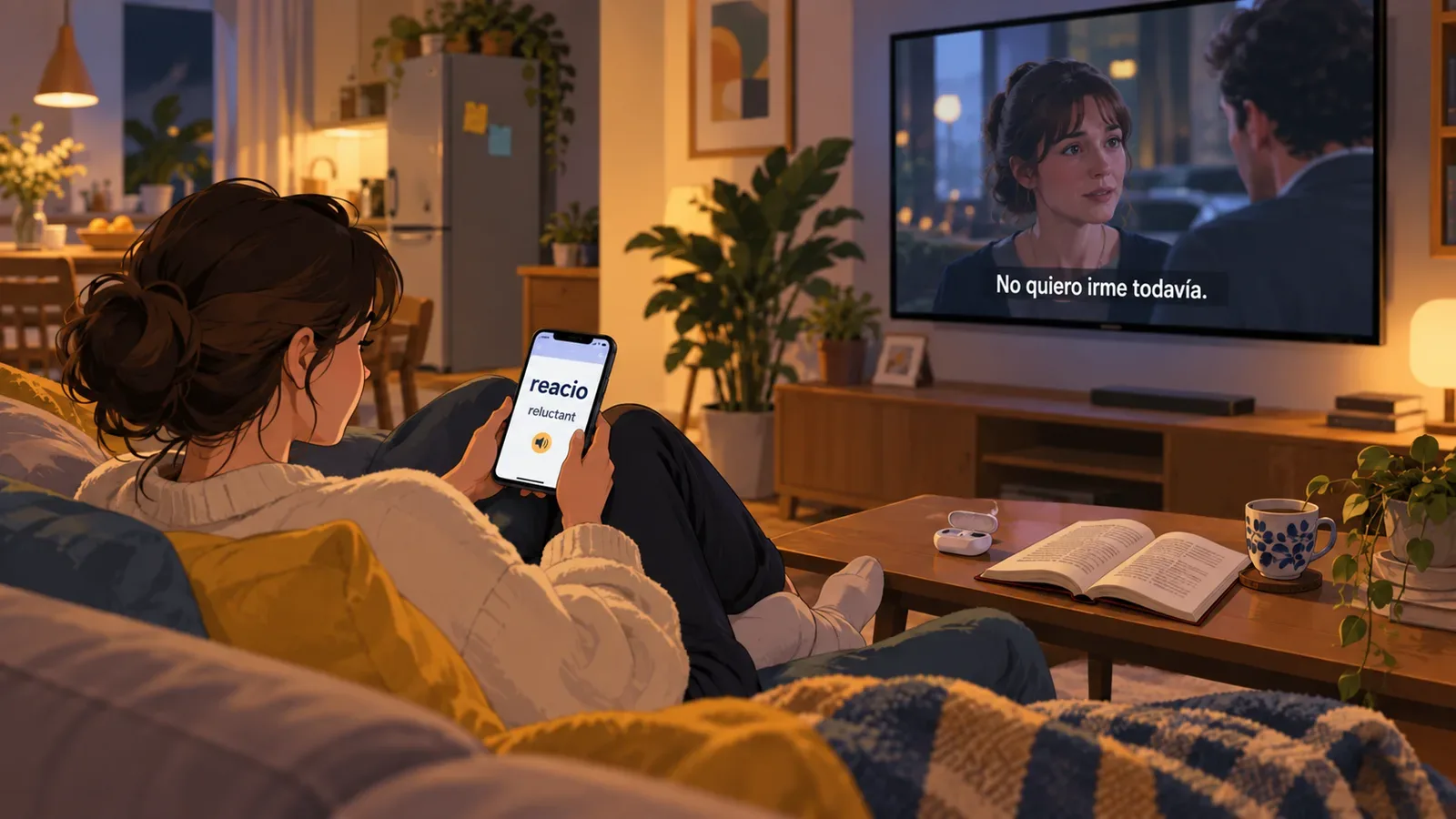
I use VibeLing for that: a word from a show or a podcast goes into my dictionary in a few seconds, the app pulls in the translation, transcription and examples on its own, and then shows it in spaced-repetition training. The environment supplies the words, the app holds on to them. Without the second part, the first works at half strength.
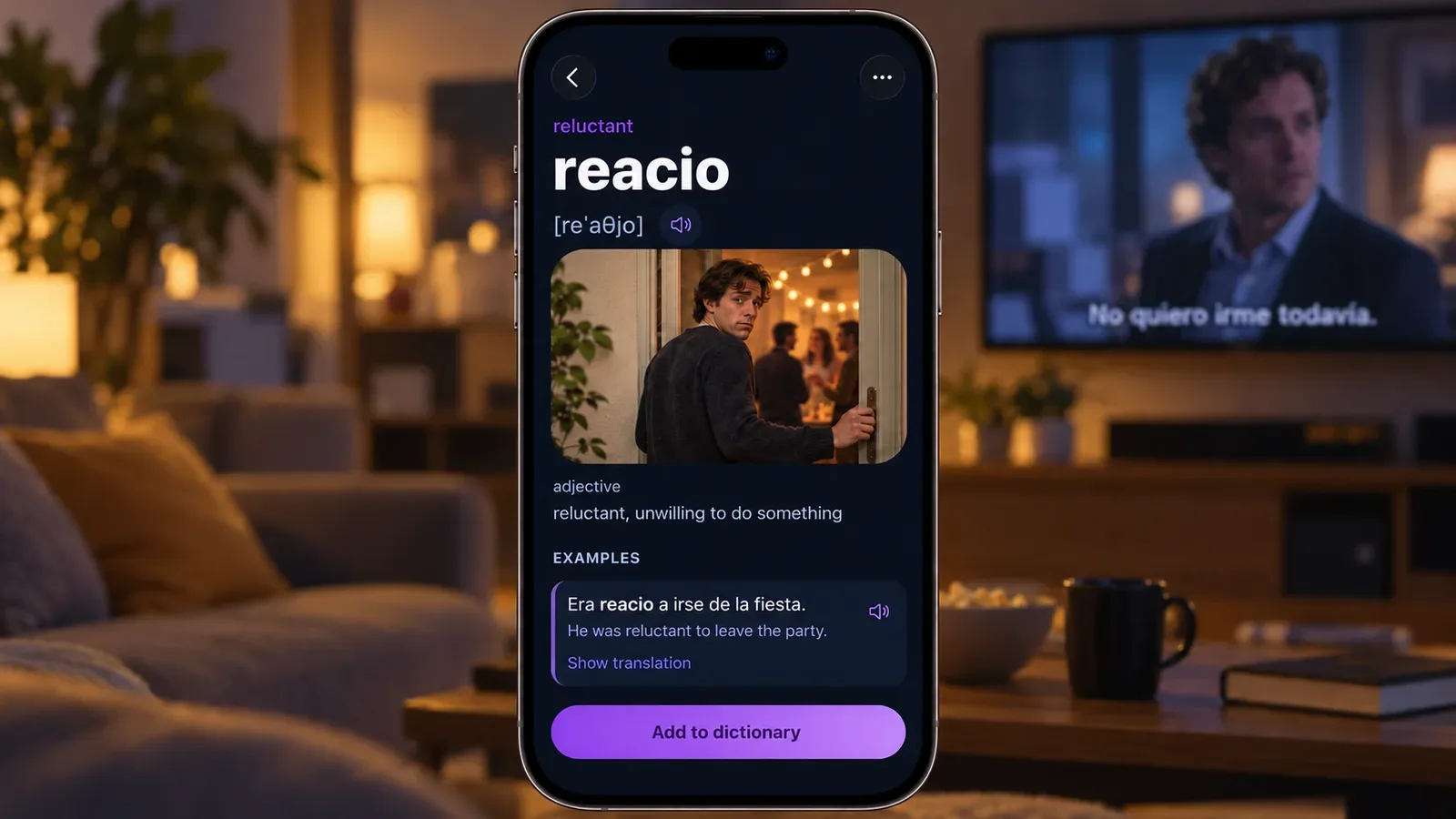
One important point: don't catch everything. If you add every unfamiliar word from an episode, your dictionary turns into a dump of fifty words per evening, and you won't review them. I only add the ones I've met for the second time or the ones I'll clearly need. Five to ten words per episode is enough.
What it looks like on an ordinary day
To make it clear that this isn't about extra hours, here is my typical weekday. There is no dedicated language time in it at all.
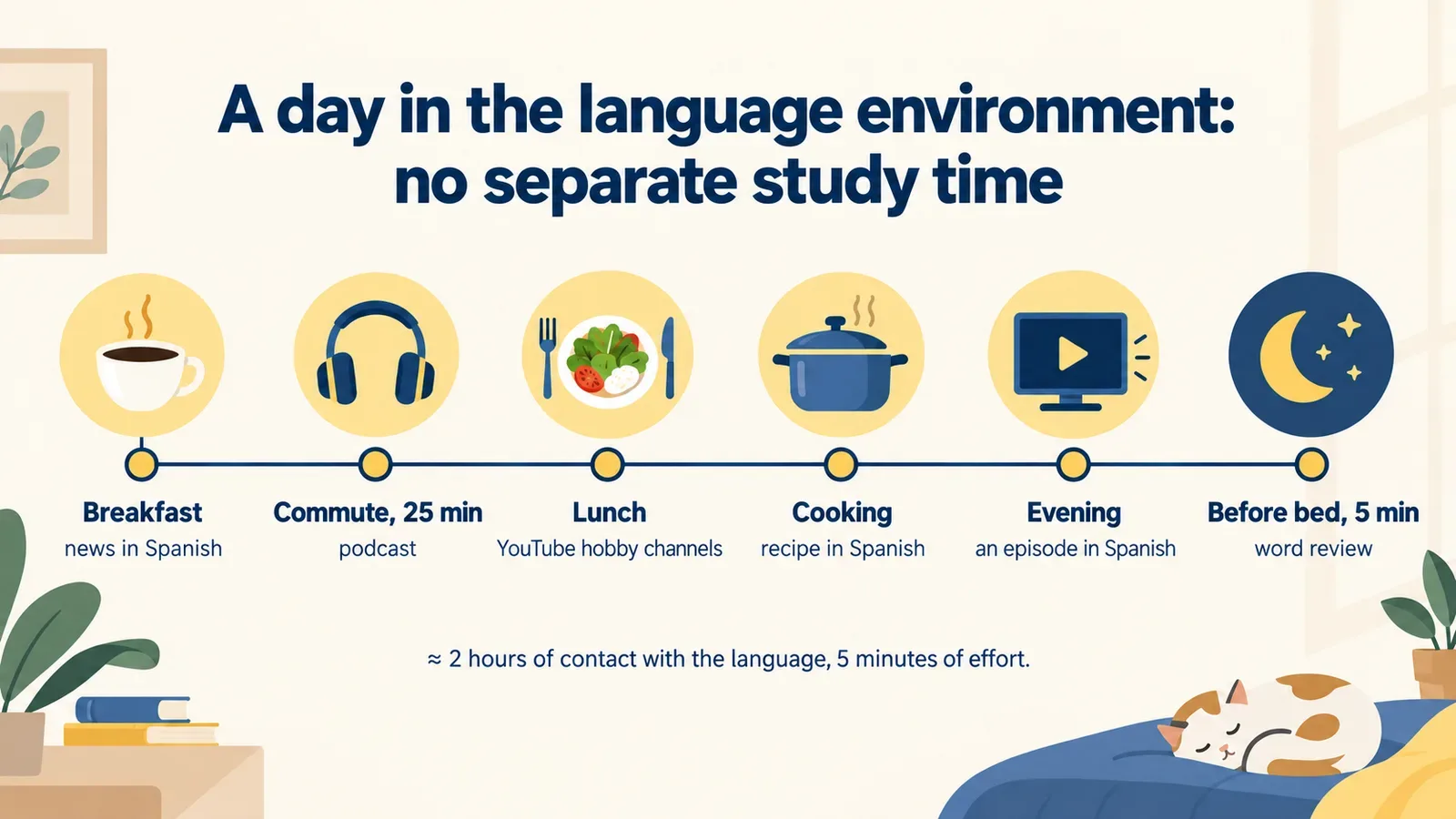
| When | What | Layer |
|---|---|---|
| Morning, breakfast | Industry news in Spanish | Screen |
| Commute, 25 minutes | A podcast I listen to actively | Audio |
| Lunch | YouTube feed, two or three hobby channels | Screen |
| Cooking dinner | Recipe in Spanish, radio in the background | Text + audio |
| Evening | One episode in the original, 5–10 words into the dictionary | Video |
| Before bed, 5 minutes | Word training in the app | Review |
That adds up to about two hours of contact with the language, of which only the five minutes of review take any conscious effort. Everything else I would be doing anyway, just in English.
Where to start if everything is in your native language right now
Don't switch everything in one day. A week later it gets hard, you put everything back, and on top of that you decide that immersion isn't for you. What works is gradual replacement, one layer every week or two.
- Week 1. One podcast for the commute or for cooking. Just one, but every day.
- Week 2. One show that you watch only in the original with subtitles.
- Week 3. Replace two or three sources in your feed with Spanish ones.
- Week 4. Texts with a purpose: recipes, manuals, a book on the nightstand.
- After that. The speech layer: one topic at home in Spanish, voice notes to yourself.
And from the very first day, set up a place where the words from this environment will land. For me that's VibeLing: a dictionary I throw words from shows and podcasts into, and short training sessions that don't let them leak away. An environment without such a place gives you the feeling that the language is all around while your vocabulary stands still. With it, the words you met on Tuesday are already recognizable by ear on Thursday, and that is exactly the moment a home environment starts working no worse than the real thing.