The Right Way to Use Subtitles to Learn Spanish Words
«Watch it in the original» comes up in every other conversation about learning Spanish, and that's where the confusion starts. Some people insist subtitles must never be turned on, or your ear will never develop. Others watch with English subtitles and are convinced they're studying. Others dutifully switch to Spanish subtitles, finish an entire season and by the finale can't recall a single new word.
The question isn't which subtitles you turned on. It's what happens the moment an unfamiliar word appears on screen.
Why English subtitles give you so little
Reading in your own language is faster and easier than picking a foreign one apart by ear. The instant English text appears at the bottom of the screen, your attention goes there and the Spanish audio turns into background noise. On paper you're watching in the original; in practice you're reading a translation with foreign-language music behind it.
It's easy to test. Watch twenty minutes with English subtitles, then try to recall which Spanish words the character actually used to say the line you just read. Usually nothing comes back: those words never reached your awareness at all.
That doesn't make English subtitles forbidden. They have one honest job — keeping you from abandoning a show that's still too hard for you. If without them you lose the plot and switch off after two episodes, watching with them beats not watching at all. Just don't count that hour as study time.
What Spanish subtitles actually give you
First, they show you which word you just heard. Spanish is full of things that sound identical and are written differently: hay, ahí and ay, or haber and a ver, or tubo and tuvo. The silent h alone means that a word you heard perfectly clearly can be impossible to look up — you'd never guess hacia starts with a letter nobody pronounces.
Second, they show word boundaries. In fast speech ¿qué es lo que quieres? arrives as one long blur, and until you see the line written out, separating it is nearly impossible. Subtitles show you where one word ends and the next begins, and after a dozen episodes your ear starts doing it on its own.
Third, they take away the panic. When you know you can glance down at any moment, you listen in a more relaxed way and don't drop out of the story after the first line you miss.
Watching with no subtitles is a mode, not a goal
Watching without subtitles is useful, but not as an endurance test. If you catch less than half the dialogue, your brain stops looking for meaning and switches over to the picture. An hour of that adds no words at all.
It makes more sense to keep all three modes on hand and switch depending on the situation:
| Mode | When to use it | What it trains |
|---|---|---|
| English subtitles | The show is clearly above your level and you'd quit otherwise | Almost nothing — it only keeps you in contact with the language |
| Spanish subtitles | The main mode for most levels | Vocabulary, the sound-to-spelling link, sentence structure |
| No subtitles | An episode you've already seen, or a simple format: sitcom, vlog, cartoon | Listening and processing speed |
The combination that works for most people looks like this: watch the bulk of your viewing with Spanish subtitles, and once a week rewatch an episode you already know with none at all. The familiar plot keeps you afloat, so all your attention goes to the speech.
The main mistake: watching and keeping nothing
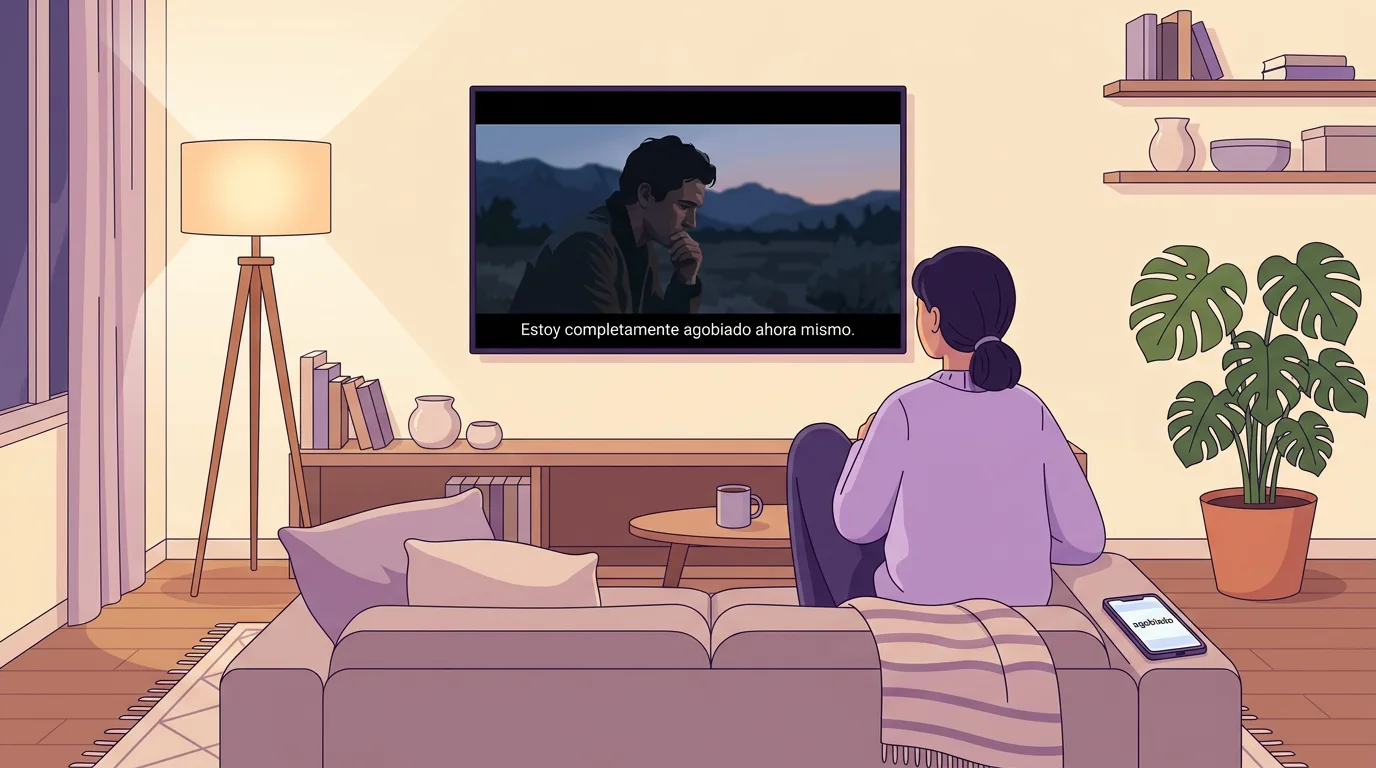
The usual story goes like this. You turn on Spanish subtitles, an unknown word goes by, in half a second you guess the meaning from context, nod, and keep watching. Forty minutes later the episode ends and nothing at all is left of it.
Understanding a word in context and remembering it are different things. Context does nearly all the work for you: the scene, the intonation and the actor's face deliver the meaning even with zero knowledge of the word. That's exactly why watching feels like comprehension, and a day later you can recall neither the word nor what it meant. I wrote about that mechanism separately in why you forget new Spanish words.
The routine that actually works
You don't need to hit pause every thirty seconds — that way you'll end up hating both the show and Spanish. A short ritual is enough.
- Watch the episode normally, with Spanish subtitles, without stopping at every word you don't know.
- Pause only when the word gets in the way — you didn't understand the whole line, or the word has shown up for the second time this episode. That repetition is the signal that it's frequent and worth your attention.
- Save the word right then, during that pause, together with the sentence it appeared in. Without the sentence you won't remember a week later what it was about.
- Don't take more than three to five words per episode. Nobody learns twenty words off a list; five is entirely realistic.
- Review them across the week, not «sometime later». Two days without review is enough for yesterday's word to fade almost completely.
On rewinding: replaying a scene you didn't catch is worth doing once, twice at most. If the meaning still doesn't come together, let it go — it's usually slang or a proper name, and you don't need either right now.
How to pick what to watch
The simple benchmark: you understand roughly seven or eight lines out of ten. If you understand everything, the show isn't giving you new words. If you understand half, watching turns into work.
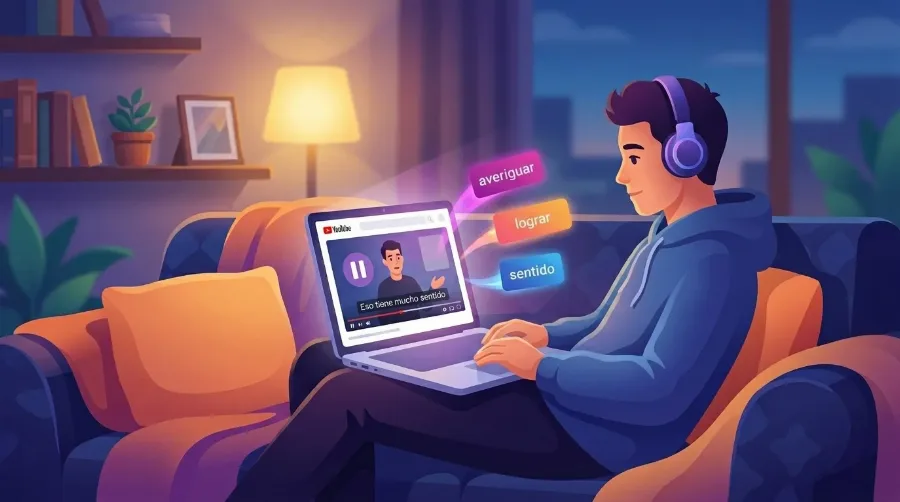
Sitcoms and everyday dramas are the easiest place to start: day-to-day vocabulary, short lines and clean studio delivery. Medical, legal and science-fiction series hand you an impressive but very narrow lexicon that you'll almost never need in conversation. And if a full series feels like too long a format, the same method works on short videos — I covered that in how to learn Spanish words from YouTube videos.
What to do with the words you catch
A word typed into your phone's notes app stays there until the end of time and never crosses your path again. For it to stick, you need to meet it several more times, at widening intervals.
In VibeLing that part is built for exactly this moment: the word goes in within a couple of seconds, the app pulls the translation, usage examples and pronunciation on its own, and then brings it back for review right when you're about to forget it. Sessions are short — they fit into a checkout line or the opening credits of the next episode — and there's a mode where you say the word out loud, which is precisely what silent watching never gives you.
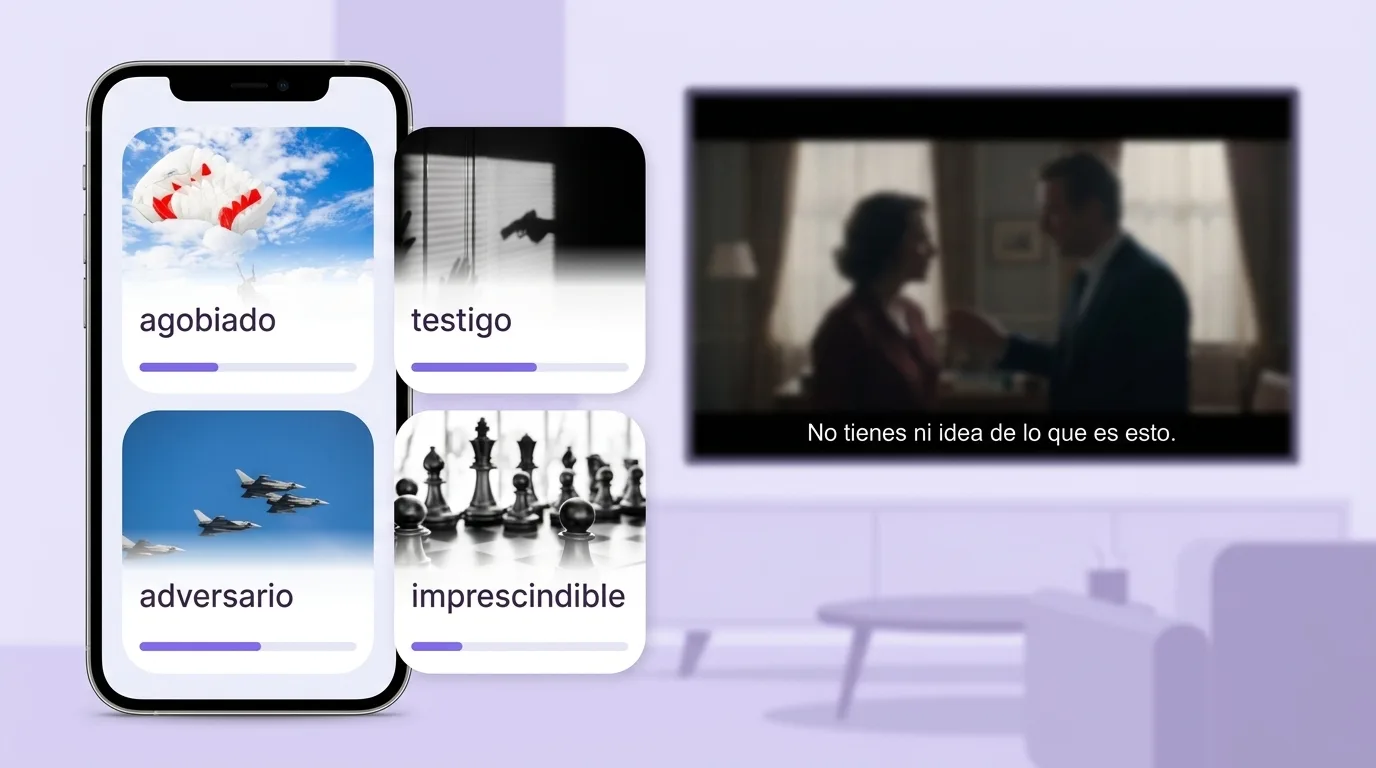
After a month of watching this way, a hundred words pile up in your dictionary, each one from a scene you remember. That's a completely different quality of memory than a textbook list: the word has a voice, a face and a situation attached to it.
What not to do
- Running two subtitle tracks at once. The English one will take all your attention and the Spanish one will be decoration.
- Writing everything down. A list of thirty words after a single episode is guaranteed to stay unlearned.
- Treating watching as your whole practice. Shows build vocabulary and listening beautifully, but they teach speaking badly — for that you have to pull the words out of memory yourself.
- Quitting after three days. The first episodes are always harder: you haven't adjusted to the actors' voices or to how that particular show talks.
In short
Spanish subtitles are the main mode. English ones are a crutch for content that's too hard. No subtitles is training on familiar material. But the mode by itself settles nothing: vocabulary grows not because you watch in the original, but because you save three to five words an episode and then review them.
If you'd rather the words from your shows didn't vanish by the following evening, it's worth building your own dictionary and dropping them in as you watch — VibeLing will bring each one back exactly when you need it.