Free Online Word Games That Build Vocabulary
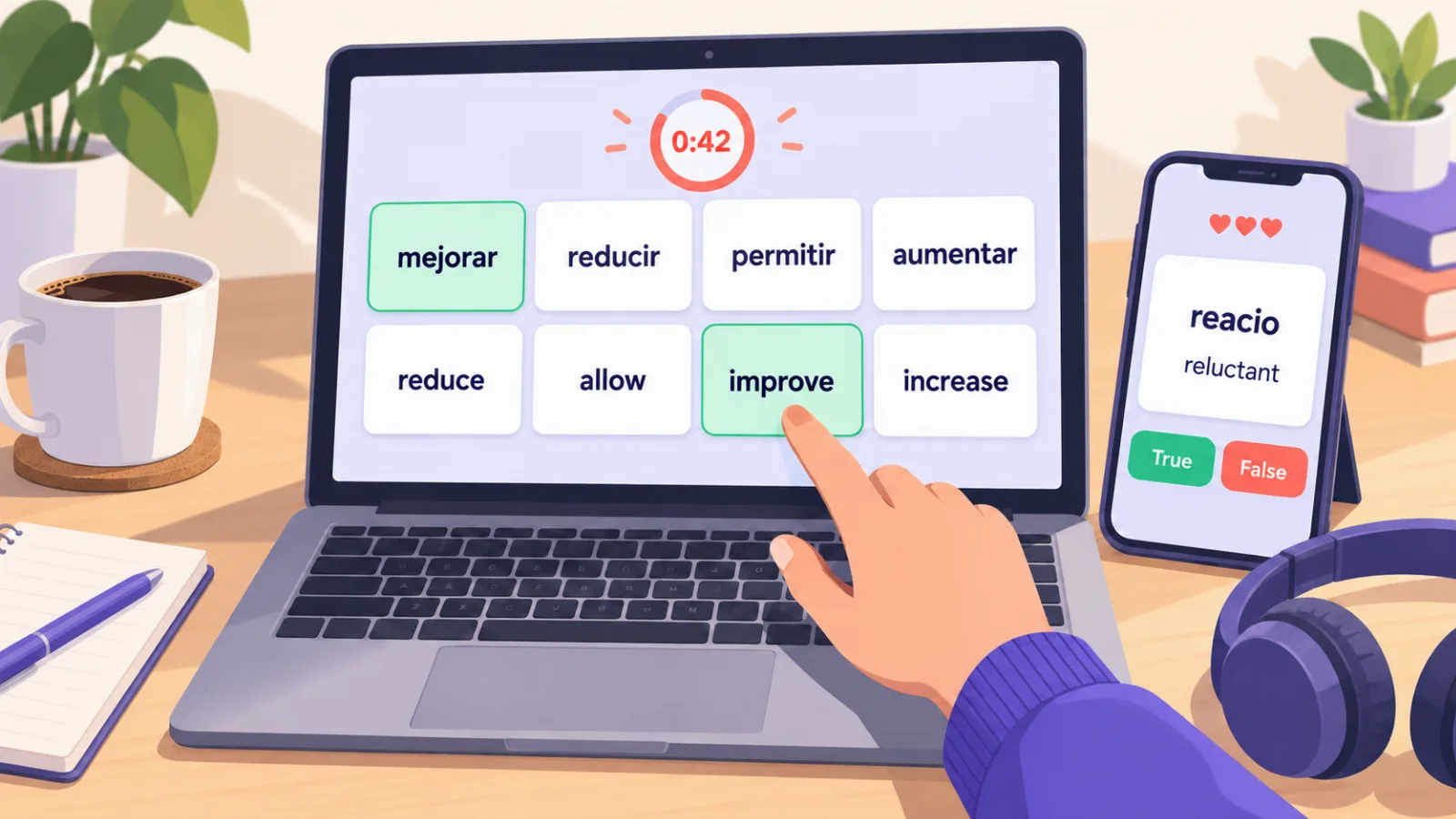
You can read a word list five times and remember none of it. A game with a timer makes you do something with the same words: decide whether a translation is right, match pairs, spot a word in a sentence. The effort is small, but it is exactly what sticks.
vibeling.app has eight free word games that run in the browser. No sign-up, no install, they work on a phone and on a computer, and there are nine languages to choose from: Spanish, English, Portuguese, French, Italian, German, Romanian, Serbian and Turkish. Below is a breakdown of each game: what you do, how long a round takes, which skill it trains and who it suits. The examples are in Spanish, but all eight work the same way in any of the nine languages. All of them live on one page: vibeling.app/en/games.
All eight games in one table
| Game | What you do | How long | What it trains |
|---|---|---|---|
| True or false | Is the translation right: "True" / "False" | 60 seconds, 3 lives | Speed of recognition |
| Pairs | Match words with their translations | 60 seconds | Memory for a group of words |
| Guess the picture | Pick the word for a photo | 10 pictures, 10 seconds each | Word-to-image link |
| Listening sprint | Hear a word, pick its translation | 10 words, 12 seconds each | Listening |
| Guess by definition | Pick the word a definition describes | 10 definitions, 15 seconds each | Understanding without translation |
| Fill the gap | Fill the gap in a sentence | 10 sentences, 20 seconds each | Choosing a word by context |
| Odd word out | Find the word that doesn't belong | 8 sentences, 20 seconds each | Feel for collocations |
| Build the sentence | Put the words in the right order | 5 sentences, 30 seconds each | Word order |
A single round of any game takes one to three minutes. Playing all eight back to back is about a quarter of an hour.
1. True or false
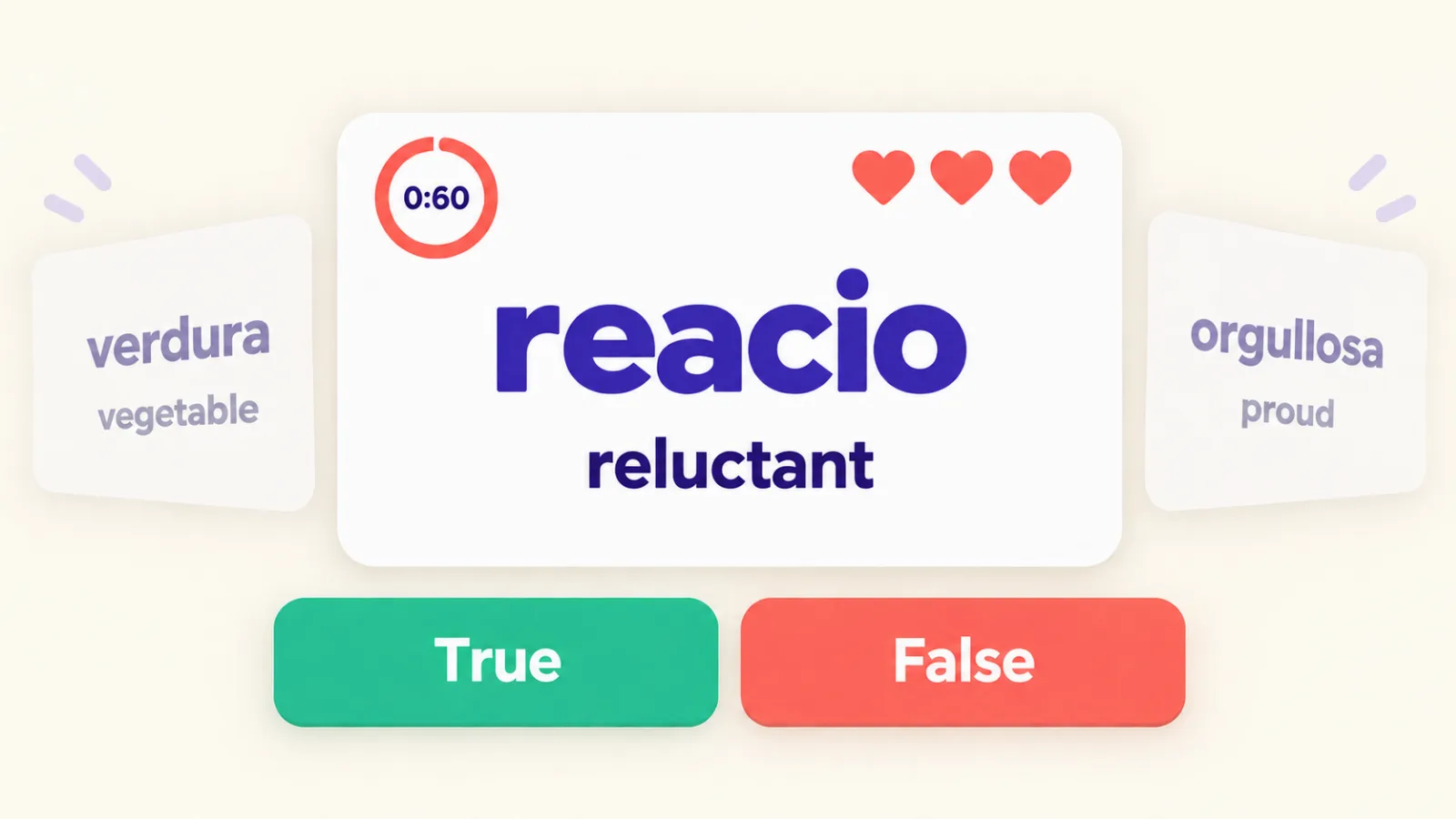
You see a word and a translation, for example reacio — "reluctant". Tap "True" if the pair is correct and "False" if the translation belongs to another word. You get sixty seconds and three lives, and every mistake costs one.
This is the fastest of the eight: in a minute, a few dozen words go past you. It doesn't teach new words, but it shows clearly which of the ones you know you recognise instantly and which make you pause. The catch is that the wrong translations are often close to the right ones in meaning or part of speech, so tapping "True" on autopilot doesn't work.
Who it suits: anyone who has already built up a stock of words and wants to check how firmly they sit. Play: True or false.
2. Pairs
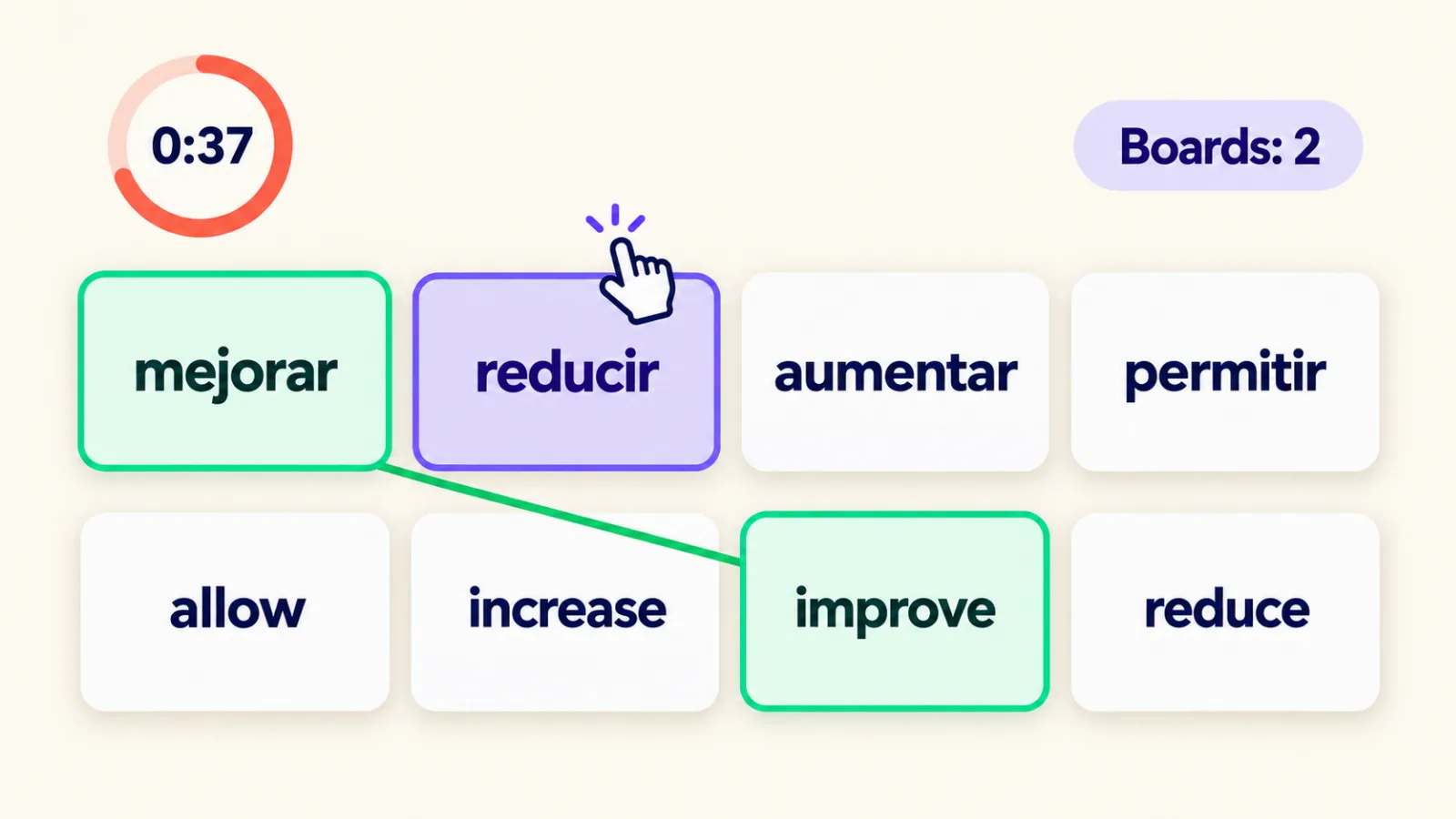
The board shows several words and the same number of translations, shuffled. Tap a word, then its translation; if the pair is right, both tiles disappear. A wrong pair costs two seconds. You have sixty seconds, and the goal is to clear as many boards as you can.
Unlike True or false, here you have to hold several words in your head at once: while you look for the match for mejorar, your eye catches reducir and aumentar, and on the next move you already know where they are. Every matched pair narrows the choice for the rest, so by the end of the board the words you didn't know get matched too, which is not a bad way to meet them.
Who it suits: everyone, especially when you want to quickly go over a group of words on one topic. Play: Pairs.
3. Guess the picture
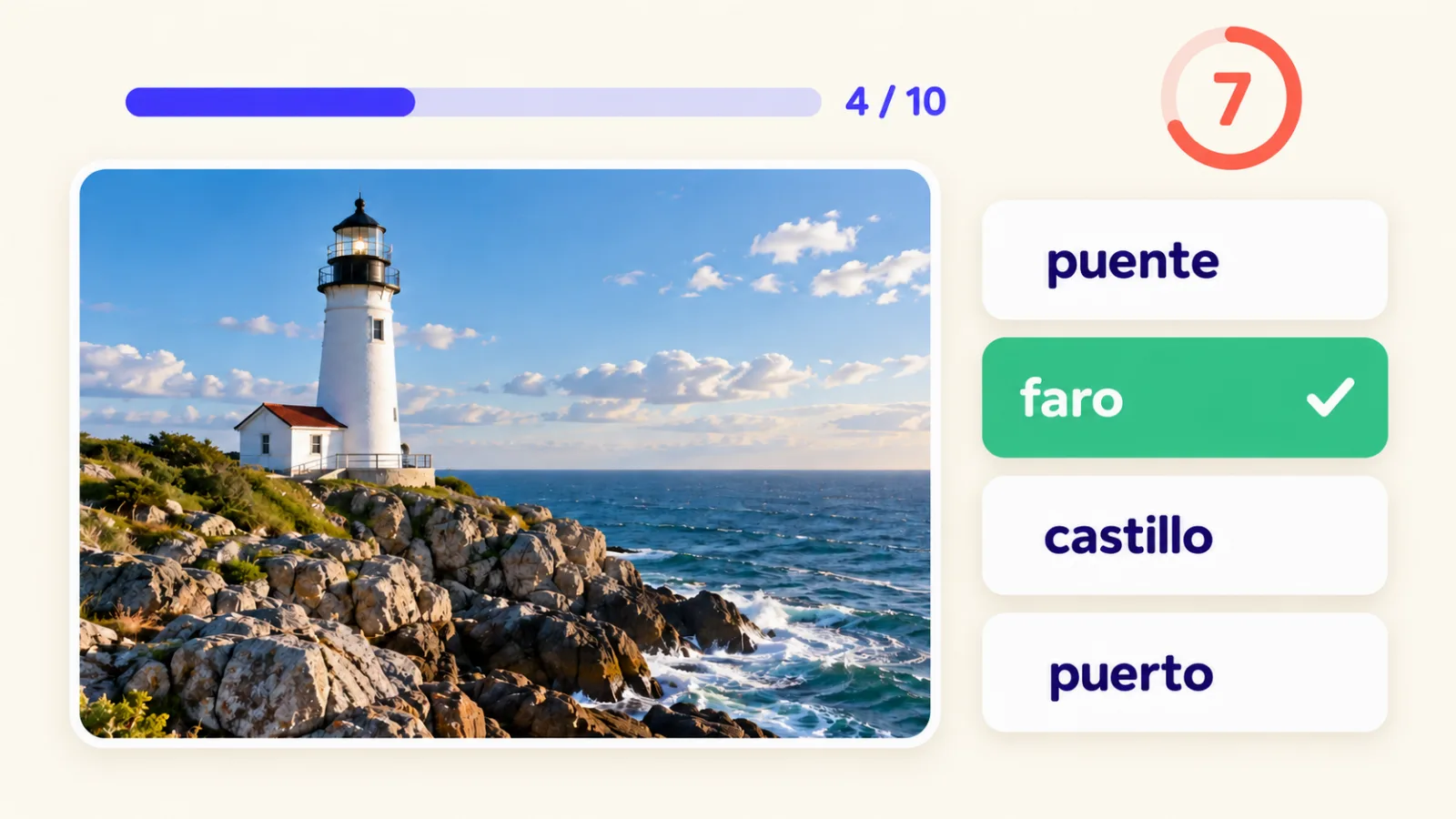
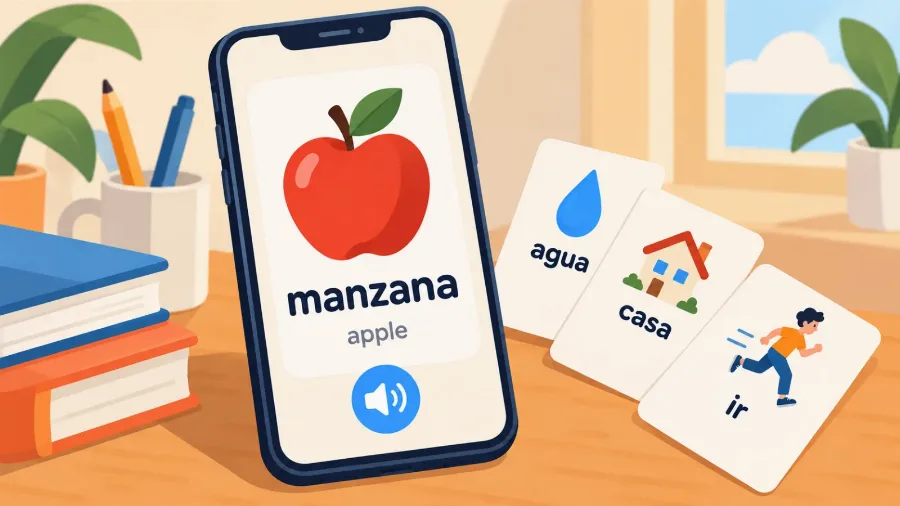
You get a photo and four words, and you pick the one that shows what's in it. Ten pictures, ten seconds each.
This is the only game of the eight that skips translation entirely. The word faro gets tied to a picture of a lighthouse rather than to the English word, and later it comes to mind together with the image. For objects, food, animals and actions this is the most natural route, roughly how children pick up words. It won't work for abstract words like fiabilidad, which is why the game mostly uses concrete vocabulary.
Who it suits: beginners, and anyone who wants to stop translating in their head. Play: Guess the picture.
4. Listening sprint
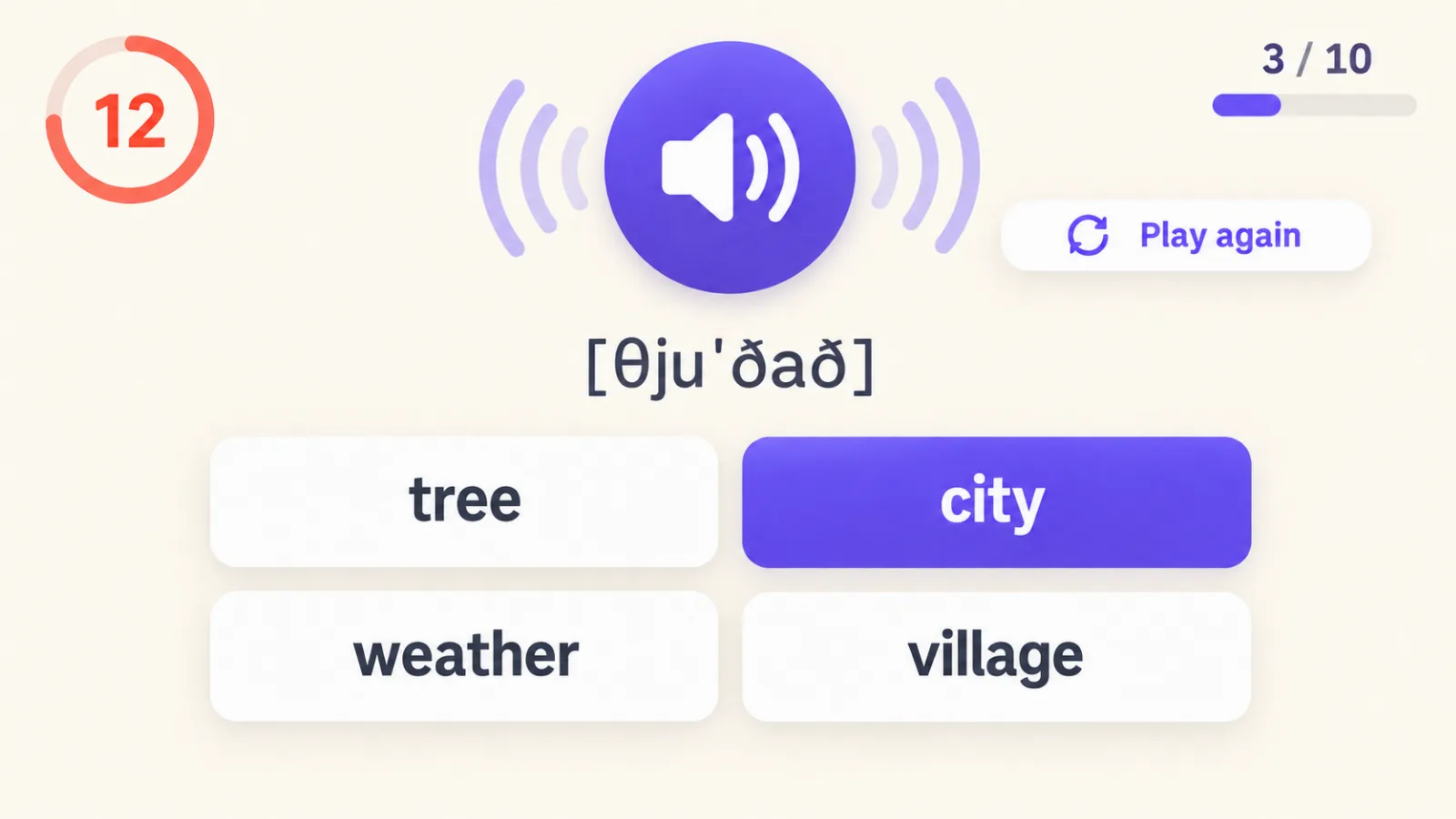
A word is read aloud, and the screen shows four translations. Ten words, twelve seconds each, and you can replay the word.
Recognising a word by sight and recognising it by ear are different skills, and the second one doesn't come from reading on its own. Everyone recognises ciudad on the page; in fast speech, where the final d almost disappears and it sounds close to "ciudá", fewer people do. Listening sprint is about exactly that: you have to identify the word by its sound, with no spelling in front of you. Along the way you remember how it is actually pronounced.
Who it suits: people who read comfortably but fall behind when listening. Play: Listening sprint.
5. Guess by definition
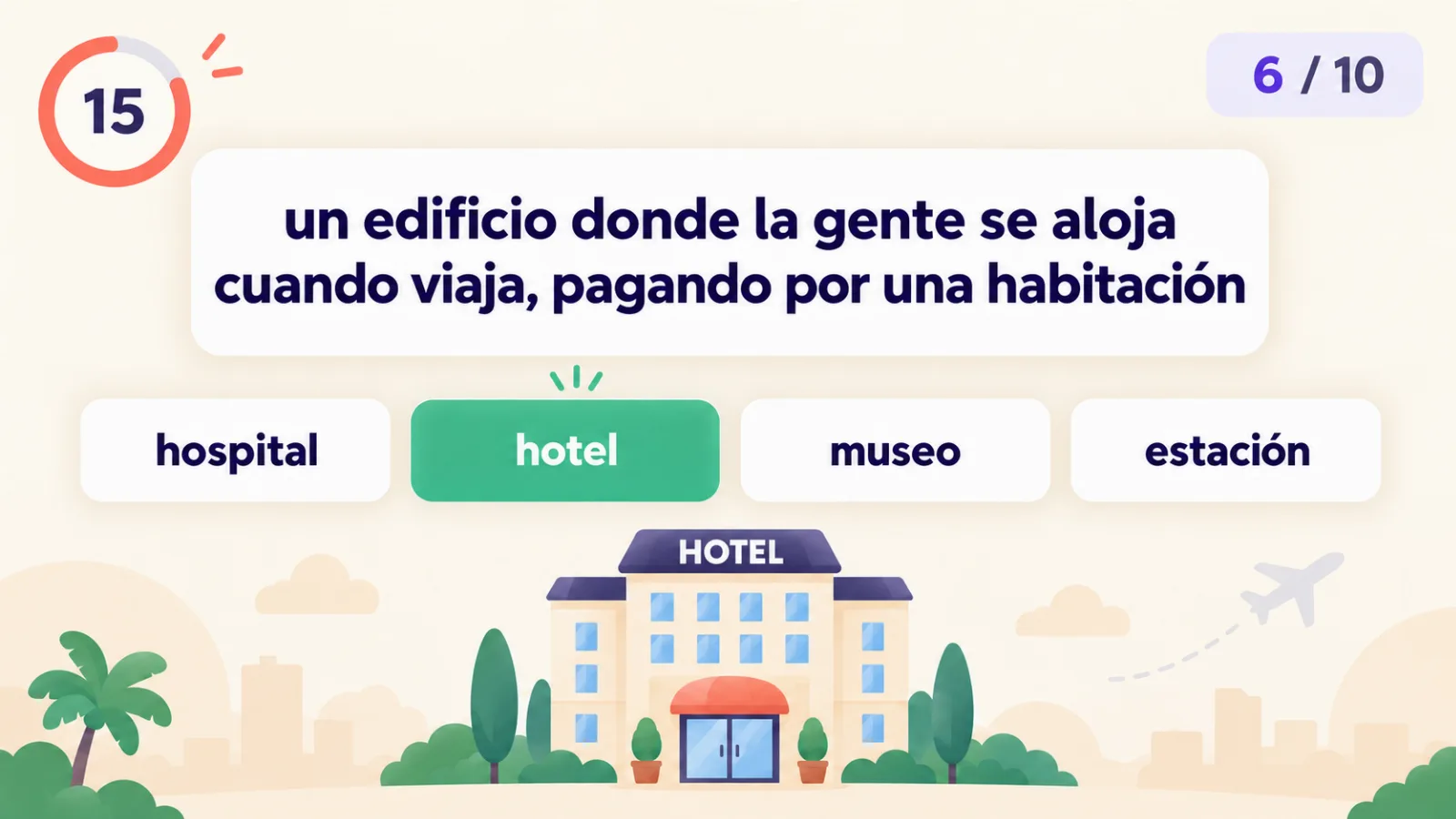
The screen shows a definition in the language you're learning and four words. You pick the one it describes. Ten definitions, fifteen seconds each.
un edificio donde la gente se aloja cuando viaja, pagando por una habitación — hospital · hotel · museo · estación
Here you have to understand a whole sentence, not one word, and that trains what people do at advanced levels: follow an explanation in the language itself, with no translation. There is a nice side effect: while you read the definitions, you revise dozens of words that aren't among the answer options.
Who it suits: intermediate and up; beginners will find it hard, and that's normal. Play: Guess by definition.
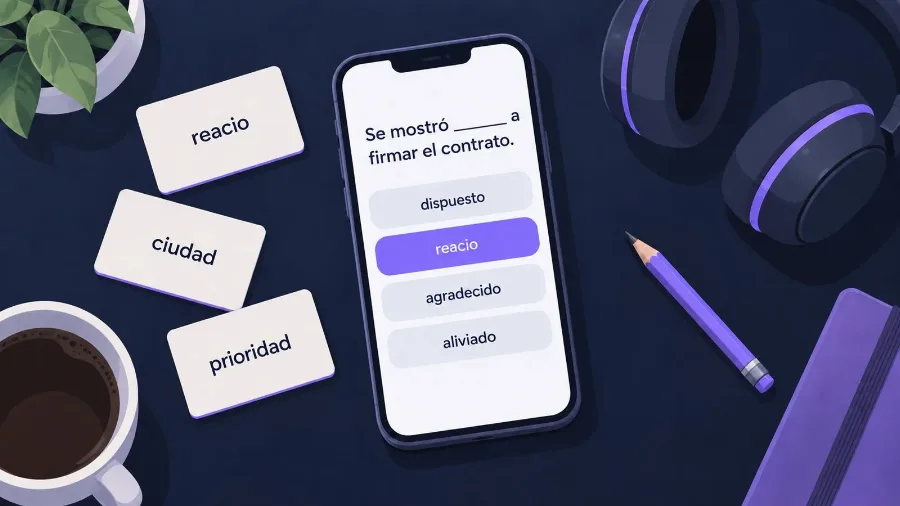
6. Fill the gap
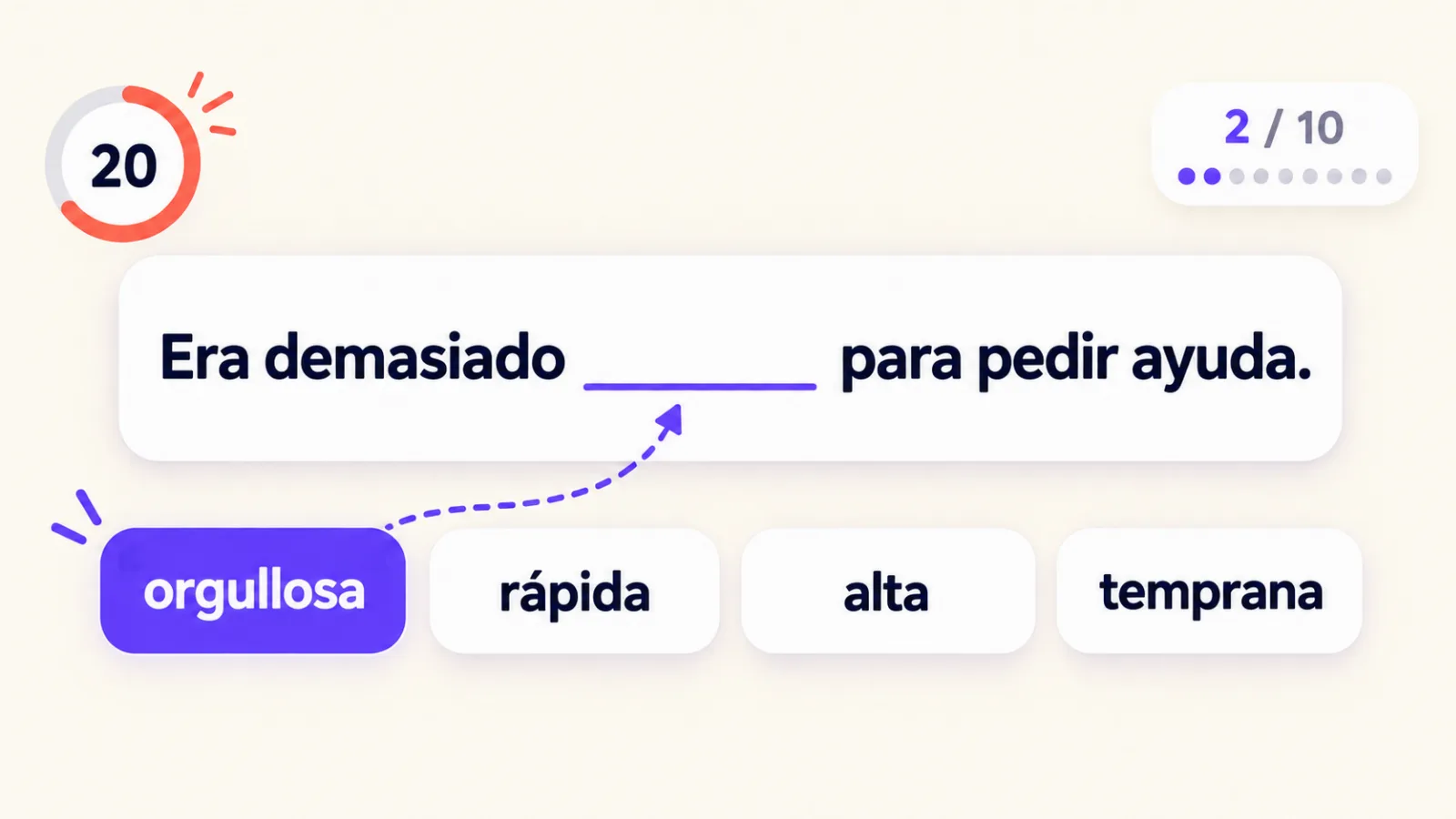
A sentence with one word missing and four candidates. Ten sentences, twenty seconds each.
Era demasiado ______ para pedir ayuda. — orgullosa · rápida · alta · temprana
Of all the multiple-choice games, this one is closest to how you actually use a language. The word is tested through meaning: to answer, you have to read the whole sentence and see what fits. You also remember the surroundings: orgullosa on its own sticks worse than demasiado orgullosa para pedir. There is more on why context tasks beat plain translation choice in our breakdown of vocabulary exercises that actually work.
Who it suits: people who recognise words but can't use them yet. Play: Fill the gap.
7. Odd word out
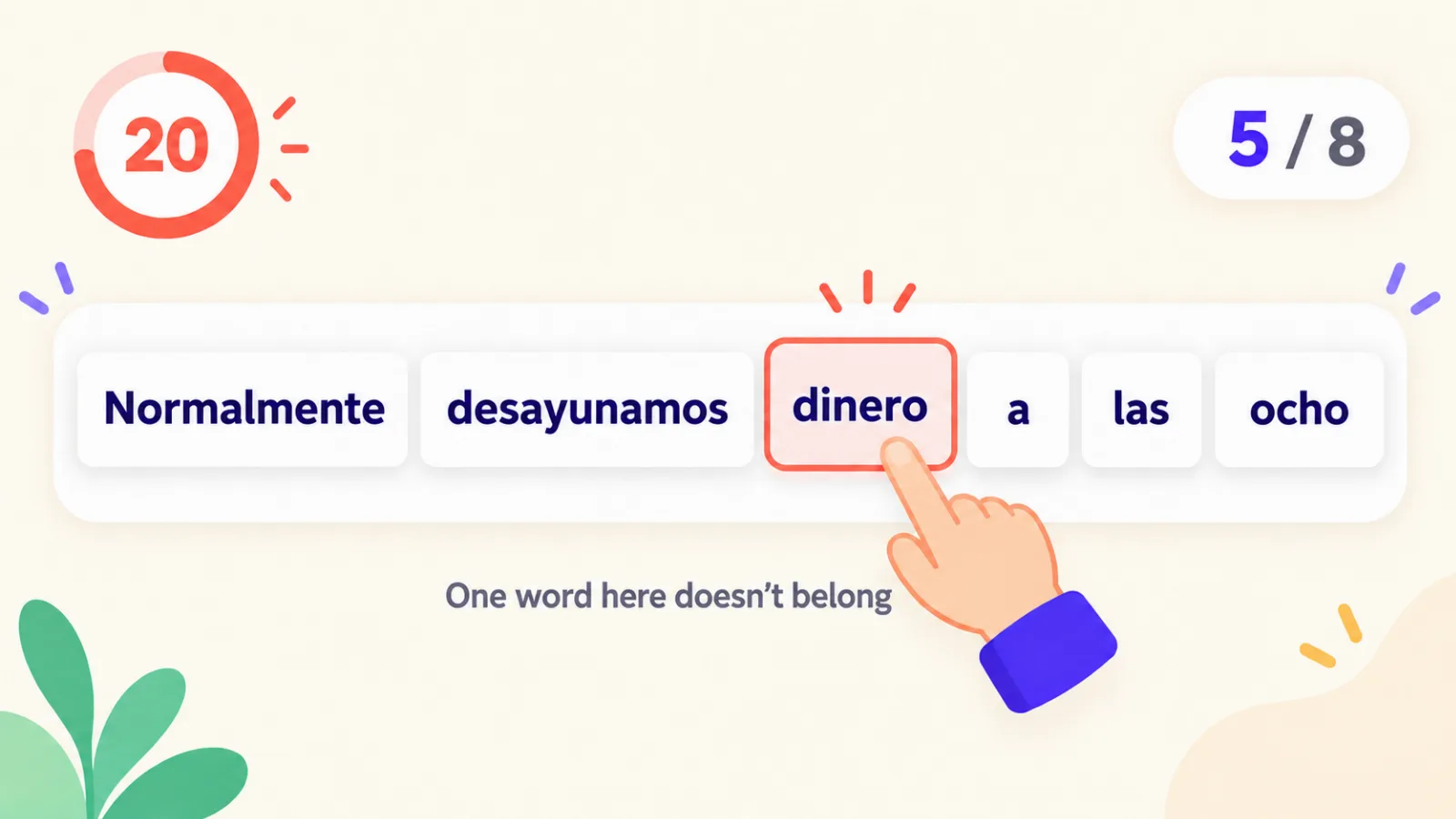
One extra word has been slipped into a sentence, and you have to find it. Eight sentences, twenty seconds each.
Normalmente desayunamos dinero a las ocho.
This is a game about attention and a feel for how a sentence is built. As long as the sentence reads as a bunch of familiar words, the extra one goes unnoticed; once you start seeing what follows what, it jumps out at once. It's useful for people who skim a lot and are used to guessing the meaning from the words they know without noticing the rest.
Who it suits: intermediate and up, as a warm-up before reading or writing. Play: Odd word out.
8. Build the sentence
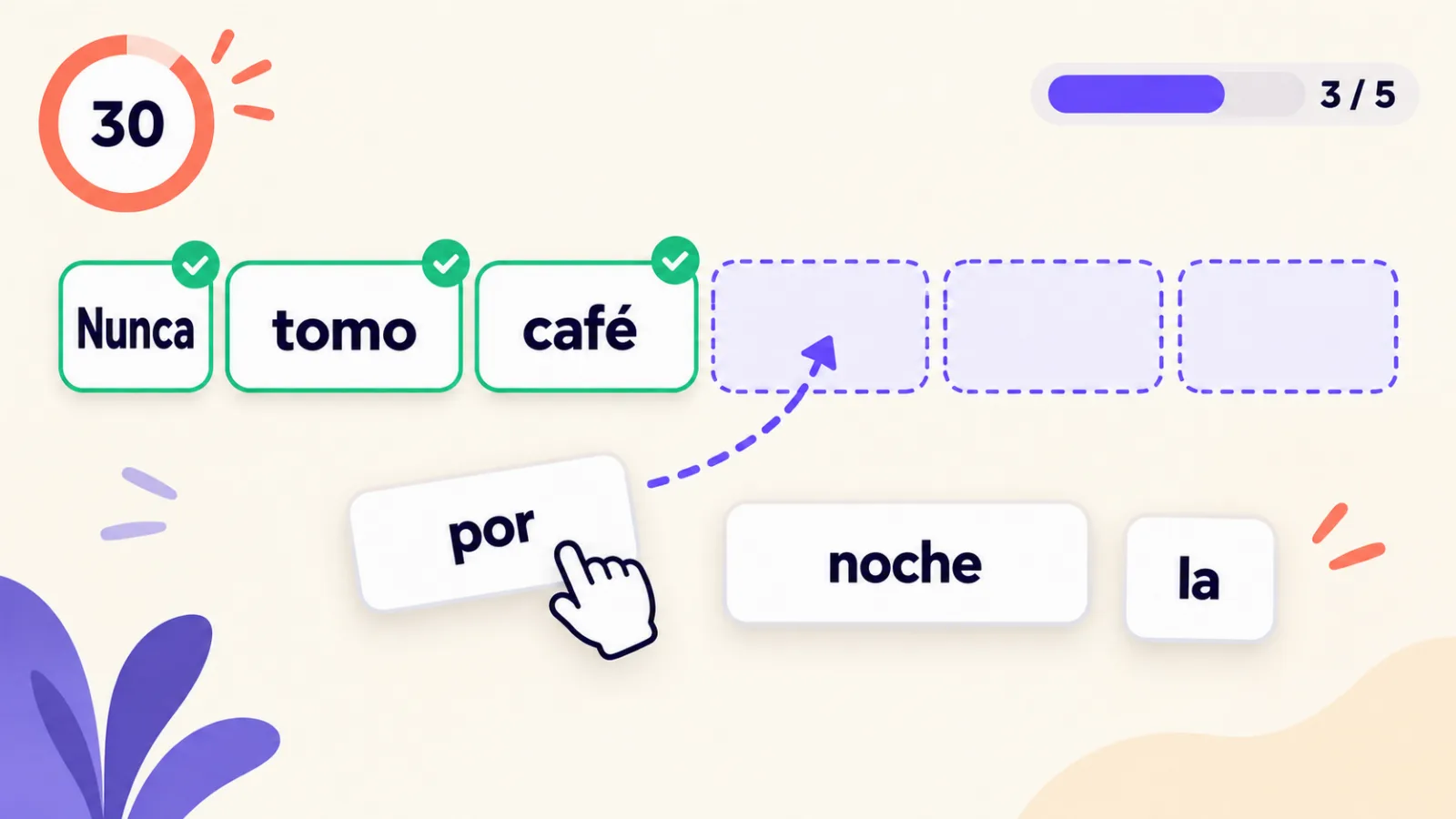
The words of a sentence are shuffled, and you tap them in the right order. Tapping a word you've already placed sends it back. Five sentences, thirty seconds each.
tomo · nunca · café · por · noche · la → Nunca tomo café por la noche.
This is the only game of the eight where you build instead of choosing. Word order, where the adverb goes, fixed combinations like por la noche: none of that can be learned from separate flashcards, only by assembling sentences. Thirty seconds feels like a lot until a nine-word sentence comes up.
Who it suits: people who know the words but speak with pauses, working out the order. Play: Build the sentence.
Which game to pick for your goal
You don't need to play all eight every day. It's easier to pick one or two for whatever is lagging right now:
- I want to revise a lot of words fast — True or false and Pairs.
- I don't understand spoken Spanish — Listening sprint, two or three rounds in a row.
- I translate in my head and want to stop — Guess the picture and Guess by definition.
- I recognise words but can't use them — Fill the gap, Odd word out, Build the sentence.
A routine that works looks like this: five minutes of games as a warm-up before the main session, whether that's a training run in the app, a TV series or a lesson. Your brain has already switched into the language, and the words that came up in the game latch on more easily to whatever you do next. Separately, it's worth taking the vocabulary size test every couple of months: it has eighty words of different frequency, you tick the ones you know and get an estimate of your vocabulary size. That's how you can tell whether it's growing at all.
Why games on their own aren't enough
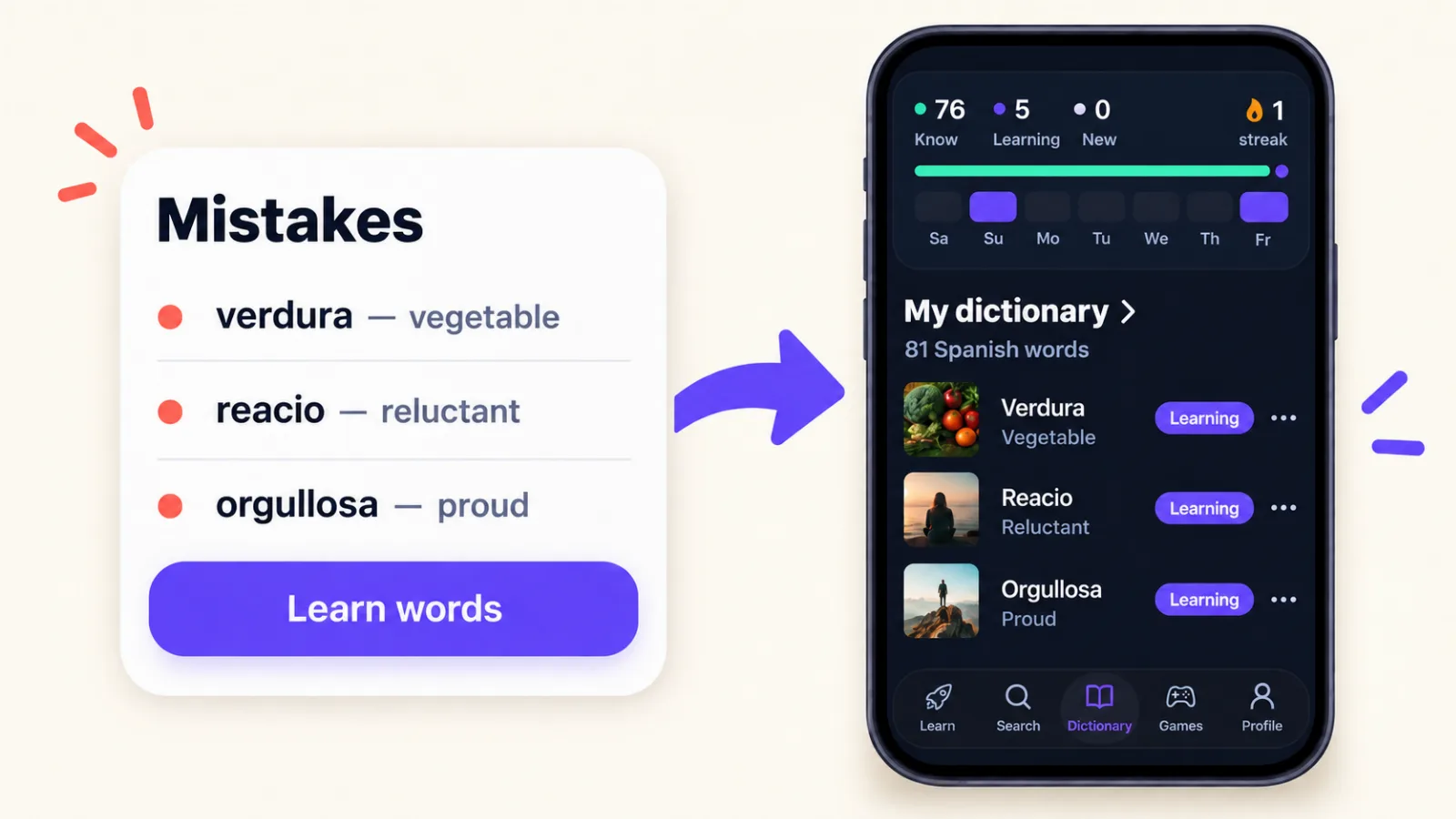
Games have a weak spot, and it's worth being honest about it. The words come from a shared dictionary, and the game doesn't remember what you got wrong yesterday. A word you failed to recognise in Listening sprint may not come up again for a month, and in a month it will be forgotten, even if you looked it up in the results. For a word to stay, it needs to be reviewed several times at growing intervals, and that is a job not for a game but for spaced repetition.
That's why every results screen has a "Mistakes" list and a "Learn words" button. It takes those words into VibeLing: they land in your personal dictionary with a translation, examples and audio, and the app starts bringing them back for review until they stick. The game finds the gaps in your vocabulary, the app closes them. A one-minute round of Pairs, three words in the mistakes, three words into the dictionary: over a month of such warm-ups you end up with a solid list of words you genuinely didn't know, rather than a list from a textbook.
If you've already started playing, try this after your next round: don't close the tab, tap "Learn words" and see what happens to those words a week later.