Best App to Learn German Vocabulary
German usually starts well. The alphabet is familiar, and plenty of words come almost free — Haus, Maus, Butter, Finger, Wasser. Then the vocabulary gets less obvious and stops sticking. You work through fifty nouns, and two weeks later you can produce Straße and danke, and even those without the article.
Usually the problem is not your memory. It is that a German word cannot be learned the way an English one can. Too much is packed inside it, and most of that gets dropped when you learn from a list.
Why German words fade faster than you expect
In English, a word on a list is more or less the whole word. A German noun carries at least two more obligatory pieces, and without them the knowledge does not work.
The article is part of the word, not an add-on
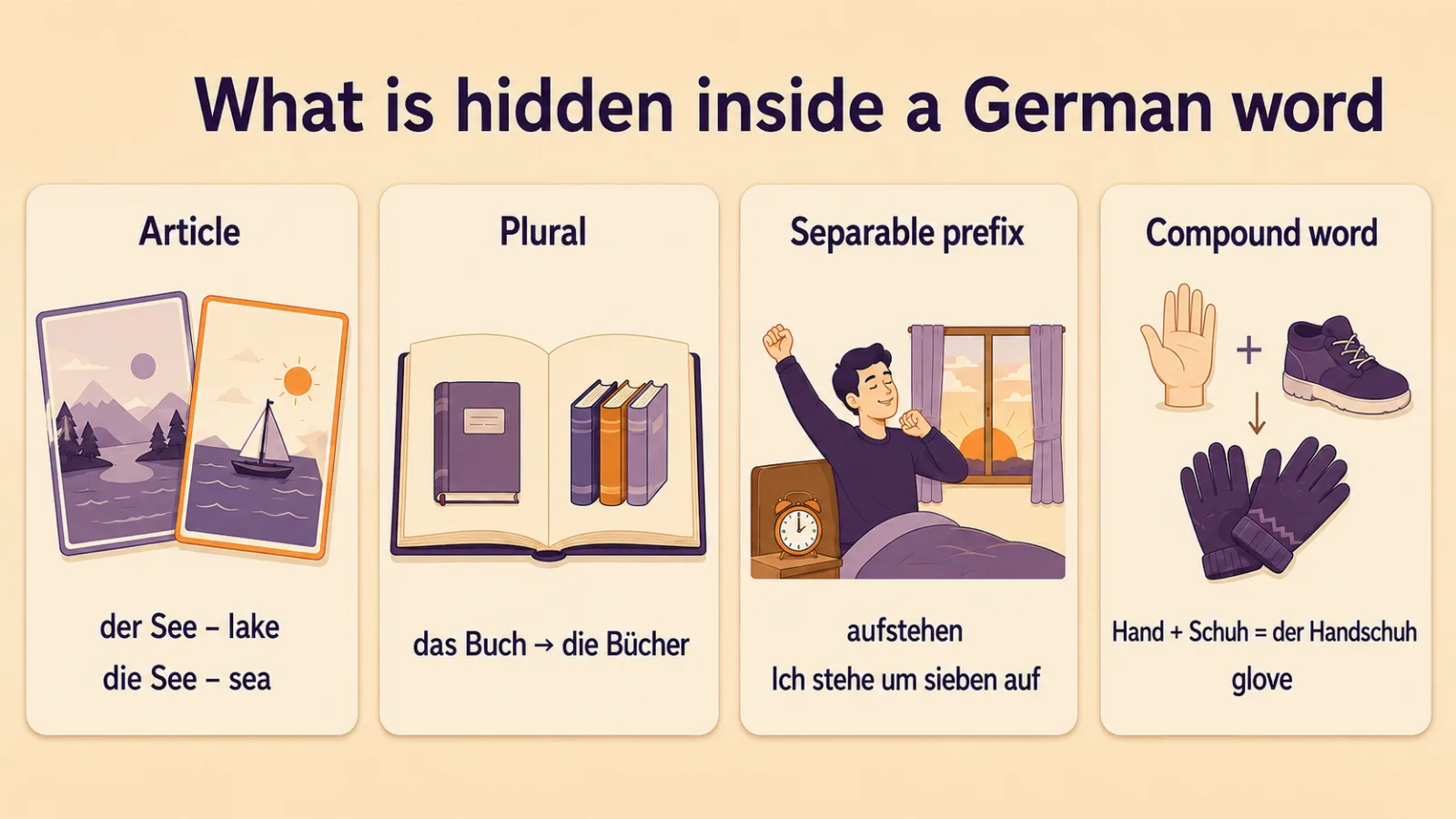
English has no grammatical gender at all, so der, die and das are a brand-new category rather than a familiar one with different labels. You cannot derive them from the shape or the meaning. The sun is feminine — die Sonne; the moon is masculine — der Mond. A girl is neuter: das Mädchen. And der See is a lake while die See is the sea, with only the article telling them apart.
Learn a noun without its article and you will be guessing in every case afterwards: auf dem Tisch, but auf der Straße. A card that says "Tisch — table" is close to useless; "der Tisch — table" actually works.
Plurals do not follow a rule
There is no single ending. There are about five patterns, and which one a noun takes is a matter of exposure:
- das Buch → die Bücher
- der Mann → die Männer
- der Tisch → die Tische
- die Frau → die Frauen
- das Auto → die Autos
It is far easier to learn the plural together with the word than to relearn half your vocabulary later.
Verbs come apart
A separable prefix travels to the end of the clause, so a verb you learned in the infinitive looks different in real speech. aufstehen (to get up) becomes Ich stehe um sieben auf. anrufen (to call) becomes Ich rufe dich morgen an. Hearing that, a beginner often fails to recognise a verb they already know.
Long words are actually short ones
German compounds only look intimidating. Inside are simple parts you already have:
- der Handschuh — hand + shoe = glove
- der Kühlschrank — cool + cupboard = fridge
- der Staubsauger — dust + sucker = vacuum cleaner
- das Krankenhaus — sick + house = hospital
Break compounds into pieces and your vocabulary grows faster: one Haus you have learned then turns up inside a dozen other words.
False friends, and the English ones sting
das Gift — poison, not a present.
bekommen — to receive, not to become.
der Chef — the boss, not the cook.
sensibel — sensitive, not sensible.
also — so, therefore; not "also".
These are dangerous precisely because they feel obvious, so they never make it onto the review pile. We looked at that mechanism — the brain marking a word as already known and quietly dropping it — in the piece on why you forget new words.
What it really means to learn a German word
All of the above points to one thing: the smallest useful unit in German is not a word–translation pair but a small bundle of data.
| What a card needs | Example |
|---|---|
| The word with its article | die Rechnung — the bill |
| The plural | die Rechnungen |
| A phrase it lives in | Können wir bitte die Rechnung haben? |
| Pronunciation | so that ch, ü and ei are not guesswork |
You can assemble that by hand for every word, but the will to do it runs out around word thirty. That is why an app helps noticeably more with German than with easier languages.
What a German vocabulary app should do
Most language apps are built as a course: you follow someone else's syllabus and learn whatever the author put in it. For German vocabulary something else matters more — being able to keep your own dictionary. Useful signs:
- You can add your own words. You learn what turned up in a series, in a letter from the Vermieter, or at the doctor's, not an abstract top-100.
- Context arrives automatically. The app pulls the translation, an example and the pronunciation so you are not building cards by hand.
- Spaced repetition. A word comes back when you are about to forget it, not when the list gets round to it.
- Different exercise types. Recognising a word, saying it out loud and filling it into a gap are separate skills and need separate practice.
- Short sessions. Ten minutes on the train beats an hour once a week.
We applied the same logic to picking an app for memorising vocabulary — the mechanics carry over; only the traps of the particular language differ.
How this works in VibeLing
Switch VibeLing to German and it becomes a personal workshop for words:
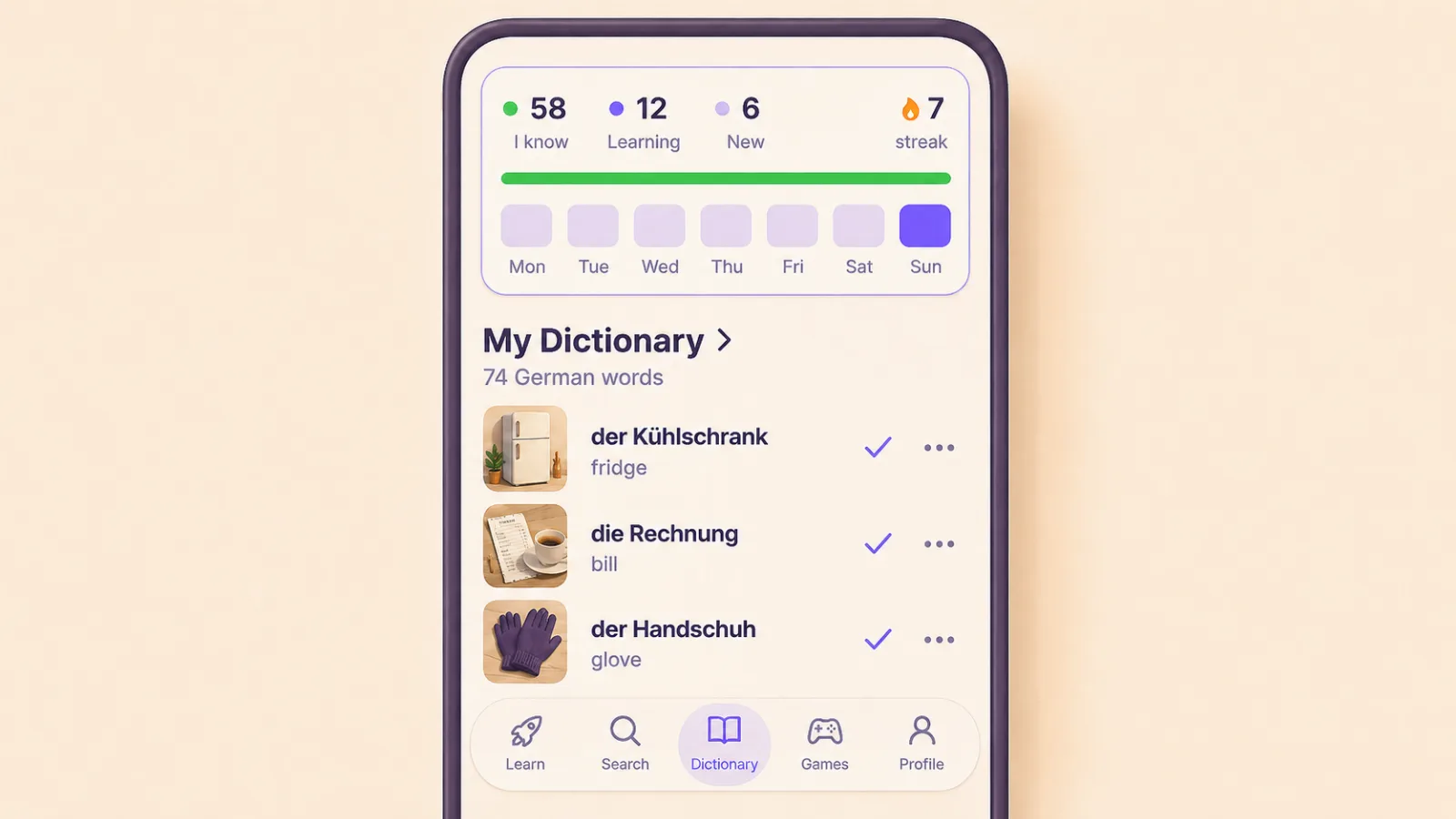
- Any word or phrase — from a series, a notice, a conversation — can be saved in a couple of taps, and the app finds the translation, a usage example and the audio itself.
- Words go into your own collections: everyday vocabulary in one, work vocabulary in another, whatever you need for B1 in a third.
- Practice runs in short sessions and includes saying words out loud — which matters for German, because reading eu, ei and ch has to become automatic.
- Spaced repetition under the hood decides which words you see today.
Where to start this week
- Write down 10 German words you actually need in the next few days — always with the article.
- Give each one a living phrase rather than a dictionary definition.
- Listen to each word and say it out loud at least once.
- Do one short session a day and stop revisiting the list by hand — that is what spaced repetition is for.
German starts to feel logical at roughly the point where you have a couple of hundred words learned with their article and their context: you begin to see how long words are assembled from familiar parts and where the prefixes land. To get there sooner, start your own German dictionary in VibeLing and add the first ten words today.