Vocabulary to Nail a Job Interview in Spanish
Spanish for a job interview is a narrow and fairly predictable set of words. You will be asked about your experience, your responsibilities in your last role, your strengths, why you are leaving and what you want next. There are about fifteen questions, and they repeat from company to company.
That leads to something encouraging: preparing by "improving your Spanish in general" is slow and mostly useless. It is faster to learn one specific layer of vocabulary — the verbs used to describe work, the words for results, and a handful of filler phrases so you never freeze mid-sentence. That is two weeks of work, not six months.
Why your general vocabulary is not enough
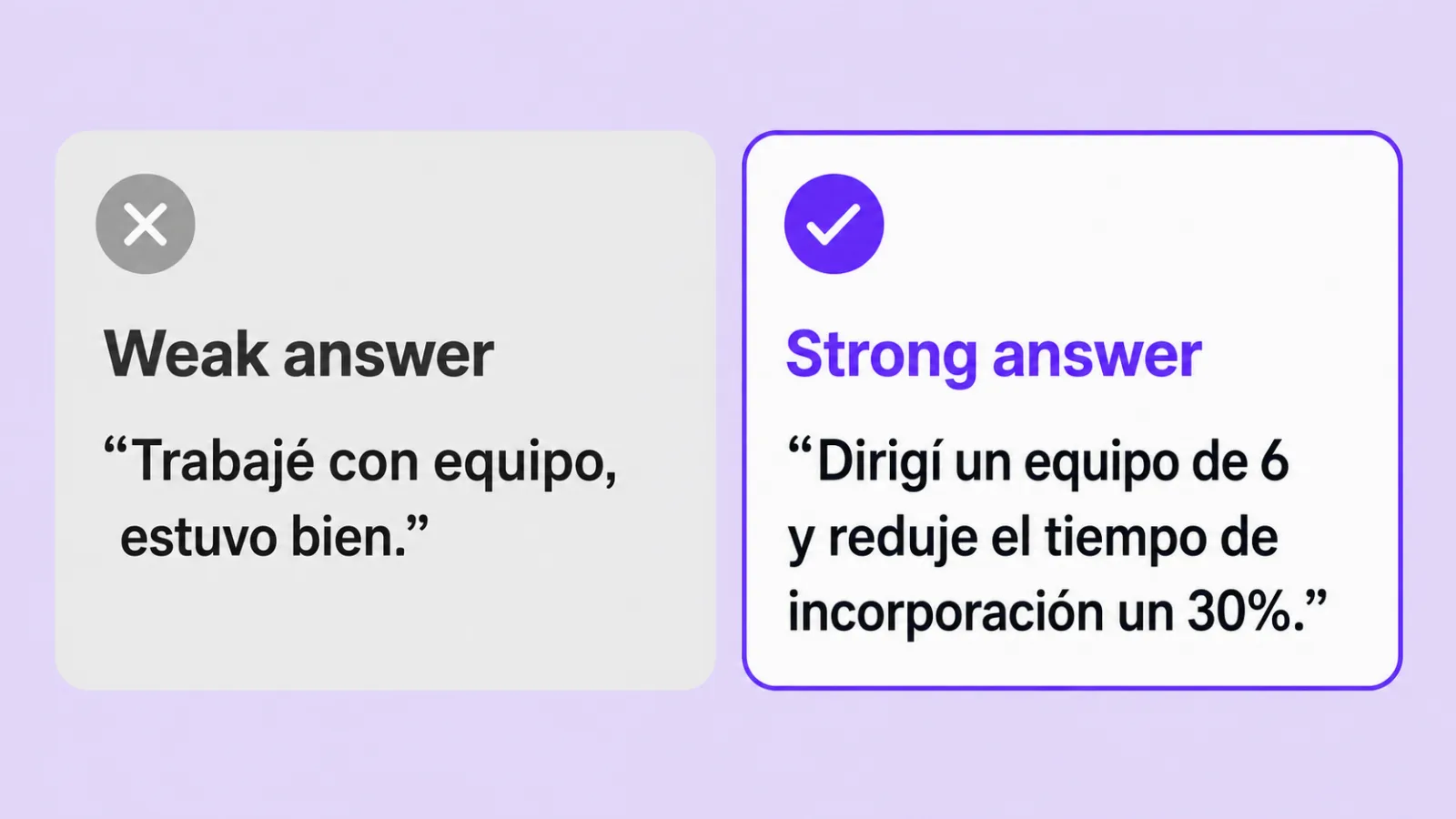
Grammar is rarely what lets people down in an interview. You know trabajo and equipo perfectly well, but not how to say "I was responsible for onboarding new hires" or "we cut build time by a third". So the answer shrinks to Trabajé con equipo, estuvo bien — and it sounds weaker than the experience behind it.
The gap between a pale answer and a convincing one usually fits into five or six words. Those are the ones to learn first.
Responsibilities: what you actually did
This is the first thing you will be asked. Spanish leans on verbs that carry their own preposition here, and that is exactly where people stumble.
| Word or phrase | Meaning | Example |
|---|---|---|
| ser responsable de | to be responsible for | Era responsable del proceso de incorporación. |
| encargarse de | to be in charge of, to handle | Me encargaba de un equipo de seis personas. |
| supervisar | to oversee | Supervisé la migración al nuevo sistema. |
| gestionar | to manage, to deal with | Gestionaba toda la comunicación con los clientes. |
| reportar a | to report to | Reportaba directamente al director técnico. |
| formación | background, training | Tengo formación en análisis de datos. |
Watch the prepositions: responsable de, encargarse de, reportar a. There is no point learning them apart from the verb — memorise the whole chunk.
Results: what came out of it
A strong answer almost always contains a number. Spanish result verbs are built for that: they naturally pull in "by how much" and "in what time".
| Word | Meaning | Example |
|---|---|---|
| lograr | to achieve | Logramos un crecimiento del 20% en seis meses. |
| entregar | to deliver | Entregué el proyecto dos semanas antes de lo previsto. |
| lanzar | to launch | Lancé la versión móvil desde cero. |
| reducir | to reduce, to cut | Redujimos a la mitad el tiempo de respuesta. |
| aumentar | to increase | El cambio aumentó la retención un 15%. |
| optimizar | to streamline | Optimicé el flujo de informes. |
| escalar | to scale | Escalamos el servicio a 50 000 usuarios. |
A useful template for any situation: verb + what + un/en + how much. For example, Reduje el tiempo de incorporación un 30%. One sentence like that replaces a minute of rambling.
Team and collaboration
Even for a technical role, half the questions will be about people: how you negotiated, how you handled conflict, who you trained.
| Word | Meaning | Example |
|---|---|---|
| colaborar con | to work together with | Colaboraba a diario con el equipo de diseño. |
| las partes interesadas | stakeholders | Presenté los resultados a las partes interesadas. |
| multidisciplinar | cross-functional | Trabajábamos en un equipo multidisciplinar. |
| formar a | to mentor, to train | Formé a dos desarrolladores junior. |
| asumir la responsabilidad | to take ownership | Asumí la responsabilidad del proceso de publicación. |
| alinearse en | to align on | Nos alineábamos en prioridades cada lunes. |
Verbs that bring their own preposition
Recruiters speak in everyday Spanish, and everyday Spanish runs on verbs glued to a preposition. The tricky part is that the meaning does not follow from the pieces, so contar con has to be learned as a single unit.
- encargarse de — to take on, to handle: Me encargué de la parte de analítica del proyecto.
- contar con — to have, to rely on: Contábamos con un presupuesto muy ajustado.
- enfocarse en — to focus on: Nos enfocamos en reducir los errores.
- depender de — to depend on: El plazo dependía del equipo de infraestructura.
- dar seguimiento a — to follow up on: Doy seguimiento a los detalles mañana.
- ponerse en contacto con — to reach out to: Ponte en contacto conmigo si tienes dudas.
The same interview will also push you to choose between ser and estar a dozen times — if that pair still feels slippery, we covered it separately.
The questions you will be asked
Learn to recognise these instantly, so you do not spend the first seconds decoding them.
Háblame de ti. — Tell me about yourself.
Cuéntame una situación en la que tuviste un plazo muy ajustado. — Tell me about a time when…
¿Qué buscas en tu próximo puesto? — What are you looking for in your next role?
¿Por qué quieres dejar tu trabajo actual? — Why are you leaving your current job?
¿Dónde te ves dentro de tres años? — Where do you see yourself in three years?
¿Tienes alguna pregunta para nosotros? — Do you have any questions for us?
Pay special attention to Cuéntame una situación en la que… — it opens a good half of the behavioural questions, and what follows it should always be a story with a concrete example, not a reflection.
Phrases so you never go silent
The worst moment in an interview is the pause after you have understood the question but have not assembled the answer yet. In your own language you fill it automatically; in Spanish you need these ready in advance.
- Buena pregunta. — buys you a couple of seconds and sounds polite.
- Déjame pensarlo un momento. — asking for a pause outright is perfectly normal.
- ¿Podrías reformular la pregunta, por favor? — if you did not catch it.
- Para asegurarme de que te he entendido bien, me preguntas por… — check and buy time at once.
- Diría que la razón principal fue… — a comfortable opening for a longer answer.
Those five phrases remove most of the pressure: you always have something to say. If nerves get in the way more than missing words do, have a look at how to overcome the fear of speaking Spanish.
Terms, offers and everything after
The final part of the conversation is about conditions. The vocabulary here is very specific, and not knowing it makes it easy to misread something important.
| Word | Meaning |
|---|---|
| el preaviso | notice period |
| la retribución | total compensation, not just salary |
| los beneficios sociales | benefits: insurance, holidays and so on |
| el período de prueba | probation period |
| las acciones / el equity | equity, stock options |
| la ayuda a la reubicación | relocation package |
La retribución is the one people misread most often: in job ads it covers the whole package, not the money that lands in your account.
How to learn all this in two weeks
The list above is roughly sixty items. A lot, if you treat them as separate words, and quite manageable if you follow three rules.
- Learn phrases, not words. A card saying responsable — responsible will not help you in the room. A card saying Era responsable del proceso de incorporación hands you a ready structure that you only have to fill with your own experience.
- Put your own biography into them. Take every result verb and write one sentence about yourself with a real number in it. Those sentences stick far better than textbook ones.
- Repeat on a schedule. Two weeks before the interview the goal is not to learn something once, but to still have it on the day — which is what spaced repetition is for.
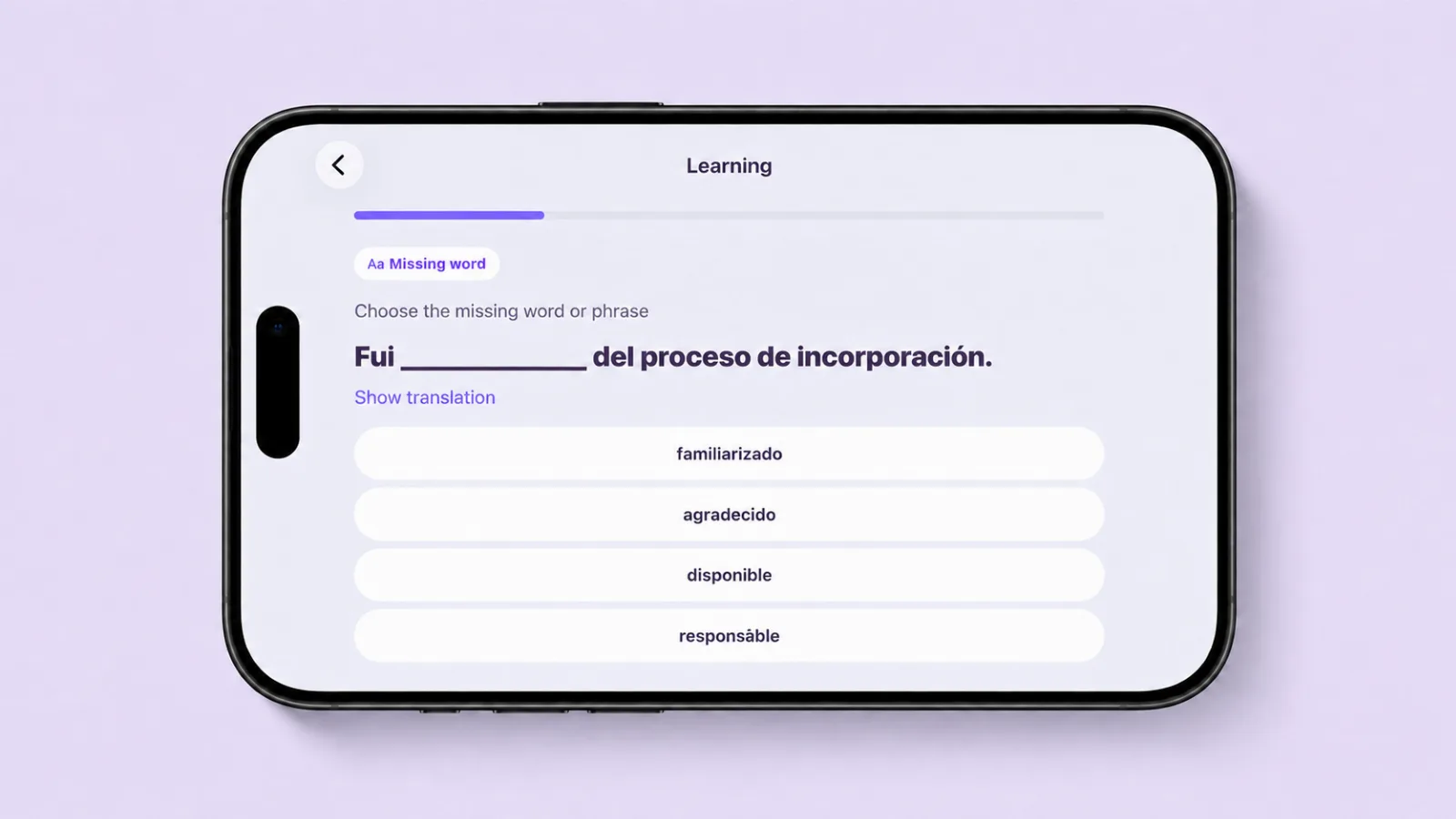
VibeLing fits this job neatly. Any phrase from this page can go straight into the search field as a whole: the app breaks it down, shows the translation, the pronunciation and usage examples, and the phrase lands in your personal dictionary. From there training picks it up — words come back for review on a spaced schedule, and the missing-word exercise forces you to recall the structure actively instead of just recognising it on the page.
What you end up with is your own set of cards for one specific interview, with your responsibilities, your numbers and the phrases you will actually say out loud.
In short
- Interview vocabulary is a narrow set of about sixty phrases, and two weeks is enough to close it.
- Learn preposition chunks whole: responsable de, encargarse de, reportar a.
- Attach a number to every result verb — that is what separates a strong answer from a vague one.
- Memorise five filler phrases so silence never works against you.
- Collect the phrases that match your own experience and run them through spaced repetition.
If you would rather prepare without grinding through word lists, build your own interview dictionary in VibeLing: save phrases as you prepare, and the app will bring them back to you the day before the interview.