Overcome the Fear of Speaking Spanish
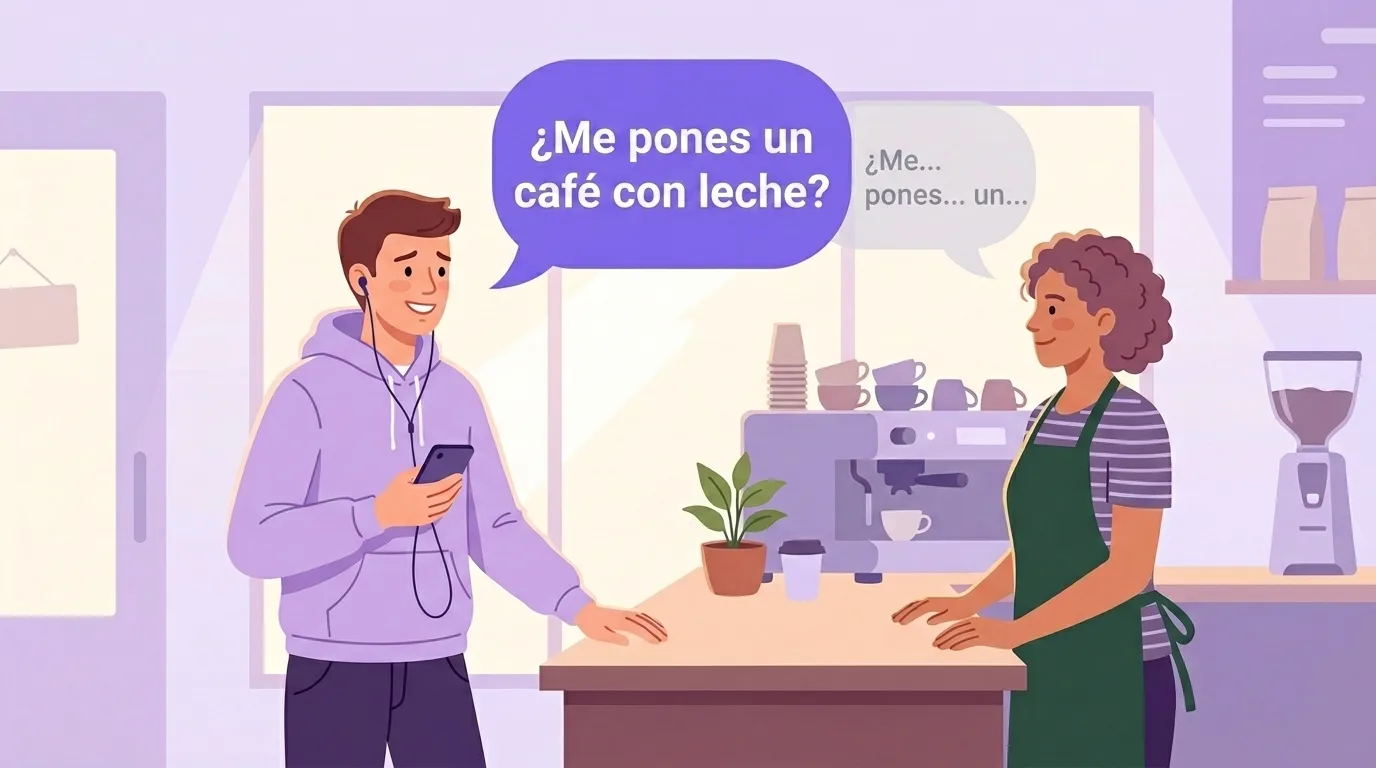
The situation is familiar to almost anyone who has studied Spanish for more than a year. You read articles without a dictionary, you follow shows, you can write a work email in five minutes. And then someone stops you on the street to ask for directions — and out comes something like "uh… recto… and then… izquierda". Even though you know both sigue todo recto and gira a la izquierda en el semáforo.
This isn't a level problem. The passive Spanish is already there, otherwise you wouldn't have understood the question. The problem is that speaking is a separate skill, and bolted onto it is a fear that no amount of grammar will cure.
What this fear is actually made of
Usually of three things at once, and it helps to separate them, because they're treated differently.
Fear of being judged. It feels like the other person is counting your mistakes. Almost always they aren't: a native speaker is busy with meaning, not with your gender agreement. But the exam feeling stays, especially if school marked you down for every error.
Perfectionism. You want to say exactly what you'd say in English — same tone, same irony, same little qualifier in the middle of the sentence. While you're assembling that, the pause grows, and you go quiet altogether.
No automaticity. You know the word, but the last time you retrieved it was with your eyes, off a page. You have never once said it with your mouth. Between "I recognise it in text" and "I can get it out in half a second" there's a gap, and only saying things out loud closes it.
First: give yourself permission to speak badly
That sounds like advice from a motivational post, but there's arithmetic behind it. Someone who speaks with mistakes but speaks gets practice every day. Someone waiting until they can speak correctly never gets any — because correctness only comes out of practice.
A simple benchmark: if you were understood, the sentence worked. Ayer yo voy a la tienda is grammatically wrong and completely clear. Nobody will judge you for it. Silence, on the other hand, the other person really does notice.
Second: learn the phrases for emergencies
Half the panic comes from the feeling that if you get stuck, that's it, the conversation is over. In reality native speakers have a standard set of phrases for exactly these moments, and it takes one evening to learn:
¿Cómo se dice… ? — "how do you say…?"
Déjame decirlo de otra forma. — "let me rephrase that."
Creo que no te sigo. — "I'm not sure I follow."
¿Puedes repetirlo un poco más despacio? — "could you say that again, a bit slower?"
Es como un… ya sabes, cuando… — "it's like a… you know, when…"
That last one is the most useful. It gives you the right to describe a word instead of retrieving it. Forgotten destornillador — say la herramienta que usas para poner tornillos, and the conversation moves on. Native speakers do this constantly, they're just faster at it.
Third: practise speaking where there are no witnesses
The most underrated step. Before you talk to people, it's worth simply starting to say words out loud on your own — because your mouth needs training too, it has its own muscle memory.
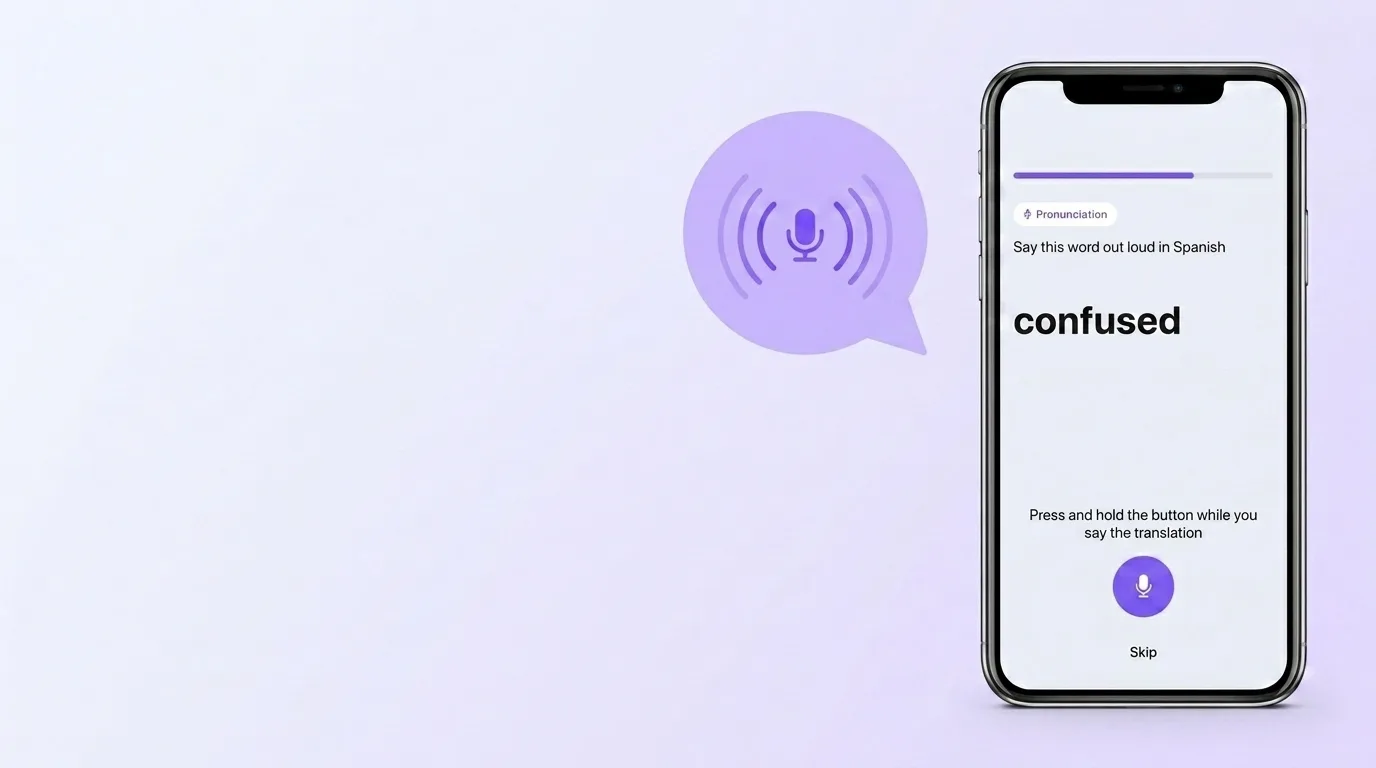
VibeLing has a separate exercise for this: the app shows you the translation, you press the button and say the word out loud in Spanish, and it checks your pronunciation. Nobody hears you, there's no grade, and the word moves from the "I recognise it" category into the "I can get it out" category. Those same words come back to you on a spaced repetition schedule, so after a few rounds they start popping out by themselves.
A related trick is reading out loud whatever you're already reading. A paragraph of news, a couple of subtitle lines. Five minutes a day does more than an hour of silent reading.
Fourth: speak in chunks, not in words
The main reason for those pauses is trying to assemble a sentence out of individual words while the conversation is happening. Native speakers don't do that: they keep ready-made blocks in their heads and build speech out of them.
| How beginners assemble it | How a native says it |
|---|---|
| Yo… quiero… preguntarte… | ¿Te puedo preguntar una cosa? |
| No estoy seguro de que yo… | No estoy seguro, la verdad. |
| Es difícil para mí decir | Difícil decirlo. |
| Yo pienso que quizás nosotros podemos… | ¿Y si…? |
Each block like that is one unit of memory, not four. Which is why learning in phrases beats learning isolated words: there's a separate walkthrough of that — why you should learn Spanish phrases, not just words.
Fifth: lower the stakes gradually
You don't have to walk into a conversation club right away if the very thought makes your hands cold. There's a ladder you can climb one rung at a time:
- Talk to yourself. Narrate what you're doing out loud: Estoy haciendo café, tengo que llamar al banco. Sounds silly, works beautifully.
- Voice notes. Record a minute about your day on your phone. Listen back. The first few times will be unpleasant, then it becomes routine.
- Voice messages to someone. Send one to a friend who's also learning. They have the same level of anxiety; nobody is judging anybody.
- People who aren't native speakers either. There are far more of them in the world than natives, and they speak more plainly. Starting your speaking practice with them is psychologically easier.
- Native speakers. By this point you won't be going silent at the first pause.
What to do at the actual moment of panic
When your brain switches off mid-sentence, what helps isn't reasoning but short mechanical moves:
- Slow down. Speaking slowly is not a sign of weak Spanish. Native speakers stretch out bueno… and o sea… in conversation too, and it sounds perfectly normal.
- Say it more simply. Can't build the subjunctive clause — say two simple sentences instead. The meaning will land.
- Name your state out loud. Perdona, tengo el español un poco oxidado. The other person will immediately slow down, and you'll stop bracing for impact.
- Ask a question. While they're answering, you have time to regroup. And you move the conversation along at the same time.
About the mistakes you're afraid of
One thing is worth keeping in mind: people who listen to your Spanish almost never remember it an hour later. They remember what you talked about and what you seemed like. A dropped article doesn't make it into that memory.
What genuinely gets in the way of being understood isn't grammar, it's pronunciation and stress. In Spanish the stress carries meaning outright: PÚ-bli-co, pu-BLI-co and pu-bli-CÓ are three different words. Put the stress in the wrong place and your listener really may not follow. So what's worth drilling is how words sound, not perfect tenses. On learning words so they reach your speech instead of settling into the passive pile, there's a detailed piece: how to learn Spanish words so you can speak.
In short
The fear of speaking doesn't go away because you learned another thousand words. It goes away because you opened your mouth many times and nothing bad happened. Start with the safest thing there is: say words out loud alone with your phone. Set up a personal Spanish vocabulary and say every new word out loud instead of only reading it. A couple of weeks in, you'll notice the words you need start coming out on their own in a real conversation — because your mouth has already said them.