Spanish Slang and Idioms: How to Learn Them Properly

There is an annoying moment in learning Spanish: you know every word in the sentence, and the meaning still gets away from you. "Estoy hecho polvo", "dio en el clavo", "lo dejamos por hoy" — the words are simple on their own, together they make no sense. These are idioms and slang, and textbooks barely touch them. Then the opposite happens: you learn a dozen expressions from a "100 Spanish idioms" list, drop "está lloviendo a cántaros" into a conversation, and the other person looks at you like you just quoted a textbook from 1985. Which, to be fair, you did.
Let's sort out how idioms differ from slang, why lists from the internet don't work, where to get living expressions from, and how to use them so you sound normal rather than like a tourist with a phrasebook.
Idioms and slang are two different jobs
They usually get lumped together, but you need to learn them differently.
| Idioms | Slang | |
|---|---|---|
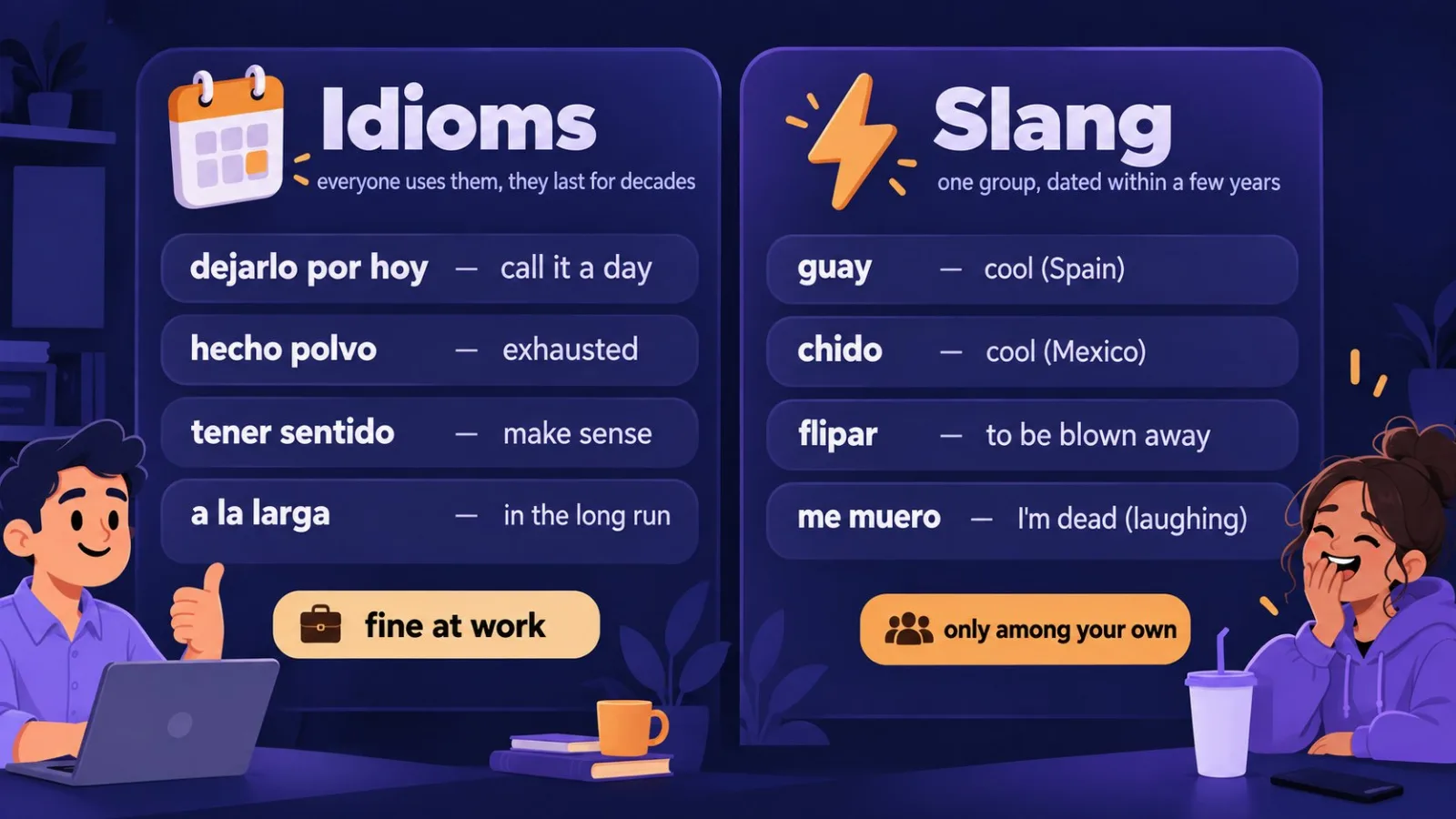
| What it is | Fixed expressions whose meaning isn't the sum of the words: dejarlo por hoy — to call it a day | Informal words and meanings used by a particular group: guay — cool (Spain), chido — cool (Mexico) |
| Who uses it | All native speakers, any age | A specific generation, region, profession or subculture |
| How fast it dates | Slowly, over decades | Fast: in five years a word can mark you as out of touch |
| Where it fits | Almost anywhere, including work | Only in informal speech, and not always even there |
| Main goal | Understand, then gradually use | Understand, first and foremost |
Idioms are part of the ordinary language. A native speaker will say "estoy hecho polvo" in the office, in a message to a colleague and to their grandmother on the phone. Slang is a badge of belonging, and in Spanish it's also strongly regional: a fifty-year-old manager in Madrid who says "qué chido" sounds just as odd as a teenager in Mexico City saying "mola mazo". So idioms can be treated like ordinary vocabulary, while slang calls for caution.
Why "100 Spanish idioms" lists don't work
The first thing anyone does when they decide to work on idioms is google a list. And they get a list where expressions of completely different frequency sit side by side. "Dar gato por liebre" you'll hear a couple of times a year, if at all. "Tener sentido", "darse cuenta", "no pasa nada" — several times a day. In the list they look identical, and you spend equal time on each.
The second problem is register. A list doesn't tell you where an expression fits. "Estirar la pata" means "to die", but it's a crude joke, and you wouldn't say it at a funeral. Right next to it in the list will be the neutral "fallecer", with no labels at all.
The third is region and age. Many lists are compiled from old textbooks and copied from one another for years. That's where "llover a cántaros" in every second list comes from: everyone knows it, but natives say it far less often than learners do. And the lists rarely say whether an expression is from Spain, Mexico or Argentina — which for slang is the whole point.
A list is useful for one thing only: going through it and ticking off what you've already met in real speech. Learning it top to bottom — no.
The first goal is to understand, not to use
This is the main shift, and it removes half the problems. Your passive stock of idioms and slang should be several times bigger than your active one. You must understand what "me muero" means after a funny video (not "I'm dying" but "I can't, this is too funny"), but you're under no obligation to say it yourself.
A practical rule: an expression moves into your active vocabulary once you've heard it from different people in different situations at least three or four times. Once in a series is not enough: it might have been a character's joke, a regional word or something specific to one person. If the expression shows up again in a podcast, then in the comments, then in a conversation — it's alive, and by now you roughly know who says it and when.
This is slower than memorising a list, but you won't end up being the person who uses expressions from a show about Madrid teenagers in a meeting with a client from Bogotá.
Where to get living expressions
Since lists are out, the source has to be one where you can see the context: who is speaking, to whom, in what situation.
- Series and films set in the present day. Not fantasy, not period drama — everyday stories where people talk in kitchens and offices. How to pull words out of them is covered in our piece on learning Spanish with movies and TV shows. A bonus of a series: the same expression will come up several times over a season from different characters — there's your "alive or not" test. And pick the country deliberately: a Spanish show and a Mexican show will teach you different slang.
- YouTube and podcasts in your field. If you're a programmer, watch programmers; if you're in marketing, watch marketers. You'll pick up the slang of your profession and your age group, not the kids on TikTok.
- Comments. Reddit, comments under videos, threads on X. It's written, but informal, and the fastest way to see what people actually write right now.
- Real conversations, if you have anyone to talk to. Here you can ask: "¿qué significa eso?" is a perfectly normal question, and natives constantly clarify each other's slang.
Bad sources: textbooks more than ten years old, "Spanish slang" books in shops, articles titled "50 slang words every learner must know". By the time they're published half of it is already dated.
How to learn an idiom so it doesn't fall apart
An idiom is one word that happens to be written as several. You learn it as a unit, whole, the same way you'd learn phrases rather than single words. Three things to save together with it:
- The exact form. Idioms don't tolerate substitutions. "Pan comido" can't become "pan cocinado", "tomar el pelo" can't become "coger el pelo". A native will understand you but will notice the slip immediately. Write the expression down word for word, in the form you heard it.
- The sentence you met it in. Not "hecho polvo — exhausted" but "Hoy estoy hecho polvo, me voy a casa temprano". The context shows which words the idiom goes with and in what tone it's said.
- A register label. Literally one word: "neutral", "colloquial", "vulgar", "Spain", "Mexico". A month later you won't remember where you got the expression, and the label will save you from an awkward moment.
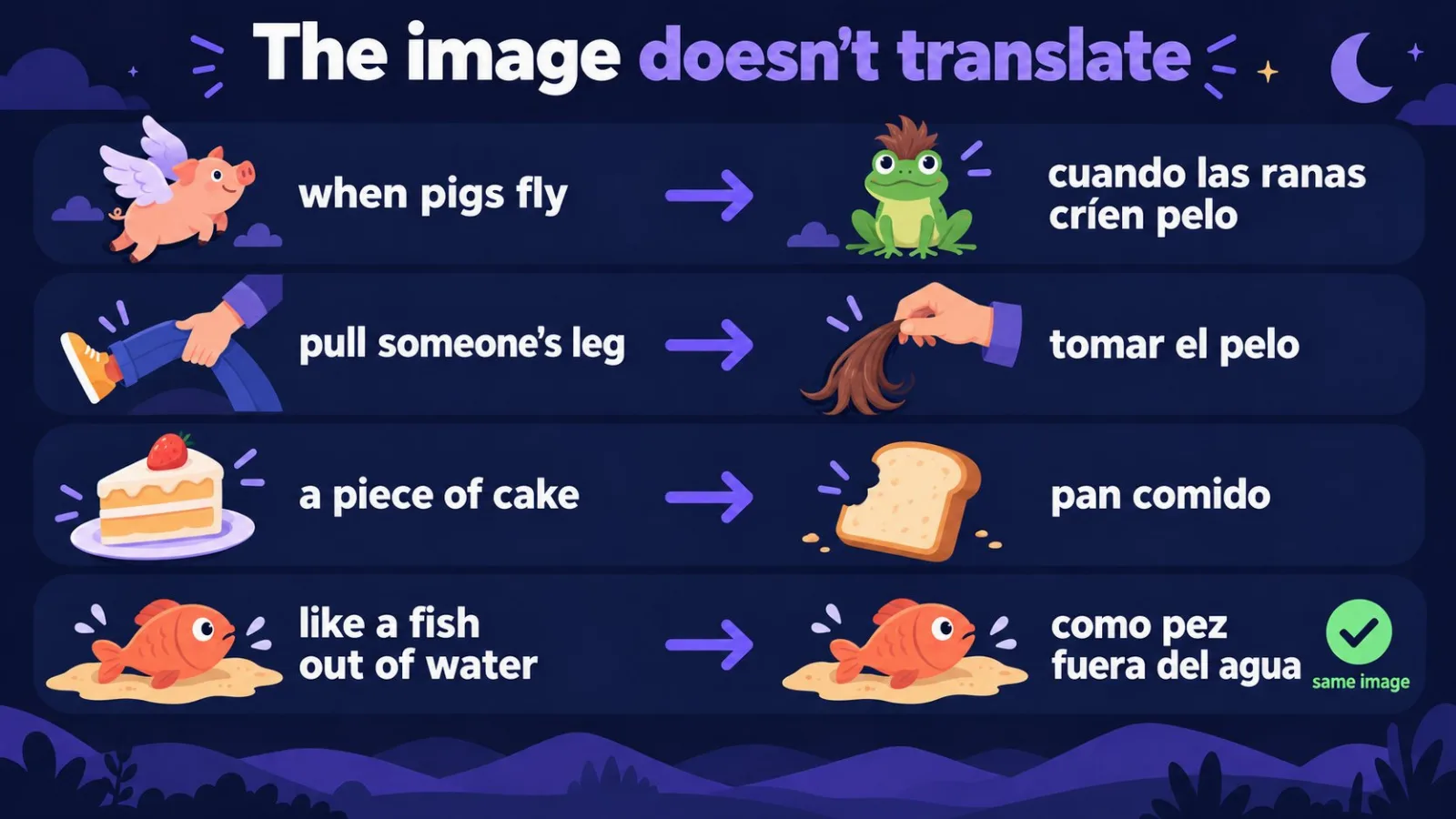
A separate trap is translating the image. Some Spanish idioms match English ones exactly: "como pez fuera del agua" is "like a fish out of water", word for word. But most don't match, and a literal translation of an English idiom into Spanish gives you nonsense. "When pigs fly" in Spanish is "cuando las ranas críen pelo", "to pull someone's leg" is "tomar el pelo", "a piece of cake" is "pan comido". It's the Spanish image you need to remember, not your translation of it.
Register: where slang fits and where it doesn't
The same meaning can be expressed in Spanish at several levels of formality, and what sounds ridiculous is not the expression itself but its mismatch with the situation.
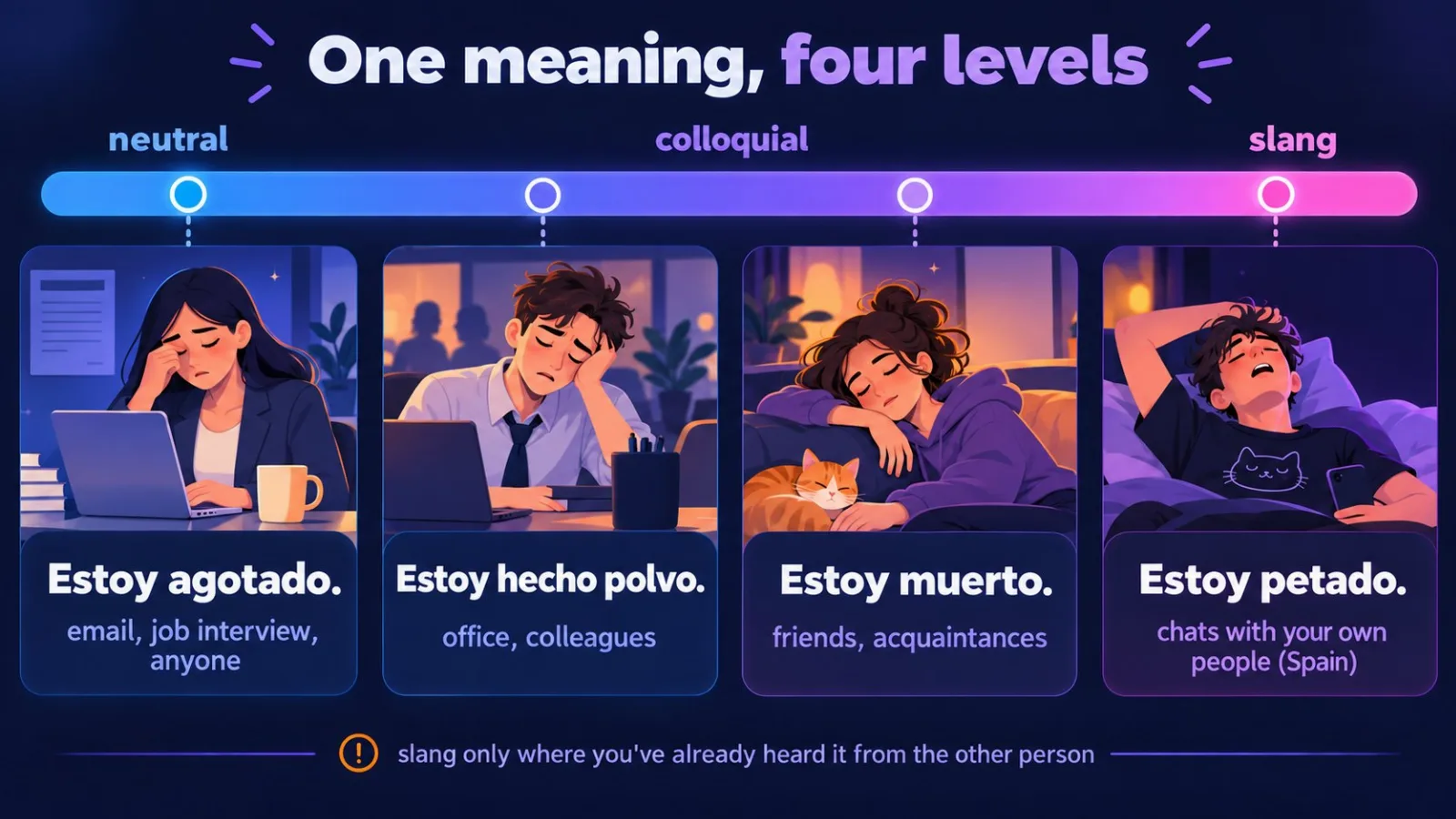
Estoy agotado. — neutral, works anywhere.
Estoy hecho polvo. — a bit more colloquial, still fine in the office.
Estoy muerto. — colloquial, with friends and colleagues you know well.
Estoy petado. — slang, among your own people and in chats (Spain).
A simple rule if you're unsure: slang only where you've already heard it from the person you're talking to. If someone says "qué guay" in the conversation, you can answer in kind. If the exchange is neutral, stay neutral. Nobody suffers because you said "estoy muy cansado" instead of "estoy petado". The other way round can be awkward.
Where there is no slang by definition: work emails, job interviews, conversations with a doctor, with officials, with strangers older than you. Idioms are fine there, but neutral ones: "ponerse al día", "estar en la misma página", "a la larga" — that's normal office Spanish.
Five rules for not sounding ridiculous
- No more than one idiom at a time. Speech stuffed with idioms every other word sounds like a parody. Natives drop them in rarely, between ordinary sentences.
- Don't borrow slang from another age group or another country. If you're 35, TikTok words in your mouth sound the way "no cap" would in a business email. Listen to people of your age and your field, from the country whose Spanish you're actually learning.
- Don't change the words inside an idiom or conjugate it creatively. If you're not sure of the exact form, say it in plain words instead.
- Don't translate English idioms literally. "Están lloviendo gatos y perros" — people will get it, but it isn't Spanish. Either you know the Spanish equivalent, or you say it plainly: "está lloviendo muchísimo".
- When in doubt, keep it simple. A plain neutral sentence is never a mistake. A misplaced idiom can be.
How to store and review idioms so they don't fade
The trouble with idioms is that they're awkward to look up in a dictionary and they get lost among ordinary words in a notebook. And they fade faster than single words: the image is foreign, there's nothing to hold on to.
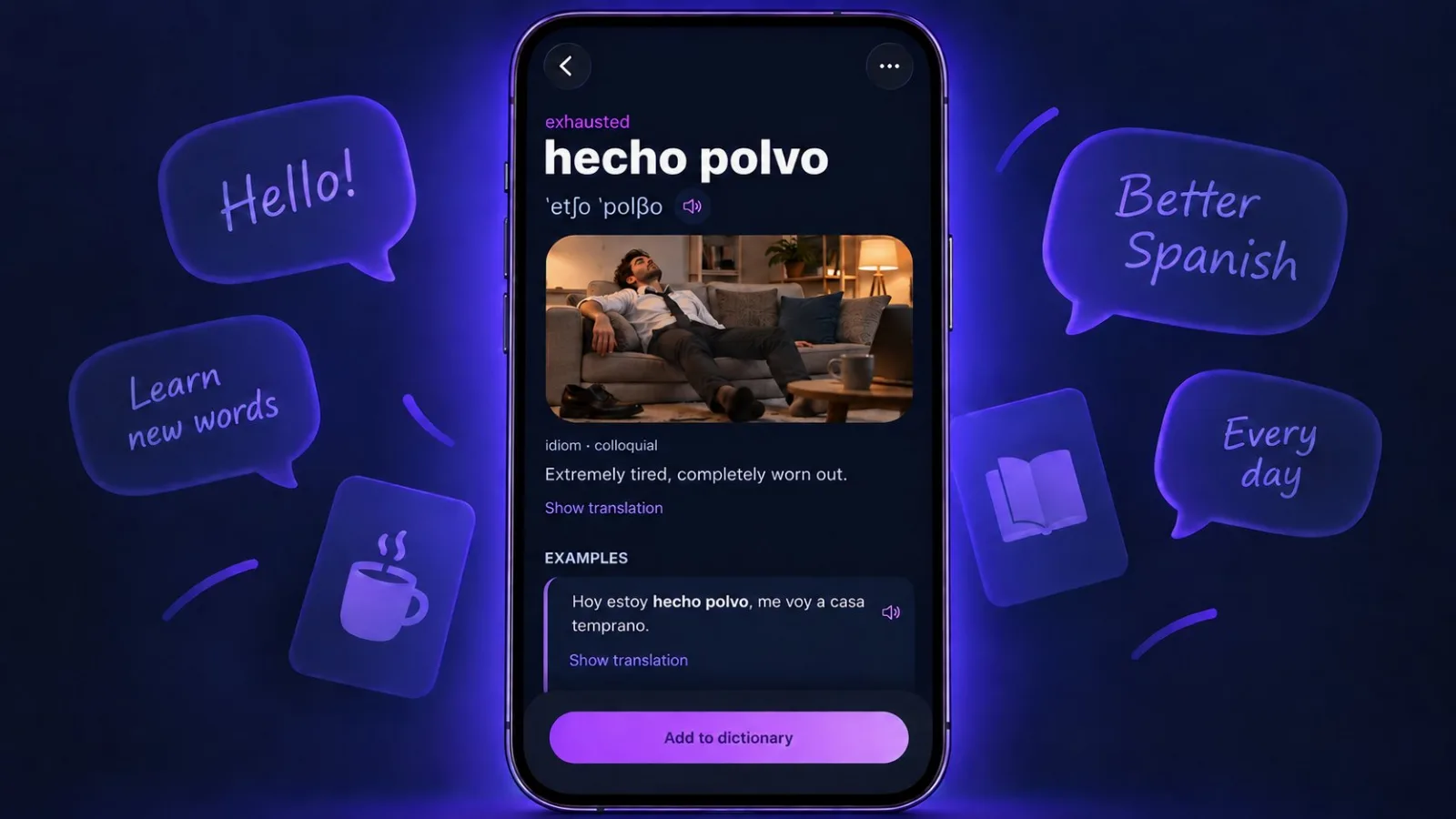
In VibeLing an expression is saved like a regular word, just a longer one: you type "hecho polvo" as a whole and get a translation, an explanation, example sentences and audio. You can add your own example from the show. From there the idiom joins the general review queue and comes back on a spaced schedule, right when you've almost forgotten it — which is exactly the moment a review sticks best.
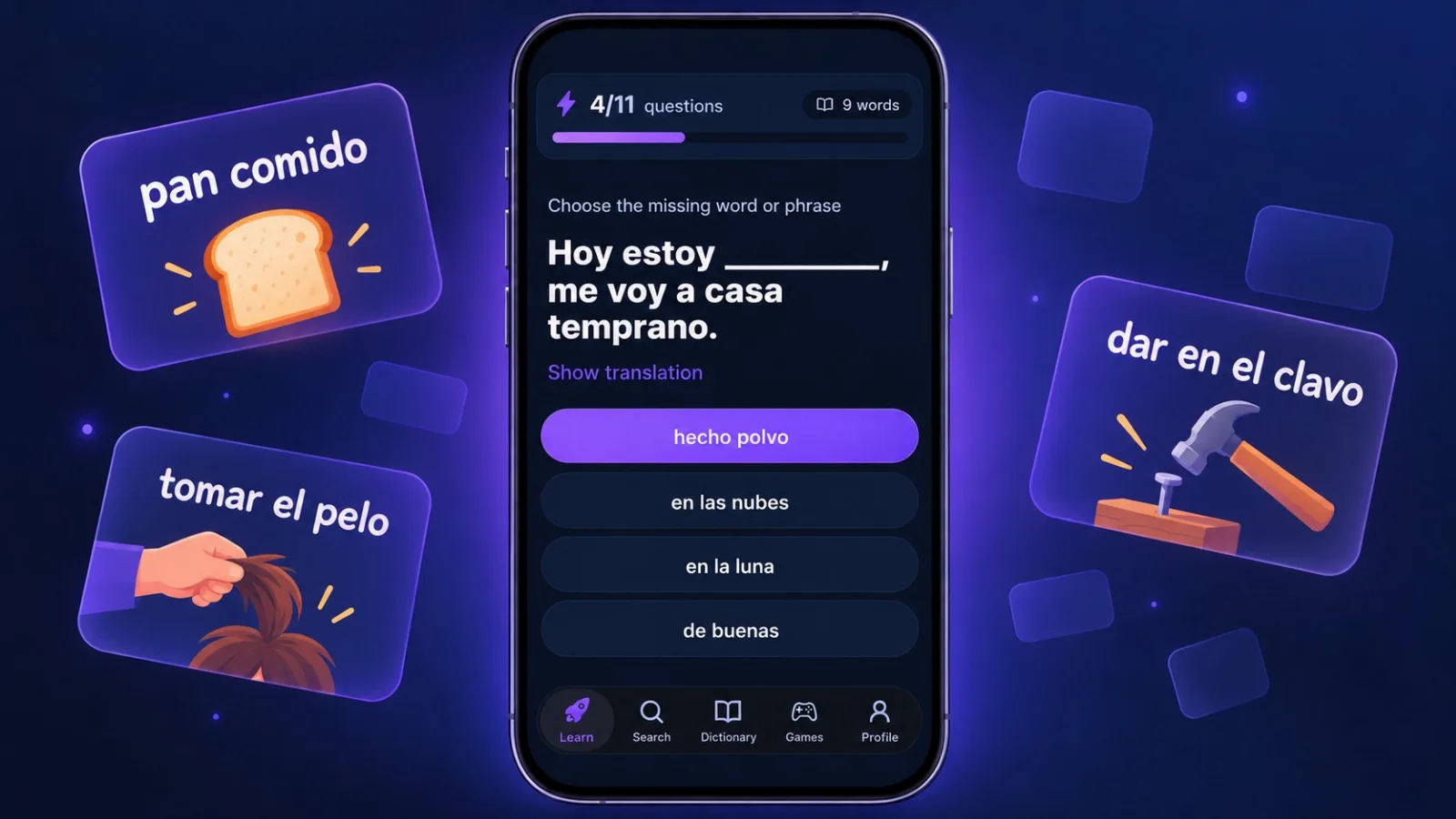
The "Missing word" exercise is especially useful for idioms: the app shows a sentence with a gap and you choose which expression fits in it. That trains exactly what you need — recognising an idiom in context and feeling where it belongs. And in "Build the word" mode you assemble the expression letter by letter, so "pan cocinado" instead of "pan comido" simply won't pass.
Plus, everything you save is your expressions from your sources, not someone's list. Six months on, your dictionary holds a hundred idioms, each of which you've seen in real speech and know who says it and when.
In short
- Learn idioms like ordinary vocabulary; with slang, understand first and use with care.
- Lists from the internet don't show frequency, register or region — take expressions from living sources: series, podcasts, comments.
- An expression goes active after you've met it several times from different people.
- Save the exact form, the sentence it came in and a register label. Don't translate the image.
- When in doubt, say it plainly. That is never a mistake.
If you want the expressions you hear to stop slipping away, give them a home: in VibeLing an idiom is saved in one tap, gets a translation and examples, and comes back for review exactly when it starts to fade. A couple of months in, you'll be surprised how much living Spanish has piled up from nothing but series and comment sections.